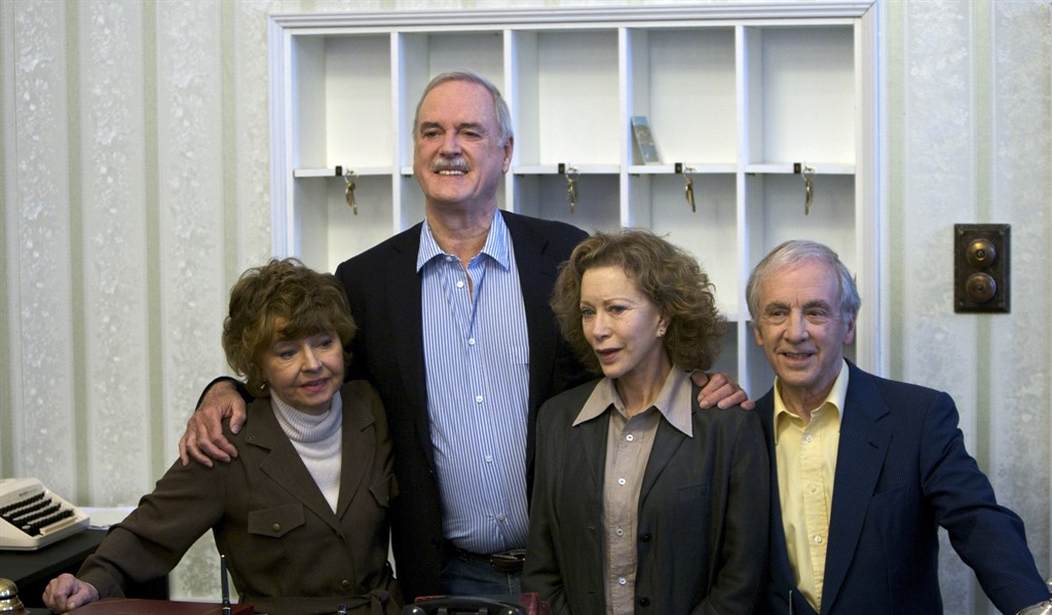
Every once in a great while, John Cleese shows signs of social sanity. A hat tip to our Stephen Green for posting this at Instapundit.
The UK has always been based at the deepest level on Christian values, regardless of dogma
— John Cleese (@JohnCleese) March 16, 2026
Despite the many mistakes made by churches, for centuries British people have been influenced by Christ's teaching
If these values are replaced by Islamic ones, this will not be Britain… https://t.co/7wbwlz5lIC
Well, no &%$$# kidding, John.
I’ll bet my last 10p coin that 30 years ago you never figured on things coming to this, or that it would come to this with your help. Then again, nobody expects the Islamic Inquisition!
(In the interests of honesty, I should tell you that I had to tone down that rather annoyed response four times before I had something that wouldn’t give my well-beloved editor a heart attack—which would have been counterproductive.)
I mean, I’ve only been preaching that very sermon since the day before I joined the team here at PJ Media back in 2019, and there have been many times since then, as well, up to and including the day before yesterday. For whatever it’s worth, I’ve been more vocal about it than many.
If you follow the rather abundant number of links in the paragraph above, you'll notice they all lead to my previous posts on the subject — and they share a common theme: that we are losing control of our own culture, and that this loss is a choice, one made largely by those among us who wield the power of government.
As one respondent over at Instapundit suggests:
To borrow from Pastor Doug Wilson, "John Cleese likes the apples. But he hates apple trees." [Pastor Wilson was referring to Richard Dawkins, specifically.]
If Britain does succumb to the Muslims because, for all practical purposes, there is no longer a functional Anglican church, John Cleese, Stephen Fry, and Richard Dawkins will have helped that to happen.
Too bad they're expressing regrets now. They should have thought about that forty years ago. Their ridicule did the job quite efficiently.
Indeed, and that’s the sad part. And another:
This is not new for Cleese. His posts are all either anti-mass immigration into England or anti-Trump. I don't think he sees the irony.
Correct. No, he doesn't.
It’s that juxtaposition that makes Cleese's comments so frustrating. He’ll complain all day long about President Donald Trump if given the opportunity, for example, and yet, in the doing, he’s actually fighting against the very person who more than just about anyone else on the scene is working toward the preservation of western culture.Cleese, having spent a good deal of his life pushing hard against the roots of the culture, is starting to see what lies ahead absent that influence on the culture. Understandably, he doesn't like what he sees. Thing is, it's not like we haven't been warning people about this for decades.
Cleese has been tearing down cultural fences for many years, but is just now figuring out what those fences were actually for. Well, the outcome of his efforts wasn’t as he envisioned, Now, he can’t figure out how to make this revelation fit within the worldview he’s carried all this time. More succinctly, he still doesn't get it. Perhaps more correctly, he can't allow himself to get it.
Oddly, the atheist Richard Dawkins now finds himself in a similar position. He’s somewhat more perceptive than Cleese here, but still arrives at the same dilemma—how to reconcile his long-held beliefs with the realizations he has come to more recently after recognizing the potential consequences of those views over time. And, of all people, Cleese called him out on this roughly a decade ago.
Outreach Magazine ran a piece by James Emery White a couple years ago, wherein Dawkins for his part attempted to proverbially cut the baby in two back. (Note the biblical King Salomon hint in the description. Cultural influence at work).
In an interview with LBC in London, famed atheist Richard Dawkins offered two startling admissions about the decline of Christianity in the modern world: first, that he mourned the loss of much of what reflects the Christian faith, and second, that he would consider himself a “cultural” Christian. Dawkins explained, “I do think we are culturally a Christian country. I call myself a cultural Christian. I’m not a believer, but there is a distinction between being a believing Christian and a cultural Christian… I love hymns and Christmas carols and I sort of feel at home in the Christian ethos.”
Dawkins further noted that he would not be happy if the world lost its cathedrals and beautiful parish churches. He even added that if he had to choose between Christianity and Islam, he would choose Christianity every single time: “It seems to me to be a fundamentally decent religion, in a way that I think Islam is not.” This admission highlights a growing trend of secular thinkers recognizing the societal value of the Christian faith despite their lack of personal belief.
Understand me clearly. I could argue this from a religious perspective, but I'm not. I'm arguing from a cultural one — as I always have.
The reason for using this angle is a simple one. I know that religious belief is a deeply personal matter, and unlike the mullahs we're currently bombing the pudding out of, I understand that such things cannot be forced. But there is a link between the cultural and the religious that neither Cleese nor Dawkins — nor Hitchens, whom Cleese mentioned in the clip — fully grasps.
The culture they now collectively lament was built on the personal beliefs and habits of its members, rooted at its core in the Judaeo-Christian ethic. Yet all three spent a lifetime arguing against that ethic, and are only now beginning to see the destruction their arguments have wrought on the very culture they mourn.
That recognition may have come, in part, simply from age and the recognition that the end of their road in this life is nearer than they'd like to think. Cleese is 86, I believe. Dawkins is 85. Hitchens, of course, is gone — he died in 2011 — and I can't help wondering what he'd make of all this now, and what his perspective might be from wherever he is. There's real truth in the old saying: When the ground starts shaking, you're going to look up.
The Islamic cultural invasion that Cleese now eyes with such alarm — wailing over the loss of English and, by extension, Western culture — is a direct consequence of positions he spent decades publicly preaching against Christianity. As I said a few days ago, they only attack when they sense weakness. We're under attack. Cleese now faces the prospect of having to take at least partial responsibility for that weakness and the damage caused.