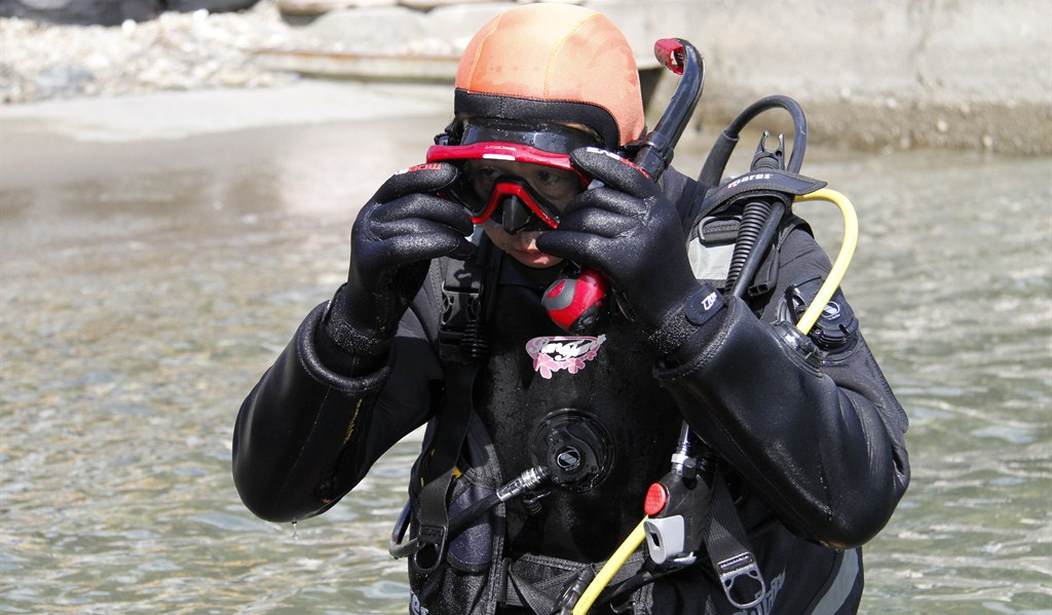

Mark Schachtner has spent about a decade diving Wisconsin lakes, often looking for the sort of things people drop, lose, or simply leave behind. Old beer bottles and medicine bottles are familiar prizes. On a recent dive in Pewaukee Lake, he found something considerably older.
About 15 feet beneath the surface was a canoe dugout roughly 17 feet long, carved from a single white oak. Radiocarbon dating places its most likely age between A.D. 992 and 1049.
From Wisconsin Public Radio:
Days after the find, Thomsen said she went out with Schachtner to collect measurements, video, images and wood samples. She called it a beautiful find. The canoe is intact and submerged on the lake bottom where it’s filled with sediment. Thomsen said that’s not due to shifts on the lake bed over time.
“It’s a classic look for a canoe that had been cached, something that had been intentionally sunk,” Thomsen said. “It was very common for the Indigenous people of the time to bury the canoes on the lake bed to fill them with sediment, and then to return a season later or two and dig them out and dry them out a little bit. Then, they would be functional.”
Michael Wiemann at the U.S. Department of Agriculture’s Forest Products Lab in Madison determined the canoe was made out of white oak similar to other canoes previously found in Lake Mendota. Miami-based lab Beta Analytic conducted radiocarbon dating that showed a 70 percent chance the canoe was in use between 992 to 1049 AD or about 1,000 years ago.
Put another way, somebody shaped this canoe before William the Conqueror invaded England, before Notre Dame Cathedral rose over Paris, and centuries before Columbus crossed the Atlantic.
Wisconsin looked very different then, but the lake was already part of somebody’s life.
Wisconsin Historical Society maritime archaeologist Tamera Thomsen examined the canoe and found evidence of the remarkable amount of work required to create it. Char marks remain on the wood, along with scraping marks left as its makers hollowed and shaped the massive oak.
Fire could soften and remove portions of the wood; stone tools could then scrape away the burned material, slowly turning a tree into something carrying people across the water.
Ho-Chunk Nation President Jon Greendeer pointed to something easy to overlook when we see an ancient artifact in a museum case. Somebody invested time, labor, skill, and purpose into this boat.
The canoe wasn’t decoration; it worked.
It may have carried people to fishing grounds. It may have moved food, tools, or other goods around the lake. It may have connected families and communities whose names are lost to us, but whose hands are still visible in the marks along the wood.
Researchers also believe the canoe may not have accidentally sunk. The sediment packed inside it raises the possibility that its owners deliberately submerged it for storage, perhaps intending to retrieve it when the seasons changed.
If so, there’s something almost haunting about what happened next.
Someone may have placed the canoe beneath the water, expecting to come back.
For reasons we’ll never know, nobody did.
The lake, located just west of Milwaukee, kept it instead.
Archaeologists aren’t planning to pull it out. Representatives of Native Nations, including the Ho-Chunk Nation, asked that the canoe remain where it was found, and the Wisconsin Historical Society intends to respect that request.
There is a practical reason, too. Wood preserved underwater for centuries can rapidly deteriorate when exposed to air. Recovering such an object safely can require years of conservation work.
Leaving it there also feels appropriate.
Recommended: My Brother Caught One by Hand. We Had No Idea How Ancient It Might Be.
Museums preserve history by bringing objects to us. Pewaukee Lake is preserving this piece by keeping it exactly where its makers last touched their work.
Schachtner deserves credit for recognizing that what he found was more than another object on the lake bottom, and reporting it rather than disturbing it.
Most Wednesday dives don’t reach back a thousand years.
This one did.
A man went underwater looking for old bottles, and found direct evidence that generations before Wisconsin had highways, subdivisions, taverns, football teams, and, of course, cheese factories, people were already navigating its waters with skill and purpose.
The canoe will remain below the surface.
Maybe that’s where it belongs. Its builders put it into the lake nearly a thousand years ago, and Wisconsin is finally learning enough about their story to know when not to take something away.