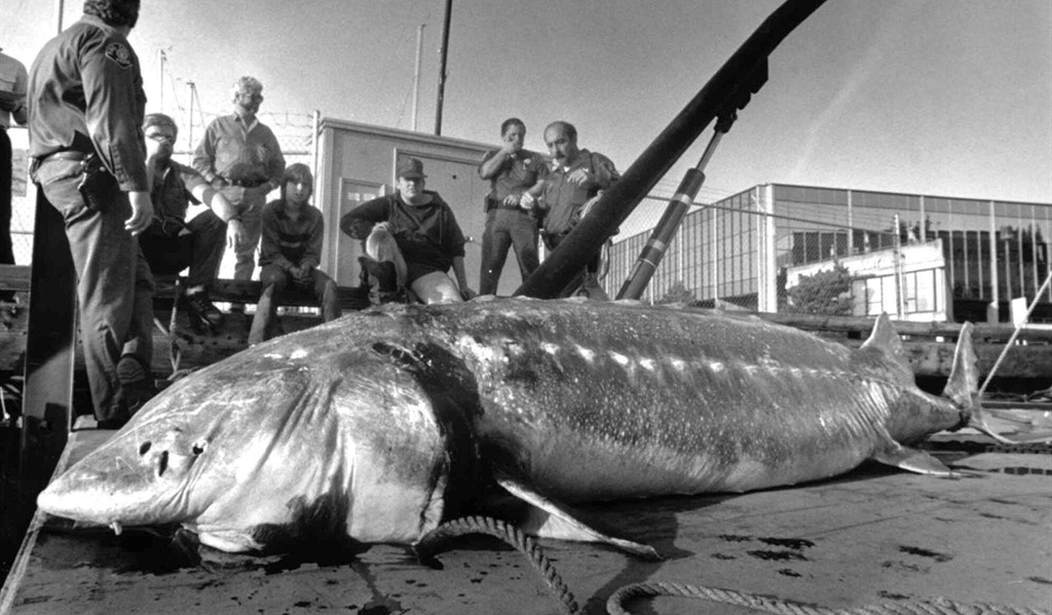
My brother once caught a lake sturgeon by hand in the Eau Claire River at Big Falls County Park. No rod, no carefully chosen lure; he simply got his hands on one of the strangest fish swimming through Wisconsin waters.
Several years later, he caught a 58-inch sturgeon on the Chippewa River, using 8-pound test in a 50-foot hole.
As of this writing, both fish are happily swimming in the same waters.
At the time, it became one of those family stories you remember because, well, who catches a sturgeon with his hands? I told him he catches them because he resembles a sturgeon. We had no idea the fish belonged to a species whose lifespan may force scientists to rethink what they thought they knew about freshwater fish.
Lake sturgeon may live for centuries.
A new study used 44 years of capture, tagging, and recapture data from five Great Lakes populations. Researchers tracked how much individual fish grew after being caught, measured, released, and later caught again.
Their models estimated that a 63-inch male could reach between 90 and 279 years old, depending on the population. For a roughly 71-inch female, estimates ranged from 99 to an astonishing 427 years.
From Popular Science:
“Scientists have long recognized that lake sturgeon are among North America’s longest-lived freshwater fish,” Scott Colborne, assistant professor in Michigan State University’s Department of Fisheries and Wildlife, tells MSU Today. “But the new study suggests they may live far longer than previously appreciated. These fish are a living connection to history.”
For context, here a few of the historical events that some lake sturgeon swimming today may have been alive for:
- The Seven Years’ War (1756 to 1763, also called the French and Indian War)
- The Boston Tea Party (1773)
- Lewis and Clark expedition (1804-1806)
- Ohio, Michigan, Wisconsin, Illinois, and Minnesota all becoming states
- First railroad train in Wisconsin travels from Milwaukee to Waukesha (1851)
- The Great Chicago Fire (1871)
- The Chicago Sanitary and Ship Canal opens (1900)
- The sinking of the Edmund Fitzgerald (1975)
Scientists typically estimate a lake sturgeon’s age by counting growth rings in fin spines. However, since these rings are increasingly difficult to interpret in older fish, researchers thought they may be underestimating the age of the oldest individuals.
To test this, Colborne and his team dove into one of the largest long-term datasets ever assembled for lake sturgeon. They analyzed the growth records from tagged sturgeon that had been measured repeatedly over several years, and developed a much more accurate picture of how slowly these ancient fish continue to grow over the course of their lives. They also applied the same mathematical models that estimate Greenland shark’s lifespan.
The data shows that many live for 200 years, with some getting close to 300.
Those numbers need a little restraint. Researchers haven't pulled a 427-year-old sturgeon from the water and checked its birth certificate. The figure is a modeled estimate based on growth rates.
Still, even the lower reaches of the new estimates change our understanding of the fish. Some lake sturgeon could have lifespans longer than the United States has existed.
For years, biologists commonly aged sturgeon by counting growth rings in fin spines. The idea sounds straightforward; each ring helps indicate another year of growth.
The trouble comes when the fish gets old. The rings become increasingly difficult to interpret, creating the possibility that scientists have been undercounting the ages of the oldest fish.
Scott Colborne, an assistant professor in Michigan State University's Department of Fisheries and Wildlife, said the new work suggests lake sturgeon live far longer than scientists previously appreciated. Researchers used repeated measurements of tagged fish rather than relying solely on those increasingly difficult rings.
Wisconsin has plenty of reasons to pay attention. Lake sturgeon inhabit the Mississippi, Lake Michigan, and Lake Superior drainage basins. The Wisconsin Department of Natural Resources lists them in the Chippewa River and its major tributaries, along with the St. Croix, Wisconsin, Wolf, Menominee, and other waters.
They've been here for a very long time in more ways than one.
Lake sturgeon first appeared about 100 million years ago, during the age of dinosaurs. They still retain primitive features, including rows of bony plates instead of ordinary scales, a sharklike tail, and a notochord rather than the familiar backbone structure found in more modern fish.
Their long lives also help explain why conservation requires patience. Wisconsin females (sturgeon, not human) don't reach sexual maturity until roughly 24 to 26 years old and then generally spawn only once every four to six years.
Lose too many mature fish, and replacing them can take generations.
Perhaps that's what fascinates me most.
Northern Wisconsin doesn't usually inspire thoughts about creatures possibly hundreds of years old.
While discussing the research with a tribal community member, Colborne learned that some Indigenous communities had long believed that lake sturgeon could live as long as 400 years.
“That was one of those goosebump moments,” Colborne said. “Here we were using modern analytical approaches, and they were pointing us toward something that Indigenous communities had long understood—that these fish live incredibly long lives.”
Additional work is needed to better understand the biology behind their longevity and also may prompt scientists to revisit how they estimate the ages of long-lived fish.
“Because of their life history, sturgeon are very resilient and adaptable animals,” Colborn said. “If we give them the opportunity to survive, they’ll figure it out. There’s a reason these fish have been around for millions of years.”
We drive past rivers, fish them, swim in them, and barely consider what might be moving along the bottom.
Then I think about my brother reaching into the Eau Claire River and putting his hands around a lake sturgeon.
I don't know how old his fish was; nobody ever will.
But somewhere in North American waters, lake sturgeon are still swimming as their ancestors did when dinosaurs walked the continent. Some may live for centuries.
And for decades, we may have been counting their years wrong.