







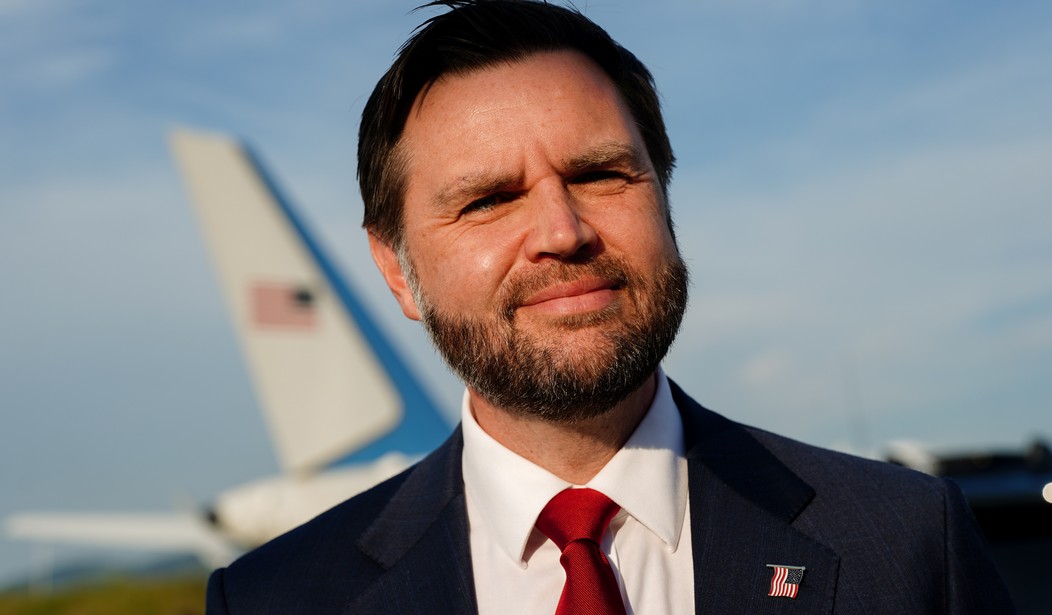
Vice President JD Vance spent nearly three hours with podcast host Joe Rogan and committed the offense Washington fears most: he sounded like himself.
He wandered through Iran, Jeffrey Epstein, aliens, angels, demons, labor unions, AI, housing, and family life. He laughed, interrupted, conceded points, and sometimes followed an idea farther than a political consultant would've allowed.
He dropped F-bombs and other colorful metaphors along the way.
Podcast host Ben Shapiro, of whom I am a fan, titled his response, “JD Vance Joins Joe Rogan. And it isn't good. At all.”
My 'mate Scott Pinsker approached his opinion with a background in public relations. He also saw the political danger.
Come Nov. 2026 and Nov. 2028, if economic concerns, pocketbook issues, and middle-class grievances are the top issues, the Republican Party couldn’t ask for a better, more relatable messenger than JD Vance. He’s the right man at the right time.
In a socialism versus free market debate, Vance will win in a landslide.
Trouble is, the vast majority of the Rogan-Vance podcast wasn’t about the economy, pocketbook issues, or the middle class. It centered on Iran, Jeffrey Epstein, Israel, traitorous “hawks,” disloyal Republicans, and whether or not space aliens are demons (or maybe angels).
JD Vance is a highly organized thinker. He speaks in paragraphs (plural). That makes him an exceptionally dangerous debater — if you don’t believe me, go ask Tim Walz — but an awkwardly verbose conversationalist.
This sit-down with Rogan didn’t play to his strengths. He’s noticeably better on the debate stage.
Politically, the most interesting development was Vance’s calculation on Israel. Instead of choosing between the pro-Israel and anti-Israel factions, he declared himself a “reasonable moderate.”
Please read Scott's excellent piece: JD Vance to Joe Rogan: Aliens Are Demons, Hawks Sabotaged the MOU, Israel Is Meddling
Both reactions make sense from inside politics, where every phrase is treated as a campaign document. But Rogan's studio doesn't work that way.
The clips on social media made Vance sound as though he had announced an official White House finding that aliens are demons. The full exchange was far less dramatic; Vance agreed that extraterrestrials, angels, and demons could be separate beings.
More from Scott's piece:
For someone who claims to be a “reasonable moderate,” he consistently — and repeatedly — assigns the least charitable interpretation to the pro-Israel/hawk faction while (mostly) ignoring the Groyper/isolationist faction. His disdain is difficult to ignore.
And because he’s so damn smart, we assume it’s deliberate.
Rogan and Vance also chatted about the VP’s claim that UFOs were demons. It was a very strange back-and-forth:
Joe Rogan presses JD Vance over his claim that UFOs may actually be demons. The vice president does not walk it back.
— The Vigilant Fox 🦊 (@VigilantFox) July 15, 2026
Rogan gave him three separate exits. Vance took none of them.
ROGAN: "You said something that I thought was very odd. You said that you thought that they were… pic.twitter.com/3w6eKsZW6GIs it wise for the vice president to speculate about the supernatural? Perhaps: Speculating is fun. Everyone wonders about the unknown. I do.
But a politician must be careful not to get over his skis, lest he look ridiculous.
As a one-off, contemplating about the angelic/demonic origins of UFOs won’t move the needle either way. But coupled with Vance’s public declaration (and Susie Wiles’ description of him) as a proud “conspiracy theorist,” he risks being portrayed as a crackpot thinker.
Obviously, that’s not helpful for a man with presidential aspirations. This was an ill-advised rabbit hole.
We watch longform interviews to catch a window into someone’s mind, soul, and heart. A politician must be mindful of what he reveals. And he must be especially mindful when he’s spitballing about unproveable, unknowable metaphysical phenomena.
The part people aren't sharing is admission: he admitted he didn't know what was true, called himself skeptical that the government could hide alien remains, and kept returning to the conversation with curiosity rather than certainty.
His Iran comments carried greater weight. Vance defended a memorandum of understanding pursued under President Donald Trump, said Gulf states would finance rebuilding only after Iran changed its conduct, and accused certain Israeli officials and American hawks of trying to derail negotiations.
Conservatives can challenge every part of the argument, Vance can answer those objections in full, and neither side needs to treat disagreements as apostasy.
His candor wasn't limited to speculative topics. Vance said the Trump administration “absolutely screwed up” communications over the Epstein files, while rejecting claims that President Trump was hiding evidence.
A trained surrogate would've buried the admission beneath careful language: Vance accepted responsibility for a failure and defended the president against the larger charge.
Vance belongs to a younger Republican generation. He didn't spend 30 years learning how to fill five minutes without revealing a private thought. He can speak in complete paragraphs, but he also tests ideas aloud, changes direction, and admits uncertainty.
Older political hands often hear risk, while many voters hear a human being.
Real conversations typically wander unexpectedly. Friends don't issue polished communiques before discussing faith, war, technology, or whatever strange question enters the room. Political coverage now tears three-hour exchanges into 40-second clips, then judges each fragment as a prepared address.
Vance will say things I reject, and he may say something foolish. Some mistakes are part of speaking freely. The country already has enough politicians who can stare into a camera, repeat approved language, and leave viewers knowing less than before.
I'll take Vice President Vance in a wandering Rogan conversation 10 times out of 10 over California Gov. Gavin Newsom, House Democratic Leader Hakeem Jeffries (D-N.Y.), or Rep. Alexandria Ocasio-Cortez (D-N.Y.) delivering another tested performance.
Vance may create headaches for handlers; he also gives people a chance to know what he believes before asking for their vote.
Republicans say they want authenticity. The first test arrives when an authentic leader says something they wouldn't have approved in advance, and Vance passed his test by speaking openly.
Conservative media now has one of its own: can it disagree with him without demanding he become the kind of politician voters learned to distrust?
Political leaders who speak freely are becoming rare, and the battle over the Republican Party’s future is already underway. Join PJ Media VIP today and save 60% with promo code FIGHT.
Join the Conversation
VIP members get the ability to comment on articles.