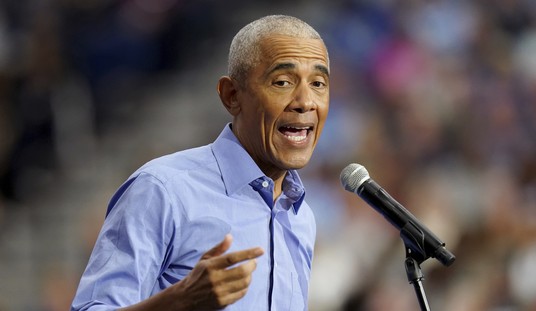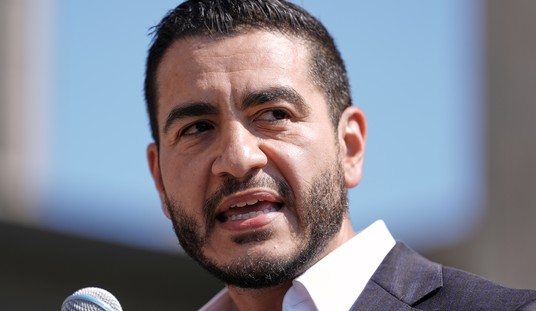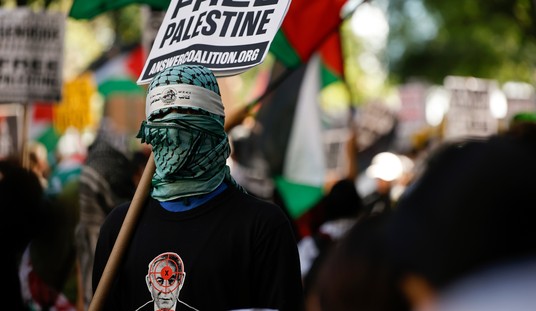

Twenty-five years after the 9/11 attack that some Democrats insist we "deserved," we're still identifying victims' DNA from the once-molten towers. We're still learning the extent to which the Saudi government had anything to do with the attack. We're thunderstruck that New Yorkers, of all people, hired as mayor a man who has more in common — and more affinity — with the hijackers than Americans.
And New Jersey Democrats actually nominated a man who will stand for election in November for Congress, who worked for and in court vouched for the character of Omar Abdul Rahman, the Blind Sheik who bombed the World Trade Center Towers in 1993. That bombing killed six people. You'll recall that Rahman worked with Ramzi Yousef, the nephew of 9/11 architect Khalid Sheik Mohammed.
The word incestuous doesn't even begin to describe this goat rodeo.
In fact, this is insanity. It is, in its purest form, the very definition of toxic empathy. It is a wish to look magnanimous and virtuous while handing your enemies the very sword that will be used to slit your throat, whether that sword is metaphorical or real.
Islam is a civilizational belief and political system that is incompatible with Western Civilization.
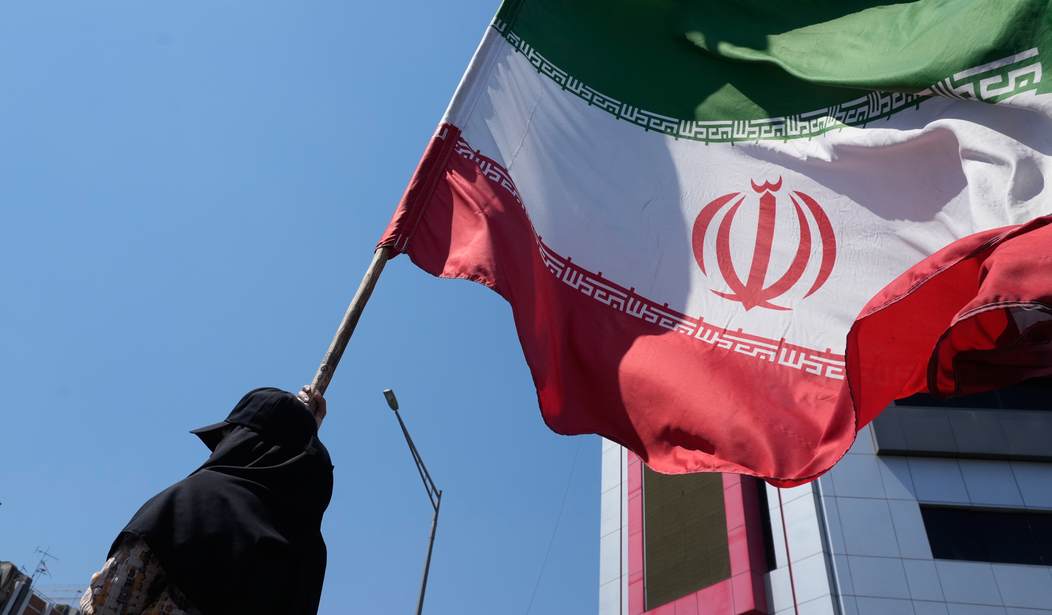
At this point you're probably wondering why I bring this up in an Iran SITREP (situation report) that I do most Tuesdays on the Adult in the Room Podcast. As an aside, it would be cool if you subscribed for free to the pod because goodness knows there's a helluva lot of good information included in the Tuesday and Thursday livestreams.
I bring it up because all those years ago, when Bill Roggio and Tom Joscelyn were laughed at for having the temerity to suggest in the Long War Journal that Iran helped the 9/11 hijackers. And they were right.
I repeat: They were right.
Remember the milieu. Sunnis would never have anything to do with Shia, the "experts" said. Iran and Iraq just had a bloody, years-long war, and they would never cooperate, they thundered.
Wrong-o. Not only did they cooperate, they still do. And it's a cooperation that exists regardless of how well the Economic D-Day works against the Iranian mullahs.
In the "Thirty-eighth report of the Analytical Support and Sanctions Monitoring Team submitted pursuant to resolution 2734 (2024) concerning ISIL (Da’esh), Al-Qaida and associated individuals and entities," which the United Nations publishes every year, they reported on the latest top-line, politically allowable status of KSM's old buddies.
My frequent guest on the Iran SITREP features on the Adult in the Room Podcast is a man who used to put together that report for the United Nations.
Edmund Fitton Brown is the former "coordinator of the Security Council team responsible for sanctions and threat assessment on ISIS, al-Qaeda, and the Taliban," so he knows a thing or two about this stuff. He also was the UK's ambassador to Yemen and a career diplomat. He is now a senior fellow at the Foundation for the Defense of Democracies. Our interview is below.
We talked about why Iran is harboring the leader of Al Qaeda and his cell members. Brown told me that it started out as a house arrest situation and that things have gotten much cozier between the two sides.
[T]hey've been there for a long time and their presence has sort of evolved over time in an interesting way. When they were first there, they were actually under arrest by the Iranians and the Iranians saw them as bargaining chips, pawns that they could use if necessary.
Then over time they realized well actually you know we can be a bit nicer to these guys but as long as they can't leave the country so you know they can have a sort of like a comfortable house arrest they can be treated even as honored guests but as long as they don't leave the country al-Qaeda can never attack us because we can you know send them these guys you know sort of ears through the mail or whatever if they do.
He says the Al Qaeda members are sort of an insurance policy for Iran.
I asked him if Al Qaeda would eventually go operational for their and Iran's shared goals. He thinks they will. See why he believes that in our interview below.