





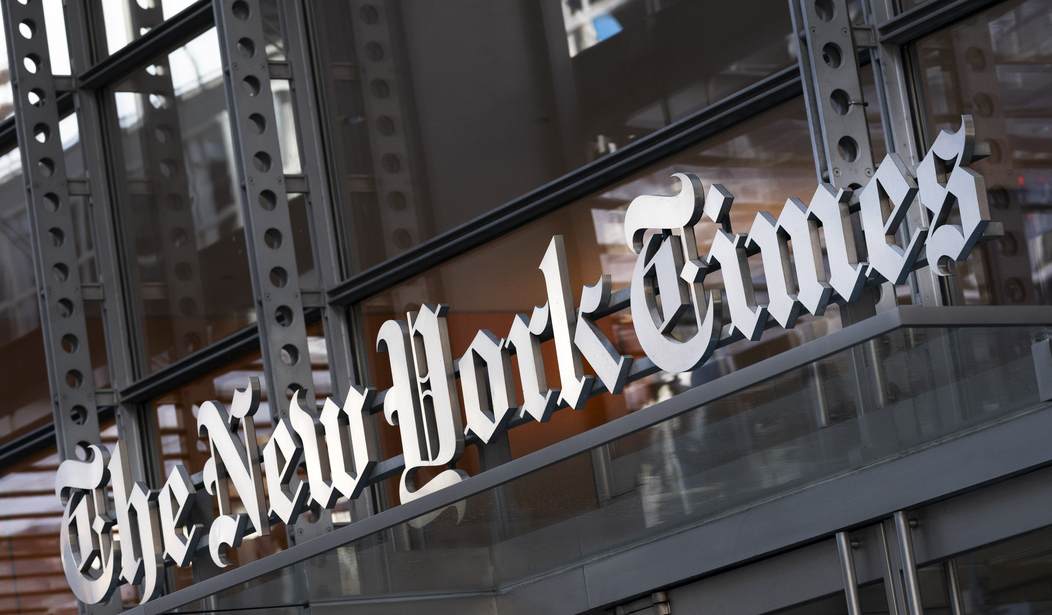
At least it’s colorful: The Gray Lady just gave us the green light to wave the white flag.
Running in the April 7 edition of The New York Times: “The Iran War Is Turning Iran Into a Major World Power.” The author, Professor Robert Pape of the University of Chicago, offers the following thesis:
- Iran will keep control of the Strait of Hormuz for “months or years,” and there’s nothing militarily we can do about it. (Sorry, guys.)
- The U.S. and Europe are now in decline — and the axis of China, Russia, and Iran is ascending.
- Iran will emerge as a “new major world power” and the “fourth center of global power” (the other three: America, China, Russia).
But before we pulverize Professor Pape’s preposterously pessimistic proposal, here’s an earlier example of The New York Times’ piercing wisdom, courtesy of author Hans Mahncke:
The story behind the New York Times’ 1903 claim that human flight was between one and ten million years away is even worse than it looks.
— Hans Mahncke (@HansMahncke) April 5, 2026
Once you understand the backstory, you realize that the New York Times story is not really about flight at all but about how elites and… https://t.co/6JlRT1nja8
It’s an X post about a New York Times story from 1903: “Flying Machines Which Do Not Fly.” (And if that story sounds familiar, it’s because beloved PJ Media alum and/or Supreme Leader Editor Paula Bolyard wrote about it in 2024.)
From Mahncke:
The New York Times did not dismiss the possibility of powered flight at random. There was a very specific reason behind it. At the time, America’s most prominent scientific authority, Smithsonian Secretary Samuel Langley, had been showered with large amounts of taxpayer funding to build an aircraft, the Langley Aerodrome. Despite all the money, institutional backing, and elite prestige, Langley and his team could not get it to fly, culminating in a series of very public failures, the last on December 8, 1903.
So when the New York Times declared that flight was millions of years away, what it was really saying was that if the most credentialed and well-funded “experts” cannot do it, then it cannot be done.
A mere nine days later, the elites’ proclamation of impossibility lay in ruins. Two totally unknown bicycle mechanics from Ohio achieved the first powered flight using improvised parts, a few hundred dollars of their own money, and sheer persistence.
From stupid ideas that crash and burn to lame-brained theories that never get off the ground, there’s a long and illustrious history of the Gray Lady getting caught red-handed practicing yellow journalism.
In fact, in honor of Artemis, there’s also this doozy from Jan. 13, 1920, when The New York Times insisted that rockets cannot function in space:
That professor [Robert] Goddard, with his ‘chair’ in Clark College and the countenancing of the Smithsonian Institution [from which Goddard held a grant to research rocket flight], does not know the relation of action to reaction, and of the need to have something better than a vacuum against which to react — to say that would be absurd. Of course he only seems to lack the knowledge ladled out daily in high schools. [emphasis added]
It was only AFTER Neil Armstrong, Buzz Aldrin, and Michael Collins left the surly bonds of earth — on a rocket, by the way — that the Times offered a correction:
Further investigation and experimentation have confirmed the findings of Isaac Newton in the 17th century, and it is now definitely established that a rocket can function in a vacuum as well as in an atmosphere.
[…]
The Times regrets the error.
Want more?
How about the Times’ 1922 insistence that Adolf Hitler’s antisemitism was overhyped:
But several reliable, well-informed sources confirmed the idea that Hitler’s anti-Semitism was not so genuine or violent as it sounded, and he was merely using anti-Semitic propaganda as a bait to catch messes of followers and keep them aroused, enthusiastic and in line for the time when his organization is perfected and sufficiently powerful to be employed effectively for political purposes.
Or its 1939 prediction that television would lose to radio:
The problem with television is that the people must sit and keep their eyes glued on a screen; the average American family hasn’t time for it. Therefore, the showmen are convinced that for this reason, if for no other, television will never be a serious competitor of broadcasting.
Or its 1985 screed that computers had limited mainstream appeal because we’d rather read newspapers:
On the whole, people don’t want to lug a computer with them to the beach or on a train to while away hours they would rather spend reading the sports or business section of the newspaper… the real future of the laptop computer will remain in the specialized niche markets. Because no matter how inexpensive the machines become, and no matter how sophisticated their software, I still can’t imagine the average user taking one along when going fishing.
(In fairness to The New York Times, its motto is “All the news that’s fit to print” — and technically speaking, all of those stories “fit” inside the paper AND liberal groupthink. But perhaps the Times ought to consider choosing stories based on accuracy instead of how well they “fit.” Truth > Tetris.)
The colorful moral of our story: Most of the Gray Lady’s white lies come from brown-nosing silver-spoon liberal elites.
So keep that in mind as we ply apart Professor Pape’s pointless paper:
In recent years, the conventional geopolitical wisdom has been that the world order was moving toward three centers of power: the United States, China and Russia. That view assumed that power derived primarily from economic scale and military capability.
That assumption no longer holds. A fourth center of global power is quickly emerging — Iran — that does not rival those three nations economically or militarily. Instead, its newfound power derives from its control over the most important energy choke point in the global economy, the Strait of Hormuz.
Very respectfully: What the hell is Pape talking about?
The world order is moving to… Russia? Since when? The Russian economy is in the toilet!
From the April 2, 2026, edition of the Moscow Times (courtesy of Google Translate):
The Russian economy ended February with a contraction, according to data from Rosstat and the Ministry of Economic Development.
After a 2.1% decline in January, Russia's GDP contracted by another 1.5%, and the cumulative total for the two months was 1.8% lower than on the same date a year earlier. As a result, by March, the economy had lost all of the growth it had shown last year, which Rosstat estimated at 1%.
"The risks of overcooling the Russian economy are increasing," notes Viktor Grigoryev, an analyst at Bank Saint Petersburg. Out of the 28 industrial sectors monitored by Rosstat, 22 were in the red in January-February. Output at metallurgical plants plummeted by 15%, food production fell by 2%, and clothing and footwear production fell by 11.1%. Even the military sector has slipped into recession: production of "finished metal products," which state statistics classify as bombs and shells, fell by 1.9% year-on-year in January and February.
Wholesale trade turnover in the country fell by 7.8% over the first two months, while retail growth has almost stopped: 0.3% in February and 0.5% year-to-date. This is the worst result since spring 2023, notes Olga Belenkaya, an economist at Finam: "Consumers have switched to 'saving mode' amid slowing income growth, still-high interest rates on loans, and increased VAT and excise taxes."
Russia’s economy is significantly smaller than China’s, America’s, or the European Union’s. (Its GDP is about the same as Canada's.) With the U.S. Armed Forces making minced meat of its anti-aircraft technology in Iran and Venezuela — coupled with its ineptitude in Ukraine — Russia seems more like a nation in decline than a global “center of power.”
Fun fact: The economies of Texas and California dwarf Russia’s, too — even though Russia has twice as many people as Texas and California… combined!
Professor Pape’s perilous pontifications proceeded:
Roughly one-fifth of the world’s supply of oil and liquefied natural gas moves through the strait. There are no real alternatives to these supply routes in the near term. If Iranian control over the strait persists for months or years, as I believe it may, it will drastically reshape the global order to the detriment of the United States.
Many analysts believe that Iran’s grip on the Strait of Hormuz is only temporary. A widespread expectation is that U.S. and allied naval forces will soon stabilize the situation and that oil flows will resume along familiar lines.
That expectation is flawed.
[…]
President Emmanuel Macron of France said as much on Thursday when he declared that it was “unrealistic” to open the Strait of Hormuz by force and that “this can only be done in concert with Iran.” He was all but admitting that the flow of oil cannot be guaranteed without Iran’s agreement.
Well, golly gee: If France can’t do it, why bother trying?
The obvious counterargument, of course, is inscribed in every military textbook since the dawn of time: Overwhelming force is a very useful tool for extracting political concessions.
Strong countries have leverage over weak countries. Been that way for a very long time. Ever hear of gunboat diplomacy?
Like the famous philosopher Al Capone used to say, “You get more with a kind word and a gun than you do with a kind word alone.”
Professor Pape prattled on:
China depends on Gulf energy to sustain growth. Russia benefits from higher and more volatile energy prices. Iran gains leverage from its position at the Hormuz choke point.
Each of these three nations has incentives that run counter to the economic stability of the United States and its allies. These three nations do not need to coordinate in a formal way. The structure of the system pushes them in the same direction. This is how a new order emerges — not through a formal alliance (at least not at first) but through converging incentives that reinforce one another over time. [emphasis added]
Yeah, but their incentives also run counter to each other: Higher oil prices are good for Russia and Iran, very bad for China. An unstable Strait of Hormuz is bad for China and Iran, very good for Russia. Lots of Iranian oil hitting the market is good for Iran and China, very bad for Russia.
Pape’s belief that all this economic turmoil is one-sided doesn’t make sense.
Pape proceeded:
Other plausible scenarios in the emerging new world order are darker still. Imagine Iran with control of about 20 percent of the world’s oil, Russia with about 11 percent and China able to soak up much of that supply. They would form a cartel to deny the West 30 percent of the world’s oil. You don’t need sophisticated analysis to recognize the catastrophic consequences: precipitously declining power for the United States and Europe, and a global shift toward China, Russia and Iran.
But then again, if China (stupidly) decided to forego 70% of the world’s oil supply and go all-in on Russia/Iran’s 30%, China would be giving Iran and Russia veto power over its economy: Whenever Russian output stalled — or the Iranians played hardball (and/or another Middle East war broke out) — the Chinese economy would nosedive.
Why would China surrender its national sovereignty like that? Wouldn’t hedging your bets on 70% of the global oil supply be a helluva lot smarter than hitching your wagon to 30%?
Besides, the Chinese economy depends on exports, because its rapidly aging population is no longer capable of domestic consumption. Since 2022, more Chinese have died than were born.
China’s top 15 trading partners in 2025:
- United States: $421 billion (11.1% of China’s total exports)
- Hong Kong: $337.1 billion (8.9%)
- Vietnam: $198.6 billion (5.3%)
- Japan: $157.5 billion (4.2%)
- South Korea: $144.5 billion (3.8%)
- India: $136 billion (3.6%)
- Germany: $118.3 billion (3.1%)
- Malaysia: $103.8 billion (2.7%)
- Thailand: $103.7 billion (2.7%)
- Russia: $103.5 billion (2.7%)
- Netherlands: $93.9 billion (2.5%)
- Mexico: $89.2 billion (2.4%)
- Indonesia: $85.4 billion (2.3%)
- United Kingdom: $85.2 billion (2.3%)
- Taiwan: $83.6 billion (2.2%)
Iran doesn’t even make the list, and Russia is a measly 2.7%. Neither nation is big enough (or wealthy enough) to matter.
Why would China jeopardize its entire economy just to play footsie with Russia and Iran?
Professor Pape’s parting prediction:
The United States faces a difficult choice: either commit to a long-term effort to reassert control over the Strait of Hormuz, or accept a new global energy arrangement in which U.S. control is no longer assured.
If it chooses acceptance, the outcome is clear: The international system will reorganize with Iran as a fourth center of global power. Yet if the United States chooses to reassert military control, it is in for a long battle, one it could well lose.
So those are our only two options, eh? A long-term military campaign we “could well lose” — or cede control to the Iranian mullahs?
What about these options:
- Beating the crap out of Iran in a short-term campaign?
- Killing Iran’s leaders until we find one that’ll make a deal?
- Regime change: Flipping the Iranian government entirely?
- Increasing U.S./Venezuelan oil output and securing new trade lines?
- Letting the nations that most rely on the Strait of Hormuz invest in its operational control?
"Professor Pape" is big on alliteration, but he's weak on imagination. Limiting U.S. options to just two is the telltale sign of a myopic mind. His op-ed is arrogant, smug, and absurdly anti-American — and thus a Tetris-level “fit” with the prevailing left-wing groupthink.
Which is why it’s so perfect for The New York Times.
Related: How I Learned to Stop Worrying and Love the F-Bomb: Unknot Your Panties and Let Trump Be Trump!
One Last Thing: 2026 is a critical year for America First. It began with Mayor Mamdani declaring war on “rugged individualism” and will reach a crescendo with the midterm elections. Nothing less than the fate of the America First movement teeters in the balance.
Never before have the political battle lines been so clearly defined. Win or lose, 2026 will transform our country.
We need your help to succeed!
As a PJ Media VIP member, you’ll receive exclusive access to our behind-the-paywall content, commenting privileges, and an ad-free experience. VIP Gold gets you the same level of “insider access” across our entire family of sites (PJ Media, Townhall, RedState, twitchy, Hot Air, and Bearing Arms). That means: More stories, more videos, more content, more fun, more conservatism, more EVERYTHING!
And if you CLICK HERE and use the promo code FIGHT you’ll receive a Trumpian 60% discount!
Thank you for your consideration.

Join the Conversation
VIP members get the ability to comment on articles.