


Almost two weeks ago, a woman whom I now refer to as the "Honduran Hurricane" stormed into my house and began telling me that nearly everything I was doing was wrong. After a three-week stay, my father had come home from the hospital the afternoon before, and apparently, I'd already failed him.
I didn't have the right medications. I didn't have the correct oxygen tank. I was supposed to be changing bandages at intervals no one else had mentioned. And what about this? And what about that? And oh yeah, did we have cats in the house because she had asthma and couldn't be around cats, and could she use my bathroom? Of course, she had to use the bathroom just hours after the toilet in my guest bathroom began leaking, and I was going to have to have it replaced. (Because over the last six weeks, practically everything that could go wrong in my life did.)
"I don't really care for this woman," my dad said to me when my aunt, who lives behind us, allowed the nurse to go use her bathroom.
When she returned, I tried harder to win her over. She was obviously from Central America — Honduras as it turns out — and I was preparing to tell her that I spend a lot of time in Costa Rica and often cover the region for work, but that went nowhere.
When it was time for her to leave, I gave up on becoming friends and followed her out, hoping that maybe if I spoke to her privately I could actually get some answers about what's next. My dad had been home less than 24 hours. The mere act of getting him home had been exhausting and frustrating, and I had no idea exactly how I was going to take care of him going forward. Some guidance from the home health people would be nice.
We got to the driveway, and she turned and looked at me, a bit softer than she'd been inside, and said, "He needs to be in hospice care." She went on to explain that he had so much working against him that keeping him alive was going to be an uphill battle and something I couldn't handle on my own, and even if I did, it probably wouldn't buy us that much time. She also told me that she was concerned about me. She hugged me and told me that I deserve to have a life and that this would leave me without one.
In that moment, I hated that woman. How could she suggest I just give up on my father? But I also loved her. Because throughout the entire ordeal that was my dad's last month or so on this planet, no one had been that honest with me. I'd watched him spend three weeks in the hospital, where some of his symptoms improved but his overall condition seemed to get worse. Deep down, I recognized signs that he might be dying, but I was afraid to say it out loud.
Admittedly, I was also afraid that I was about to lose another decade of my life to taking care of someone who technically required more care than I could possibly handle. I'd gone through that with my mom, and it nearly broke me. How this fiery nurse knew that, I don't know, but that morning, I'd prayed to God to please give me a sign, to tell me what to do. "Consider me your little Latina sign," she said to me.
It took me a couple of days to work up the nerve to talk to my dad about it. "What exactly would that mean?" he asked. I told him that instead of going to doctors every week, which he'd have to do via ambulance, and taking numerous medications, and having to follow strict diets and all of that, he'd get to stay home, hang out with me, and do whatever he wanted. He'd already told me he wasn't going to do most of that anyway.
"I don't want to die tomorrow, but I'm not afraid to die," he said. Two days later, the hospice coordinator came out to talk to us and set things up.
We talked about what aspects of his care he wanted to continue and which ones he had no interest in. He was particularly interested in physical therapy, even though he was growing weaker by the day, and I'd been told he'd likely never walk again. He'd claimed all along that he was not in pain, refusing any type of medication for it in the hospital, but the minute he took that morphine, he slept better than he had in months and woke up with a smile on his face. "I haven't felt this good since the 1990s," he said.
Everyone kept telling me that once we switched over to hospice, things would get easier. I can't say that was the case.
I had a wonderful support system — aunts and cousins who brought food and linens for the hospital bed and things like that. My dad's sister was at my house daily, bringing supplies to help make him comfortable, visiting with me and him, or simply giving me a few minutes so I could go outside and feed my animals and get some fresh air. She also patiently responded to my every anxious text, which I am quite grateful for because I sent a lot.
My uncle and cousin next door provided muscle when we needed to move my dad from his recliner to the hospital bed, which took nearly two hours. I had one cousin who knew just how terrified and overwhelmed I was, and she would come sit and merely offer her presence. And, for the most part, the hospice staff was kind, though I did find myself feeling lost a time or two because there seemed to be a lack of communication, but that's a story for another day.
It truly took a village to keep things running, but eventually, those people would go home, and it was just my dad and me. I slept on the sofa in the den where his hospital bed was every single night, and when I say "slept," I mean I might have gotten one or two hours at a time before he'd wake me up.
Sometimes he'd simply want something — a drink, some ice cream, a meal. There was one night that he had been asking for things for hours, and I was exhausted, and when he asked me to fix him some soup I'd bought him, I told him no. It was not soup time; it was bedtime. I regret that terribly because it would be the next to last time he'd ever request any food.
I learned the hard way what "terminal delirium" is. He had a bad case of it and would get very agitated, angry, and/or scared at night. He would refuse to take medication. At one point, he accused me of giving Marco Rubio all of his medication. He would ask for his mother or his late brother and get upset when they didn't talk to him, or he would accuse me of locking him in a cage because he couldn't get out of bed. Some days, I'd wake up from a brief sleep to find all his clothes, blankets, bandages, oxygen tubing, etc. on the floor. He didn't know why he did that.
Recommended: Marco Speaks: Are the Resignation Rumors True?
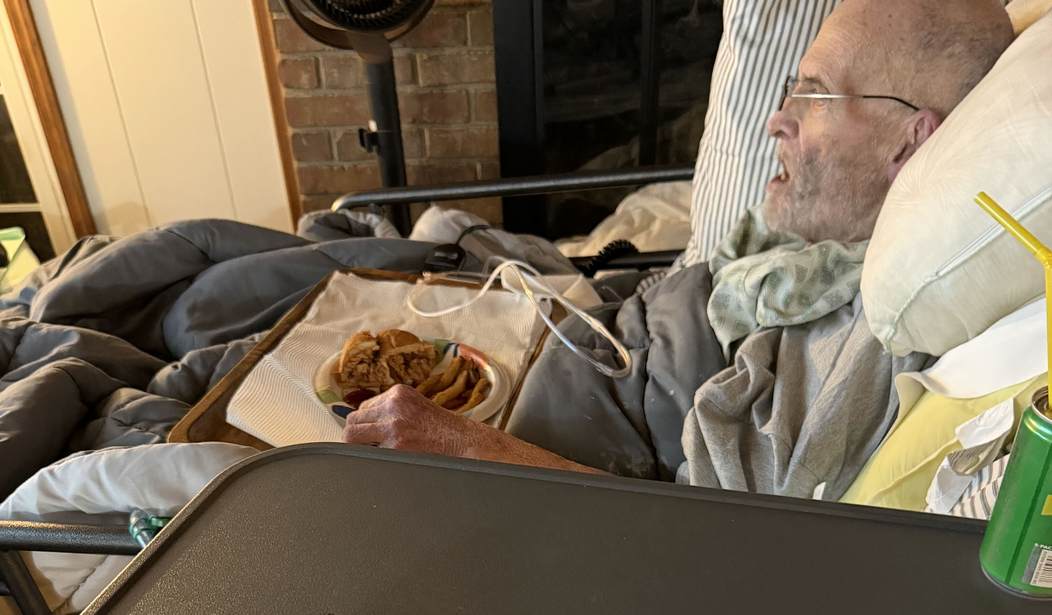
This past Saturday, we moved him from the recliner to the hospital bed, and that evening the hospice nurse came and did a few things. We watched the rest of the Georgia game together, followed by the start of Texas and LSU, and we ate barbecue from our favorite local place. I was surprised to see my dad eat nearly half of a large order of fries and about a third of a sandwich. He was happy and peaceful and was even planning ahead for the Georgia-South Carolina game the next week, making predictions about the score.
And then he fell asleep and slept for 15 hours. When he finally woke up on Sunday afternoon, the delirium was so bad that I called my aunt for help and reached out to the hospice nurse on call. She told me how to medicate him to soothe him, and as I was giving him the pills, I realized that the man who'd been drinking every ginger ale in sight for the past week could no longer use a straw. It took about an hour and a half, but he finally settled down until around 1 a.m. He woke up delirious again, and I more or less had to trick him into taking the medication. I think he finally fell asleep around 3 or 4 a.m. and slept until the next afternoon.
On Monday, a social worker, nurse, and aide all came to the house. The social worker was the kindest woman, and she was finally able to answer a lot of my questions that had gone unanswered up until that point. They cleaned him up, which was horrific to watch because he was screaming in pain and fear, and I tried my best to hold him and comfort him. After that, he went to sleep and never really woke up. The nurse told me that he was ordering a higher dose of the morphine and that I would need to administer multiple meds every four hours without exception from that point on, which if you've ever tried to administer medication to a person who is basically unconscious, you know that you have to walk many fine lines.
So, that's what I began doing on Monday afternoon, and I did it all through the night. The social worker had told us that it'd probably be a matter of days, so I took that evening to sit next to my dad and hold his hand and talk to him. I told him how much I loved him and would miss him but that I'd be okay, and how exciting was it that he'd get to see his wife and his mother and brother and the dogs he loved over the years again?
I also told him to hold on so we could at least watch one last football game together. Unfortunately, that game was Monday Night Football — the Chargers vs. the Ravens — and we lost our connection sometime during the third quarter and didn't get it back for two hours. I speak from firsthand experience when I say that sitting alone in a dark, quiet house while you listen to your father's death rattle isn't exactly the most fun way to spend a night. Thanks, Xfinity. But the TV eventually came back on, and I put on a rerun of the game.
At some point between the 5:30 a.m. and 9:30 a.m. medications, I must have fallen asleep because when my alarm went off around 9:20, I had a pounding headache, but when I looked over at my dad, I noticed something had changed. His breathing was different, more desperate (though he still looked comfortable), and I could see his heart pounding through his t-shirt. I texted my aunt and told her that I didn't think he'd be with us much longer.
She came up to say her final goodbyes to him and to let him know it was okay for him to go, and then she and I went into the kitchen to talk for a little while. She needed to get back home, so she went to say goodbye to my dad one more time and waved me over. He'd stopped breathing. I put my hand over his heart and felt nothing. I checked his pulse on his wrist and neck. He was gone.
I laugh about this now, but when I first realized he'd died, I was angry. I'd known he was dying for several days, maybe longer, but I couldn't believe he had the audacity to actually do it. Anytime I had ever encouraged him to take his health more seriously, I told him that once he was gone, I would be alone. My mom is gone. I have no siblings. I'm not married, and I have no children. And now he'd truly gone and left me alone anyway.
The next few hours were a blur of family members, the hospice nurse, and funeral home workers visiting. Once everyone cleared out, I just went outside and sat in my garden with my animals. It was a beautiful sunny day, especially for November, and while I was utterly exhausted, my headache had turned into a migraine, and I felt sick to my stomach, I was grateful for the way things had unfolded.
I didn't want my dad to die, but that wasn't my decision. He didn't want to die either, but he'd also been quite specific about how he wanted to spend his final days.
The night before he'd gone to the hospital, back in mid-October, he'd made me promise him that I would never put him in a nursing home. At some point during this ordeal, he'd ended up in one for what was supposed to be three weeks of rehabilitation (he'd agreed to it without my knowledge), but that only lasted for about five hours before he was back in the hospital, and thankfully so, because that place was awful.
After that experience traumatized both of us, I promised him that no matter what it took, I'd get him home and take care of him myself — that we'd spend whatever time he had left watching football in our den and eating crappy takeout together, even if it shortened his lifespan (he agreed) and even if it shortened mine.
And there were a few moments when I thought it would. The nights with no sleep. The delirium, especially when it made him mean. Having to keep him clean because he couldn't use a toilet. Changing bandages on pressure wounds. Being covered in bodily fluids. Fixing meals he'd actually eat and watching him take two or three bites. Handling catheters. Keeping up with medication schedules. Trying to find a way to gently tell him he'd benefit more from hospice care without making him feel like I was just giving up on him. Soothing him when he was scared or agitated. Dealing with medical professionals in my house every day, some of whom weren't so pleasant. Dealing with the financial fallout of not working for over a month, yet having to spend a small fortune on him.
Realizing that I was having to do all this while, in reality, I just wanted to curl up in bed and cry because I was losing the person who I love more than anything in the world,
Eleven days. That's how much time my dad had at home before he died. While we had some good moments, most of it looked nothing like I'd imagined. I'm not even sure he was mentally present for half of it.
But I did what I thought was best for him, what he'd always asked me to do, even when it was painful or felt unfair. I did everything in my power to ensure he didn't spend his final days alone in a cold hospital room under fluorescent lights or in a depressing nursing home surrounded by strangers who treated him only God knows how. He was at home, as comfortable as I could make him, surrounded by the people who cared about him. It was the least I could do for the man who gave me life and spent decades loving me through every moment of it.
Editor's Note: Do you enjoy PJ Media's conservative reporting that takes on the radical Left and woke media? Support our work so that we can continue to bring you the truth.
Join PJ Media VIP and use promo code FIGHT to receive 60% off your membership.



Join the Conversation
VIP members get the ability to comment on articles.