





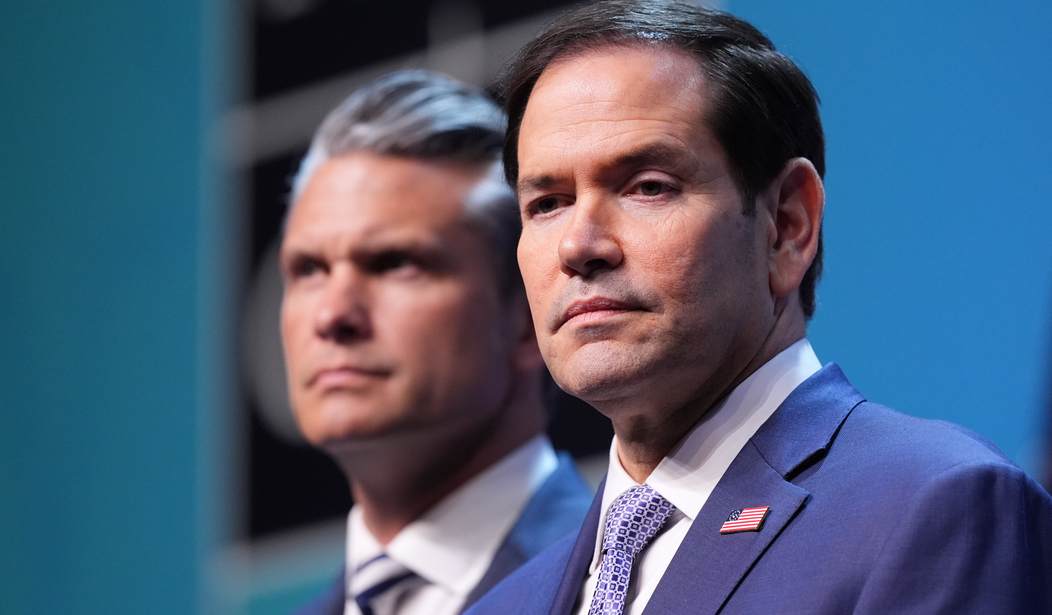
At this moment, Marco Rubio is in the Philippines for the ASEAN Post-Ministerial Conference, but his biggest project is half a world away, back home in the Western Hemisphere. The secretary of state currently has more control over a foreign country than any U.S. official has in quite some time. What happens next in Venezuela will likely play a major role in how history will remember Rubio, and more importantly, it will impact the freedom and security of millions of people across two continents for years to come.
Taking out Nicolás Maduro was not a solution, but merely the removal of the first stitch from a large wound. The corruption of his criminal regime was held together by numerous others who could have stepped in and taken over almost seamlessly: Diosdado Cabello, the man with the $25 million bounty on his head here in the United States — the one who controls internal security, repression, and torture. Delcy Rodríguez, the anti-American daughter of a prominent Venezuelan Marxist guerrilla fighter who died at the hands of the state while being questioned about the kidnapping of a U.S. executive. She has long said that her career was built around seeking revenge for her father's death and grew up indoctrinated with the idea that democracy is fictitious.
Her greatest talents include sanctions evasion and doing illicit international business with U.S. adversaries. And then there's her brother, Jorge, who is essentially her enforcer. He runs Venezuela's fake National Assembly, a congress in name only that serves only to support the regime in more recent history. He's the one who oversaw the apparatus that fixed the elections in Maduro's (and Hugo Chávez's before him) favor.
My point is that Rubio, going into this situation, started out with a really bad hand.
And, fortunately, no one in our government knew that better than him. He's built his entire political career around attempting to remove tyranny and corruption from the Western Hemisphere, and in 2025, when he became Donald Trump's secretary of state, he finally had the tools — and a boss — that would allow him to make that happen.
Rubio has said from the beginning that the goal was stabilization first. Would there be a civil war? Mass migration? That didn't happen.
Goal two was recovery of the oil industry and other resources to help the country have an economy once again. "Their natural resources are going to allow Venezuela to be stable and prosperous moving forward," Rubio said in January at a congressional hearing. "And so we created the – what we hope to do is transition to a mechanism that allows that to be sold in a normal way, a normal oil industry – not one dominated by cronies, not one dominated by graft and corruption."
The final goal was — and still is — the transfer of power to fairly elected leaders, a "friendly, stable, prosperous Venezuela."
While the process was never meant to be easy, it was going pretty well. Commercial airlines now fly from the U.S. to Caracas for the first time since 2019. Oil exports are on the rise, and revenue is held in a U.S. Treasury account, not in regime pockets and bank accounts. Investment opportunities have been opened up to private companies from the United States and other countries. Hundreds of political prisoners were released from detention centers. The U.S. reestablished diplomatic relations and reopened our embassy. Some opposition figures were able to return, and their parties' offices reopened. College students and workers have marched largely without fear, demanding freedom and a real government. The flow of cheap oil to Cuba stopped, and there's been a visible reduction in Iranian, Russian, and Hezbollah operations within the country. High-profile criminals have been taken out or extradited to the United States.
That's a lot for six months, and Rubio should be commended. We've known from the beginning that he's running the show. No one else could do it so well. If the New York Times and its sources are to be believed, you don't just have to trust my intuition:
Mr. Rubio now effectively controls Venezuela’s finances, the distribution of its natural resources and its government, according to interviews with more than a dozen officials and people close to both governments in Washington and Caracas, who provided details about his involvement in steering the country’s policies. Many spoke on condition of anonymity to describe private interactions and internal discussions.
While he has not visited Venezuela in person since the U.S. took over, the secretary of state is deeply involved in the country’s day-to-day operations, keeping in close contact with Delcy Rodríguez, who was Mr. Maduro’s vice president and now leads her country on an acting basis, with the imprimatur of the United States. The two exchange messages in Spanish on WhatsApp, trading gossip, birthday greetings and selfies.
Despite the banter, the relationship between Mr. Rubio and Ms. Rodríguez is far from a partnership. It is a manifestation of Trump-era American power, in which the winner takes all regardless of sovereignty and international law.
Rubio reportedly tells the regime how to spend its money — the Times compares it to a parent handing out allowance. He oversees sanctions, decides who can do business in Venezuela, and approves Delcy's government appointments, etc. According to the article, shortly after Maduro's capture, "Rubio told her that she had a choice between working with the United States or witnessing a broader attack targeting Venezuela’s infrastructure, military bases and senior officials." She agreed to the former.
I was almost positive that the newspaper meant this to be a hit piece, but it actually painted Rubio as a powerful and competent figure, even if it didn't mean to. A newer article in The New Yorker goes even further. It claims that Trump officials regularly tell Delcy, "Don’t get too comfortable, because at any moment I can send María Corina after you.'"
It's referring, of course, to María Corina Machado, beloved opposition leader, Nobel Peace Prize winner, and the most popular politician in Venezuela — the country's "Iron Lady" and the woman who would be, should be president right now. But we'll get back to her in a second.
So Rubio's the "viceroy," as the media now wants to call him. He's making some progress, but for the people on the ground who were thrilled when Maduro was gone, it was not visible enough. The oil is moving faster, the money is coming in, but where are the jobs and living wages? Where is the food and medicine? Hundreds of political prisoners were released, but why weren't all of them freed? Delcy praises Trump and the United States one day, but brings back her anti-democracy and imperialism rhetoric the next. Trump praises Delcy, even though she was literally Maduro's vice president. And why in the hell is Cabello, potentially the biggest crook of them all, still in charge of anything?
Exile voices told their loved ones back home to be patient, to not believe everything they hear, to trust Rubio — praise of Delcy is pragmatic, not reality. They've also realized that they cannot depend only on the United States to help them to get to the third part of Rubio's plan. They must prepare and rally themselves for when the time comes.
No one saw two major earthquakes hitting the country in late June — a 7.2 magnitude, followed by a 7.5 less than a minute later. A natural disaster unlike anything we've seen in recent history. As I'm writing this on Monday, July 20, over 5,000 are dead, a number that could double. Already crumbling infrastructure, built and neglected by Chavismo, and the vulnerable people who lived among it stood no chance.
According to the Times, Rubio was, once again, in another hemisphere: "Mr. Rubio was asleep in Bahrain last month when he was awakened by a call from the White House Situation Room. Two massive earthquakes had hit Venezuela, and early images were grim."
He called Delcy immediately and began mobilizing what has been a phenomenal humanitarian response that has required coordination with the U.S. military, multiple other countries, the U.S. private sector, and reputable charities. I don't want to downplay that at all. He also announced on Monday that he's trying to gain access to "global funding and credit" for rebuilding.
But the earthquake exposed more than bad infrastructure. It proved that the regime's corrupt and incompetent ways are still very much in place. It also exposed that a carefully thought-out three-point-plan executed by the best possible candidate looks great on paper, but it's not necessarily linear.
Even Reuters admits that "Delayed orders from senior military commanders, a lack of basic equipment and overall confusion were among the issues that hindered the deployment of Venezuelan troops in the crucial first days after two devastating earthquakes struck the country's coast last month...amid public outrage over the government's response to the disaster."
Delcy has, of course, denied all of this, but no one is buying what she's selling. Volunteers on the ground, both Venezuelan and international, and members of the international press who got into the country tell a different story. Journalists like Oscar Ramirez of Real America's Voice have spoken out in great detail about the reality they saw with their own eyes and cameras and how they were harassed and threatened by the regime for sharing it.
There was no heavy equipment. Venezuelan citizens were digging through rubble with their bare hands. Bodies lay in the streets. People were screaming for help that wasn't coming. Access for those who tried to help was blocked. Supplies were stolen. Permits for international rescue crews were delayed. People were angry. I've seen so many videos of them screaming and spitting at regime officials and military in the streets, while praising those from the United States, El Salvador, and other countries. This is exactly the type of footage the regime was hoping to block because inside these figures' delusional minds, they still think they'll maintain power for years to come.
As I've reported, Machado decided that her country needed her and vowed to return home. It was risky, but this woman has a long and storied history of putting herself in risky situations for the betterment of Venezuela, and she's good at organizing, even when in hiding, and she's got the most loyal base of any politician I've ever seen. We've heard various stories floating about that Trump and Rubio stopped her, but that article from The New Yorker tells a slightly different story.
[Trump] called Rodríguez and told her not to allow Machado to be harmed. But then her flight was diverted, apparently on orders from someone in the Administration. Though Machado’s U.S. counterparts assured her that it was all a misunderstanding, the longtime operative described it as the result of infighting. 'There are factions regarding Venezuela,' he said. 'And the faction that’s winning today says, Don’t rock the boat between now and November.'
The day after her flight was grounded, Machado flew to Panama City, planning to catch a plane from there to Venezuela. Before she could board, an official from the airline called and told her that Rodríguez’s government had threatened to revoke its license if she were allowed on the plane. Machado issued a frustrated message to followers. 'I will be in Venezuela so we can mourn our losses together, pray together, hold one another, and organize ourselves,' she insisted. 'I will do whatever it takes for us to be together.'
In the meantime, a Spanish journalist, who claims to be conservative and a MAGA ally, Javier Negre, conducted an interview with Delcy shortly before the earthquakes hit. He came away from that interview, which later proved to be incredibly friendly and lacking substance, attempting to whitewash the so-called "acting president" and painting her as some sort of moderate or center-right voice. Shortly after he began this campaign, several other so-called MAGA influencers joined in. They spoke of Machado and her supporters, claiming they were socialists and were stirring up drama on social media to foil Trump and Rubio's plans for Venezuela. They made it clear that Trump wanted nothing to do with Machado, while the president himself was saying the exact opposite when questioned about it. I can only imagine what influenced this campaign, but I've learned to tune it out.
The article from The New Yorker buys into that theory a bit, too:
All along, Machado has maintained that Trump’s vision for Venezuela is aligned with hers — a claim that seems harder and harder to sustain. In promoting an intervention, she yielded some real part of her agency to the United States. For nearly half a year now, the Administration has been stalling her return; at one point, Trump officials offered to have her named Secretary-General of the United Nations [...] Recently, the Administration announced that Rodríguez had agreed to talks with a group of opposition figures. But, instead of including Machado, the U.S. promoted another exiled leader, Dinorah Figuera, who is seen as more conciliatory.
Here's where this article and I part ways. Trump (or, really, Rubio) has not abandoned Machado. She's still very much in play. I believe the only difference of opinion is the timeline. Machado wanted elections sooner rather than later, as do the Venezuelan people, as do several members of our own Congress. But there is still too much of the regime in place for that to happen. It's being dismantled slowly but surely, but the earthquakes revealed a sobering reality.
Rubio's abundance of caution is exactly what may have taken his three-point plan a few steps backward. While he did it with the well-being of the Venezuelan people in mind, it's hard to see that when you are living in poverty, do not have free speech, can't afford food, and are now watching the very regime that led to this way of life respond to a catastrophic event with more lies and incompetence that most likely led to many needless deaths of your neighbors. It feels as if nothing has changed and nothing will ever change.
Civil war, mass migration — all of that is very much back on the table. There's also the fact that constitutionally, Delcy's temporary presidency supposedly became null and void earlier this month after 180 days. Furthermore, those who are planning to invest in Venezuela's future are likely to — and I'm hearing whispers that they're starting to — get cold feet.
To Rubio's credit, he's pivoted in a major way. It's not perfect, but I think it's the best he can do with the hand he's been dealt. Last week, the State Department announced that on August 1, a formal transition-to-democracy phase will begin. This will start with talks between two factions, one led by Jorge and one led by Dinorah Figuera, who represents the last democratically elected National Assembly that the United States recognized as legitimate government.
The agenda will be rebuilding democratic institutions — a new National Electoral Council (CNE) and Supreme Court not stacked with regime loyalists, new basic rules, and a concrete path toward elections that isn't just "someday."
Sen. Bernie Moreno suggested July 24, 2027, the birthday of the country's original liberator, Simón Bolívar. Not a bad idea.
Thank you @SecRubio. The process of getting to an election in Venezuela is essential. An historic date to pick would be July 24, 2027 in honor of the original liberator, Simon Bolívar! It would also be a great way to honor the modern liberator, @realDonaldTrump! https://t.co/0gDsj5LCHV
— Bernie Moreno (@berniemoreno) July 20, 2026
At first glance, it sounds like the regime will have a big say in what happens — 50% — but I can assure you that's not the case. Less than 24 hours before this announcement, Jorge was telling reporters that elections were not a priority. That was apparently before he got his marching orders, and suddenly, he changed his tune. Rubio is in control. He's forcing them to play along.
So, why Figuera and not Machado? Figuera is the more pragmatic choice for all parties involved. She returned to Venezuela recently after nearly eight years of exile in Spain. She's easier for the Trump administration to manage, and she's more likely to make inroads with a regime that still wants to cling to power. Sending Machado in to negotiate with the regime would be like, to put it in terms people in the U.S. would understand, asking Trump to negotiate with Elizabeth Warren and Alexandria Ocasio-Cortez. The regime suffers from Machado Derangement Syndrome the way our Democrats suffer from TDS.
A lot of people aren't happy with her exclusion, but it is what it is. It's a tactical choice that will pave the way for the Venezuelan people to have what they want, which is, without a doubt, Machado.
Machado isn't sidelined. She's endgame. Rubio knows that better than anyone. They've been close for years. They stay in touch now. He nominated her for the Nobel Peace Prize. He called her Venezuela's "Iron Lady" when he wrote a blurb about her for Time magazine last year. He's championed her causes, and he knows that country is hungry to see her finally in her rightful place in Miraflores Palace. Even if, for some reason, she's not the next president, removing her from the equation would be detrimental to the entire process.
Of course, only time will tell how this next phase goes — rebuilding a country's infrastructure and its democratic institutions at the same time won't be an easy task. If it doesn't go well, if these members of the Maduro regime cling to even a little bit of power in the years to come, many people in Venezuela, the United States, and across the entire hemisphere will lose the trust they have in Rubio.
But if he pulls it off, if Venezuela becomes a stable country with real elections, a real economy, and real security after decades of Chavismo, he'll go down in history as one of the greatest political minds of our time. After following his career closely for 16 years and knowing his heart for the people of Venezuela and knowing he understands the impact Venezuelan stability will have across North and South America, I'm betting on the latter.
Editor’s Note: Thanks to President Trump and his administration’s bold leadership, we are respected on the world stage, and our enemies are being put on notice.
Help us continue to report on the administration’s peace through strength foreign policy and its successes. Join PJ Media VIP and use promo code FIGHT to receive 60% off your membership.
Join the Conversation
VIP members get the ability to comment on articles.