
In the controversy over Islam in the United States today, one side insists that Islam is a religion like any other: Like Judaism and Christianity, it teaches those who follow it to be good, and like Jews and Christians, they would be good if the believers did follow it in every particular, but they don’t always do so. On the other side are those who maintain that Islam is fundamentally different from Judaism, Christianity and all other religions in that it is a political ideology as well as a system of religious ideas. And that political ideology is supremacist, violent, and expansionist, which makes it a matter of concern for every American.
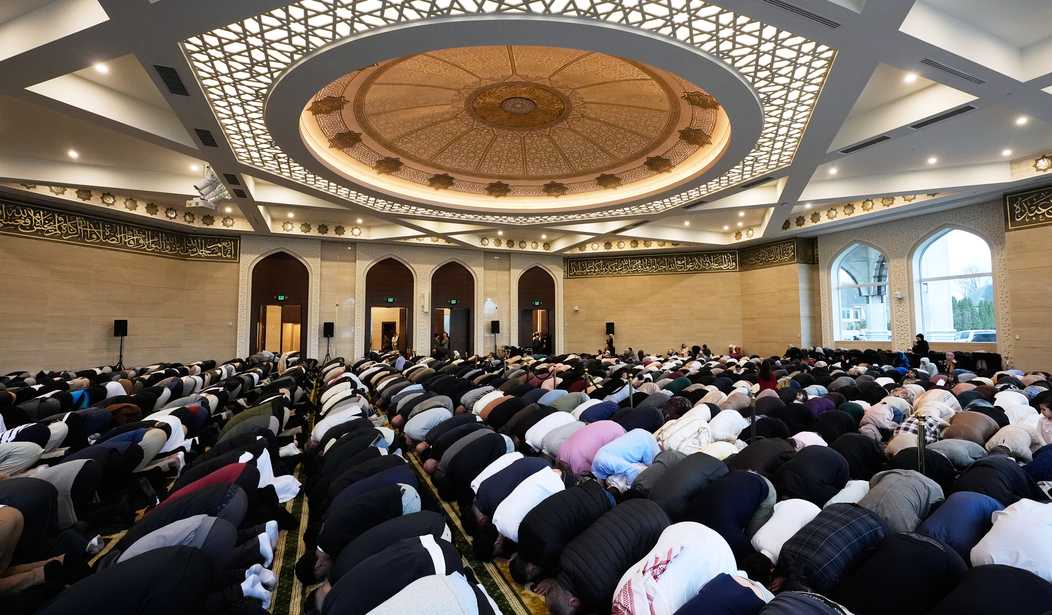
At recent conference of the Hamas-linked Islamic Society of North America (ISNA), one speaker likened the situation of Muslims in America today to that of the early Muslims in Mecca. The significance of this will elude most Americans, but it is actually a statement that government and law enforcement officials would do well to examine carefully.
Islamic tradition holds that there were two stages to Muhammad’s prophetic career: the Meccan period, comprising the first twelve years of his “ministry,” and the Medinan period, that is, the last ten years of Muhammad’s life. In Mecca, the Muslims were a small and powerless group, and Muhammad preached tolerance — that is, that non-Muslims should be tolerant toward the Muslims. In Medina after the hijra, Muhammad had political and military power, and preached defensive and offensive jihad. The ISNA speaker is saying that Muslims in the U.S. have been in a period corresponding to the Meccan period of tolerance, but that period will eventually end, and give way to a stage corresponding to the violent and belligerent Medinan period. We are already witnessing the transition.
And so at the ISNA conference, one speaker, Hussam Ayloush, the longtime executive director of the Los Angeles chapter of the Hamas-linked Council on American-Islamic Relations (CAIR), quoted the Qur’an (57:25): “Allah subhanahu wa ta‘ala [the most glorified, the exalted] says, ‘I've sent the messengers with clear proof, and I've sent down with them the scripture and the balance, the rules of justice.’” Ayloush goes on to explain that Allah sent these messengers “so that people may stand forth in justice…. Allah is sending the messengers to mankind to establish justice. That is the purpose, because… tawhid is the ultimate application of justice.”
Tawhid is Islam’s absolute monotheism. In saying that it is the ultimate application of justice, Ayloush is assuming that there can be no true or full justice without tawhid. America must thus become Islamic in order to experience true justice.
Another speaker, however, a hijab-wearing woman, explained that America’s Islamization was a long-term project. She elucidated this with reference to Muhammad’s prophetic career as Islamic tradition presents it. Speaking about “our ability to strategize, our capacity to understand how do we build alliances, how do we build strategies,” she said: “So one of the things that many of the scholars think about with Ta’if is one of the reasons Prophet Muhammad sallallahu alayhi wasallam [the prayers and blessings of Allah be upon him] didn't ask when he had the choice. For revenge against that whole community, he knew in that moment he was still building his strength, thinking about what is the strategic decision that I'm going to make in this moment. Because Prophet Muhammad was not only a man or an individual who took spiritual action. In everything he did, he took strategic action.”
She was referring to a story in Islamic tradition of Muhammad presenting Islam to the people of Ta’if and being contemptuously rejected; the people of Ta’if even threw stones at the prophet of Islam as he was leaving the town. She notes that he didn’t take revenge because his forces were not yet strong enough.
Related: Connecticut Man Tells Truth About Muhammad, aaaand Cue the Leftist Outrage
But in America, she went on, the situation would be different. “That's why,” she continued, “if you look at the sira [the biography of Muhammad] and the Medinan and the Meccan period, you see the strategies that he took when he had a great amount of power, a great amount of resources.” But in contrast to how Muhammad acted when he was in a position of power, “you see the strategies that he took when he was in a position of building strength. All of these now in the modern world we would call whether they are community organizing skills, whether they are strategic planning skill. It is a long-term— in the mission of Rasulullah [the messenger of Allah, i.e., Muhammad], a 20— more than 20-year mission. So for all of us thinking about where we are in this moment, have the vision that prophet Muhammad had.”
She was saying that Muhammad built his strength in Mecca, but was working toward the day that he would wield political and military power, as he did after his emigration (hijra) to Medina. Are Muslims in America, who are now in the Meccan stage, working now to wield political and military power, as Muhammad did in Medina? Of course. And yet who in power in America today is taking notice?