
My mother (b. 1923) used to tell stories of her grandmother who lived on the North Dakota prairie, with the nearest town 30 miles away.
Assembling and preparing Thanksgiving dinner was more than an adventure. It was a labor of love. What they didn't grow in their truck garden, they might buy at a local farmers' market or from a neighbor. Preparing and cooking the feast was an "all hands on deck" operation. While the men took care of getting the meat ready to cook (Have you ever plucked a turkey?), the women handled almost everything else. From early morning to late afternoon, the women chopped, shredded, beat, mashed, scraped, and cooked vegetables and fruit to create the dishes, pies, and other delicious confections that filled the farmhouse kitchen with warm spices and sweet, lingering scents.
Even in lean years, they made an extra effort to fill the table to overflowing. And along with the traditional declarations of what everyone was thankful for, Thanksgiving was useful for "taking stock": what the family had experienced over the last year, where they were then, and what the future might hold. It was a bonding exercise that brought the family closer together and created beautiful memories.
The few times Nana Goodrich came to dinner at our house, she marveled at how her daughter got everything to the table on time and warm. She never mentioned anything, but I wonder what she thought about Libby Pumpkin Puree? Or None Such Mince Pie Filling? The modern kitchen is light-years removed from what my grandmother and her colonial ancestors had to work with.
"In 1796, the first known American cookbook, Amelia Simmons’s American Cookery, included a recipe for 'Pumpkin Pudding' made with cooked pumpkin, milk, eggs, and spices," reports Popular Science. "Before the pumpkin could be combined with the other ingredients, the recipe called for it to be strained, separating fine pulp from tougher material."
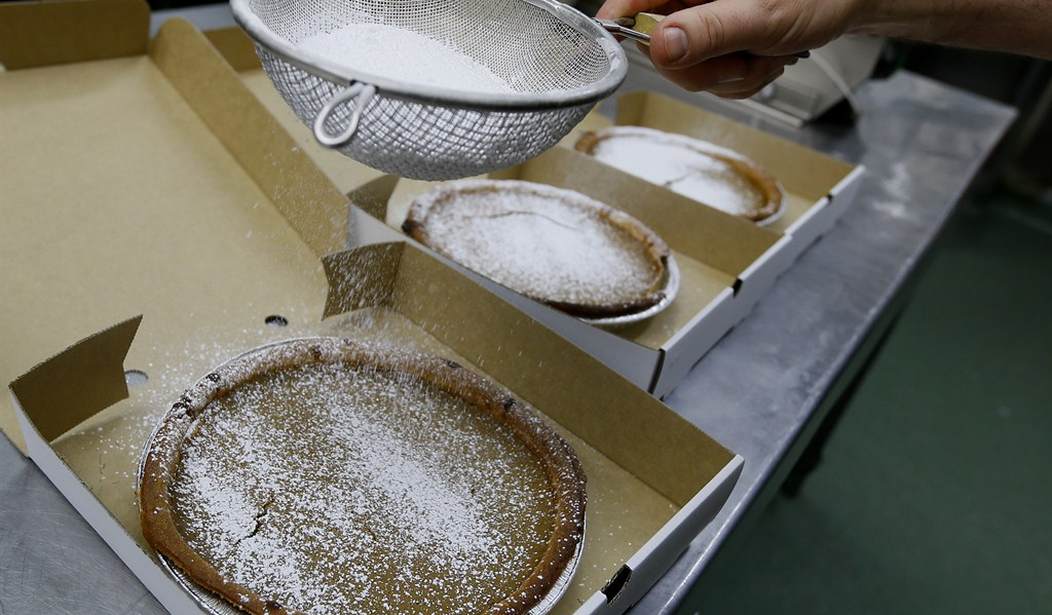
The pumpkin would have to be precooked for at least six hours to soften it up so the cook could work with it. "To turn the pumpkin into pie, the cook must mash it, scrape it, and force it through a sieve, separating smooth pulp from stubborn strings and fibers," says Popular Science.
It seems like an absurd amount of work for dessert. Pumpkin flesh doesn’t naturally break down into a silky puree. Cooking softens its tissues, but turning the squash into smooth filling requires additional mechanical work.
For generations, cooks solved the problem with heat and muscle. Eventually, factories took over the work of cooking and processing pumpkins into puree. But the solution didn’t stop there. Growers also turned to pumpkin varieties with naturally smoother, less fibrous flesh, making the job easier before the squash even reached the factory.
Sarah Josepha Hale, the long-term editor of Godey’s Lady’s Book, one of the most influential and widely circulated magazines in pre-Civil War America, campaigned for decades to make Thanksgiving a national holiday. President Abraham Lincoln finally made it so in 1863. Hale also helped popularize many foods associated with the holiday, promoting a traditional New England Thanksgiving menu through her magazine. Pumpkin pie went from being a regional New England dessert to a national tradition.
Making pumpkin puree is more complicated than simply cooking the flesh until soft. Pumpkin cells are surrounded by walls containing materials such as cellulose, hemicellulose, and pectin. Cooking softens the tissue, while mechanical processing breaks it into smaller particles. Together, these processes help determine the puree’s texture and moisture.
The goal is a smooth puree that is neither watery nor full of tough fibers. The pumpkin variety matters, as do the heating conditions and mechanical methods used to break down its flesh.
The pumpkin itself became key to the processed food industry. The ordinary orange "field" pumpkin proved too stringy and fibrous, so Libby Foods introduced a Dickinson pumpkin in 1929. The squash's tanned outer husk was not the only difference. There was far more meat inside the pumpkin and more importantly, it was far more conducive to pureeing.
"Rather than trying to eliminate the stringiness of a carving pumpkin, processors can start with a variety whose natural characteristics make the job easier," claims Popular Science. "The raw material itself becomes part of the technology."
It's certainly a far cry from Nana Goodrich's mother's kitchen. But it's not so much the food that matters. What matters is the closeness and unbreakable bonds formed, whether in a 19th-century farm kitchen or 20th-century suburban kitchen.
No factory can "process" that.