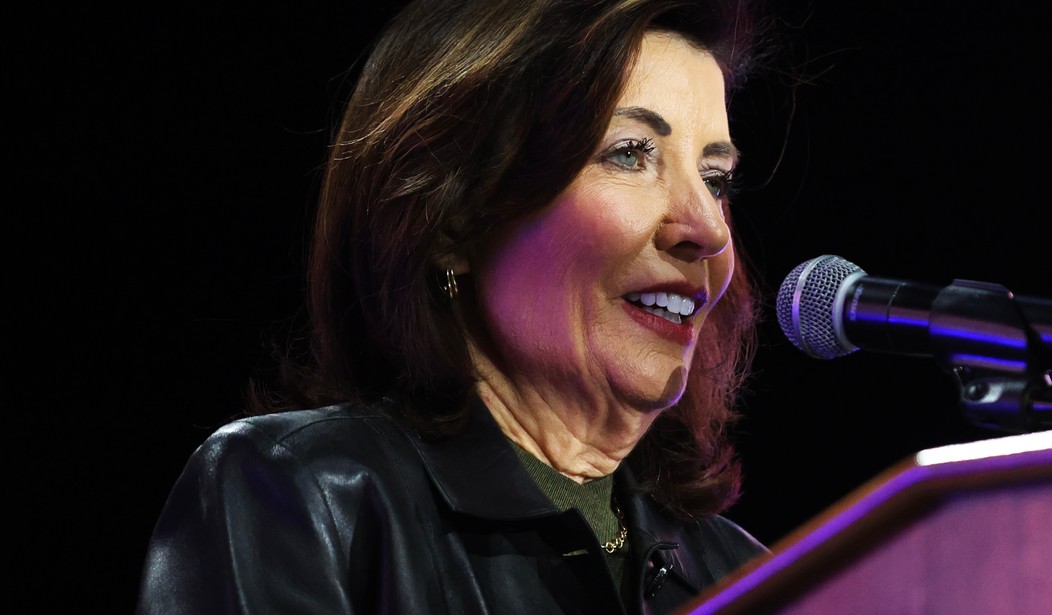

New York Gov. Kathy Hochul signed an executive order imposing a one-year moratorium on new data centers.
It's high irony. New York state was the birthplace of the transistor. General Electric Corp. established the world's first industrial research lab in 1909. Thomas Edison built the first commercial electric power plant in 1882. The state has an incredibly rich history of pioneering achievements, particularly when it comes to technology, infrastructure, and commerce.
Until now.
The hysteria deliberately generated by Vermont socialist Sen. Bernie Sanders, Rep. Alexandria Ocasio-Cortez (D-N.Y.), and others on the left over AI data centers causing utility bills to spike and water resources to be depleted is a gross exaggeration at best. Other fears, such as massive job loss and tech companies releasing AI models that could endanger humanity, have yet to be proven and may, in fact, be vastly overblown.
All of this scaremongering has led to Governor Kathy Hochul signing the executive order delaying construction of the data centers. This isn't good public policy. It isn't even good environmental or consumer policy.
AI data centers in New York can draw plenty of water from Lakes Erie and Ontario. Most of the data centers would be built upstate, where the Hudson River and canal systems are waiting to be exploited. In fact, all U.S. data centers combined use 50 million gallons of water per day, 30 times less than the total for U.S. golf courses.
What about electric bills going up 40% in the last five years?
Data centers’ hunger for power is a different situation. Data center power consumption more than doubled between 2018 and 2024, from 1.8 percent to 4.4 percent of total U.S. power use. Meanwhile, power prices have jumped 40 percent since 2020. There’s truth to the basic claim that the power grid is not ready for a massive surge in demand. For the last several years, the power grid has been getting less reliable and power bills have been climbing.
And that's our fault. More to the point, it's the fault of politicians and activists who slammed on the brakes on nuclear power, refused to modernize the grid, subsidized inefficient solar, and imposed clean energy mandates that have driven up consumers' electric bills by hundreds of dollars a year.
The state and federal permitting process for building a new non-nuclear power plant has become ridiculous. Tens of thousands of pages of meaningless, bureaucratic, ring-around-the-rosy requirements that do nothing to make electricity generation more efficient and everything to make it more expensive and complicated.
It didn't use to be that way. During the post-WWII boom, the power grid expanded at a breakneck pace that far outstripped population growth.
Between 1940 and 1980, the U.S. population grew by about 75%. During this same period, per-capita electricity use multiplied several times over. Total electricity generation surged by over 900% as household appliances, air conditioning, and heavy industrial manufacturing took off. The grid was built out rapidly to keep pace with an electrifying nation.
It was a different story from 2000 to 2023. The U.S. population grew steadily by about 18%, adding over 50 million people. Electricity demand essentially flatlined, averaging less than 0.5% growth annually.
Why? Even though there were millions more people using more devices, massive strides in energy efficiency (LED lighting, high-efficiency HVACs, and energy-saving appliances) offset the growing population. The grid became highly optimized and utilities got used to a world of stagnant demand.
Here we are in 2026, unprepared for an AI future, with an electric grid that is starving for more capacity.
People see their power bills skyrocket and naturally search for someone to blame because it’s enraging. Focusing on data centers makes an intuitive kind of sense. But the truth about our power grid is that we have been underinvesting in it for decades. Grid watchdogs like the North American Electric Reliability Corporation have been warning for years that America’s grid is starving for capacity. In 2022, Mark Christie, a former commissioner at the Federal Energy Regulatory Commission, said that we were “headed for a reliability crisis.” That year, power prices had leaped by 233 percent in some parts of the country. That was before data centers came onto the scene in a big way.
Power generation is getting a boost over the next decade when these data centers will be powered by small nuclear reactors. But first, we have to build out our AI capacity. That won't happen until the companies have the power to create their frontier AI models and expand their abilities.
We're in a transition period. The activists and political opportunists may be driving opposition to the data centers, but they can't stop time from moving forward. The data centers will be built somewhere, and the future will continue to unfold.
Hochul is going to regret her action to close the door on AI development in her state.