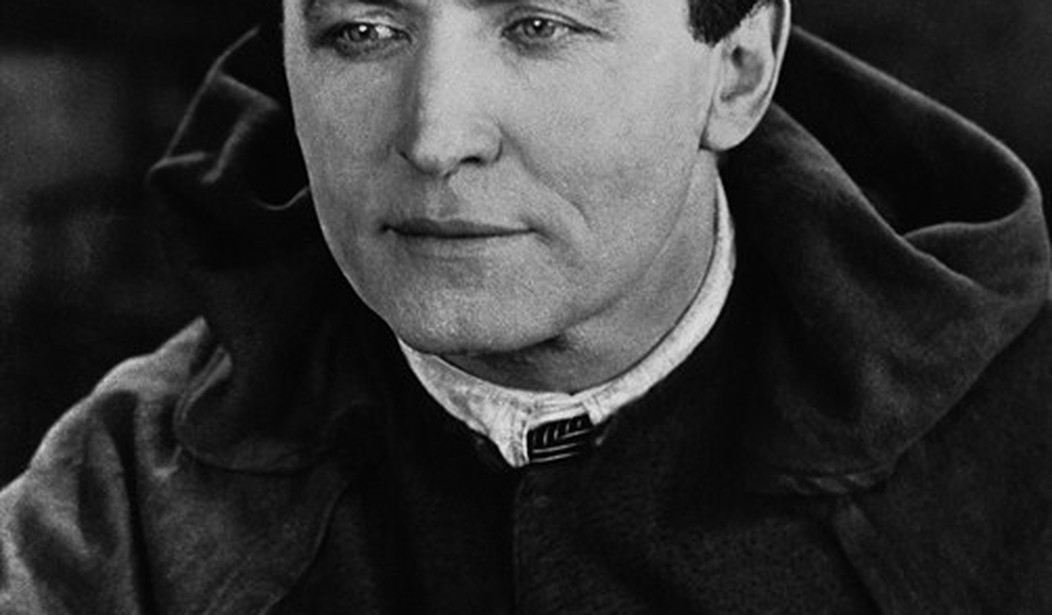

Harry Houdini spent his life getting out of places. Handcuffs, jail cells, ropes, locked boxes, straitjackets, and water tanks were challenges waiting to be beaten. Yet there was one small Wisconsin city he never quite escaped from, even after he became one of the most famous entertainers on Earth.
Appleton still claims him.
Houdini was actually born Ehrich Weiss in Budapest on March 24, 1874. His family came to Appleton in 1878 when his father, Samuel Weiss, accepted a position as the city’s first rabbi.
Ehrich lived there for about four years before the family eventually moved to Milwaukee and then New York, where money was scarce, and the young immigrant took whatever work he could find.
Four childhood years don’t sound like much across a 52-year life. They apparently meant plenty to Houdini. He repeatedly identified Appleton as his hometown and went even further, sometimes claiming he was born there. The History Museum at the Castle still notes the contradiction plainly: Budapest was his birthplace, but Appleton was what he called home.
By the 1890s, Ehrich Weiss had transformed himself into Harry Houdini, borrowing inspiration for the name from French magician Jean-Eugène Robert-Houdin. At first, he struggled. Houdini and his wife Bess worked music halls before vaudeville manager Martin Beck recognized what audiences would eventually see everywhere: Houdini could turn the simple act of being trapped into theater.
From the Wisconsin Historical Society:
Young Erich was fascinated by magic and circuses from an early age, and began his career as a magician in 1891 with Jacob Hyman as one of "The Brothers Houdini," a name inspired by the French magician Houdin. In 1893 Houdini married Wilhelmina (Bess) Rahner and together the two undertook a music hall career with an escape act.
They had little success until Martin Beck, a major figure in vaudeville spotted the act and offered Houdini a place on his Orpheum circuit in 1897. Beck sent Houdini to England where he performed with great success until his return to the U.S. in 1907.
Besides escaping from handcuffs, shackles, straitjackets and other constraints, Houdini added danger and excitement to his acts by escaping from water-filled containers.
The tricks became bigger, wetter, tighter, and more dangerous. Houdini escaped handcuffs, shackles, packing crates, straitjackets, and water-filled containers. He made movies, became an international celebrity, and later devoted considerable energy to exposing fraudulent spiritualists who claimed they could communicate with the dead. His fame grew so large that a Hungarian immigrant who spent only a few childhood years in Wisconsin became permanently woven into Appleton’s identity.
Then came October 1926. While visiting Montreal, Houdini was struck several times in the abdomen by a student after a discussion about the magician’s ability to withstand blows. Houdini later became gravely ill and died in Detroit on Halloween, October 31, from peritonitis caused by a ruptured appendix. Whether those punches caused the rupture remains disputed, even a century later.
From the Wisconsin Historical Society:
Between 1919 and 1923 Houdini expanded his career by making six motion pictures, though none were particularly successful. In the 1920s he turned his attention to debunking spiritualism, the belief that the dead can contact the living. While performing in Montreal in October 1926 Houdini was unexpectedly struck in the abdomen by a college student testing his claim to be able to withstand any blow. Houdini died in a Detroit hospital on October 31 of peritonitis resulting from a ruptured appendix, though whether the blow was the cause of the rupture remains in doubt.
There’s something almost unbearably fitting about the date. Halloween became tied forever to a man whose career depended on mystery, danger, illusion, and our willingness to believe for a few minutes that perhaps the impossible wasn’t impossible after all.
Houdini was 52.
Throughout 2026, the city has been celebrating the 100th anniversary of Houdini’s death with performances, exhibits, magic events, and tours. On October 31, exactly 100 years after Houdini died, Appleton will unveil an official Wisconsin State Historical Marker in Houdini Plaza. The ceremony takes place at the corner of College Avenue and Appleton Street, in the city Houdini spent the rest of his life insisting was his hometown.
Maybe Houdini understood something about home that can’t be measured by years or birth certificates. His family struggled after leaving Appleton; his life became a succession of trains, theaters, hotel rooms, crowds, and increasingly dangerous performances.
Somewhere beneath the locks and applause remained the memory of a Wisconsin childhood from before the world knew his name.
Appleton has spent 100 years returning the affection. There’s a Houdini Plaza, a permanent museum exhibit, his history written into the community, and now a state marker arriving on the anniversary of his death.
Harry Houdini escaped almost everything placed around him.
A century later, Appleton is still holding on.