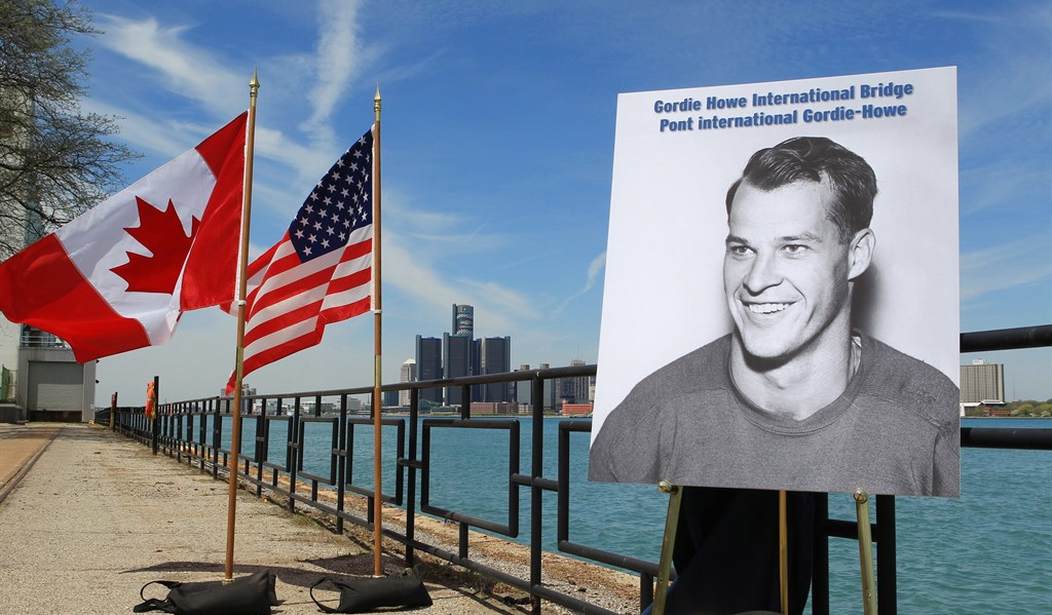

Canada and the United States finally built a new bridge between Detroit and Windsor, Ontario, then managed to turn its opening into another border dispute, but this time between children.
A joint ceremony planned for July 24 was canceled after President Donald Trump announced new tariffs on Canadian goods. Canada will hold its own celebration, while the bridge is still expected to open to traffic July 27.
The Associated Press:
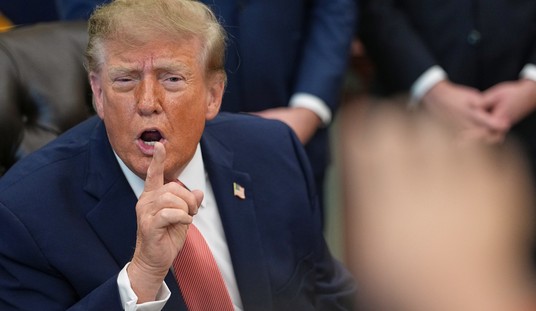
In announcing the tariffs, Trump accused Canada of unfairly discriminating against U.S. automobiles, alcohol and dairy products, escalating tensions with one of the United States’ closest allies.
“In light of trade action threatened by the United States earlier this week, it would be inappropriate to proceed with a celebratory event between the two countries,” said Jenna Ghassabeh, a spokesperson for Canadian Infrastructure Minister Gregor Robertson, in an emailed statement.
The move came after U.S. and Canadian officials reached an agreement earlier this month to open the Gordie Howe International Bridge following delays tied to disagreements between the two countries.
Canada now plans to hold its own ceremony Friday. It is now unclear whether the United States will hold a separate ceremony.
Two U.S. officials who spoke on the condition of anonymity to discuss internal deliberations said they still expect the bridge to open to traffic July 27 but are less certain than they were before.
“We remain committed to opening the bridge on July 27th, and to celebrating this milestone among Canadians on July 24th,” said Ghassabeh.
A trucker hauling auto parts, a family visiting relatives, or a commuter heading to work won't gain anything from separate podiums and bruised pride. They need a crossing that moves traffic safely and quickly.
Read More: The Gordie Howe Bridge Hits a $4.7 Billion Political Tollbooth
The Gordie Howe International Bridge offers six lanes, direct connections between Ontario's Highway 401 and Interstate 75, and modern inspection facilities on both sides of the Detroit River.
Trump's complaint isn't imaginary. His administration says Canada discriminates against American authorities, alcohol, and dairy products. The new 50% tariffs would cover nearly $20 billion in Canadian imports, including wine, cement, clothing, dairy goods, and hockey equipment.
The U.S. Trade Representative's office said that the tariffs would apply to nearly $20 billion of imports from Canada. That's about 5.2% of the $382 billion worth of goods that the U.S. imported from Canada in 2025, according to U.S. Census Bureau data.
"While the Administration continues to secure fair and reciprocal trade deals with our trading partners, Canada, unlike other partners and allies, continues to retaliate against the United States for its efforts to rebalance trade and protect U.S. industry in national-security sensitive sectors," U.S. Trade Representative Jamieson Greer said in a statement.
Canadian Prime Minister Mark Carney said in a statement that his government has made comprehensive proposals to resolve trade disputes with Washington, asserting that Trump's past tariffs violated the North American trade pact.
"This trade dispute has raised costs for families, particularly in the U.S.," he said. "Canada stands ready to engage intensively to address outstanding issues with the U.S. to the mutual benefit of our citizens."
The Trump administration has long complained that Canada and China implemented retaliatory measures in response to the barrage of tariffs Trump has tried to impose since returning to the White House last year.
They're scheduled to take effect August 19, leaving several weeks for negotiations.
Canadian Prime Minister Mark Carney says the tariffs violate the United States-Mexico-Canada Agreement and raise costs for families, yet they remain willing to negotiate. From Carney's office:
This is the latest in a series of unilateral U.S. trade actions that began with the U.S. imposing a series of tariffs in direct violation of the Canada-United States-Mexico Agreement (CUSMA), the free trade agreement between Canada, the United States, and Mexico.
These include tariffs on the Canadian auto sector, in violation of CUSMA. Canada, as is its right, has merely matched those measures.
More broadly, in response to these measures and threats to Canadian sovereignty, provinces, territories, and Canadians from coast to coast to coast have stood together, taking the necessary actions to support our economy and defend our workers, farmers, businesses, and families.
Recognising that the U.S. has been transforming all of its trade relationships, including those covered under CUSMA, over the past 18 months, Canada has made a series of detailed and comprehensive proposals to resolve this dispute and to modernise CUSMA. We stand ready to intensify those discussions in the coming weeks.
Ottawa still decided a shared bridge celebration would be inappropriate, as if refusing to stand beside American officials strengthens Canada's trade position.
Ontario Premier Doug Ford wants Canada to answer tariff for tariff and dollar for dollar. Such language plays well when voters are angry, but retaliation sends the bill elsewhere. Businesses pay more for materials; consumers pay more for finished goods, and workers face uncertainty when orders slow or supply chains shift.
Canada financed the nearly $4.4 billion project and expects to recover the cost through tolls. Construction began in 2018 after years of negotiation involving Canadian officials. Michigan leaders, local communities, and private contractors. The ribbon cutting was already postponed once, on June 12, while the governments worked through outstanding issues.
Thousands of workers spent years building a crossing designed to serve both countries. The Windsor-Detroit corridor handles roughly 7,000 trucks each day and about one-quarter of all trade between Canada and the United States.
Gov. Gretchen Whitmer (D-Mich.) has said the new crossing will speed auto production, lower costs, ease traffic, support agriculture, and create better-paying jobs.
Those benefits have nothing to do with who shares a stage Friday. Trump has every right to press Canada over trade barriers, while Carney has every right to defend Canadian industries and challenge tariffs he believes violate the trade agreement.
Neither government gains anything useful by dragging a bridge ceremony into the fight.
Both governments claim to be protecting their people, yet their actions keep placing those same people in the middle. Truckers, manufacturers, farmers, commuters, and families don't need another symbolic snub; they need leaders who can argue hard, negotiate honestly, and still recognize a shared accomplishment.
The bridge will open, even if the surrounding friendship looks strained. Ordinary people will cross it, pay the tolls, move the goods, and keep both economies running.
Washington and Ottawa should remember who the bridge was built for.