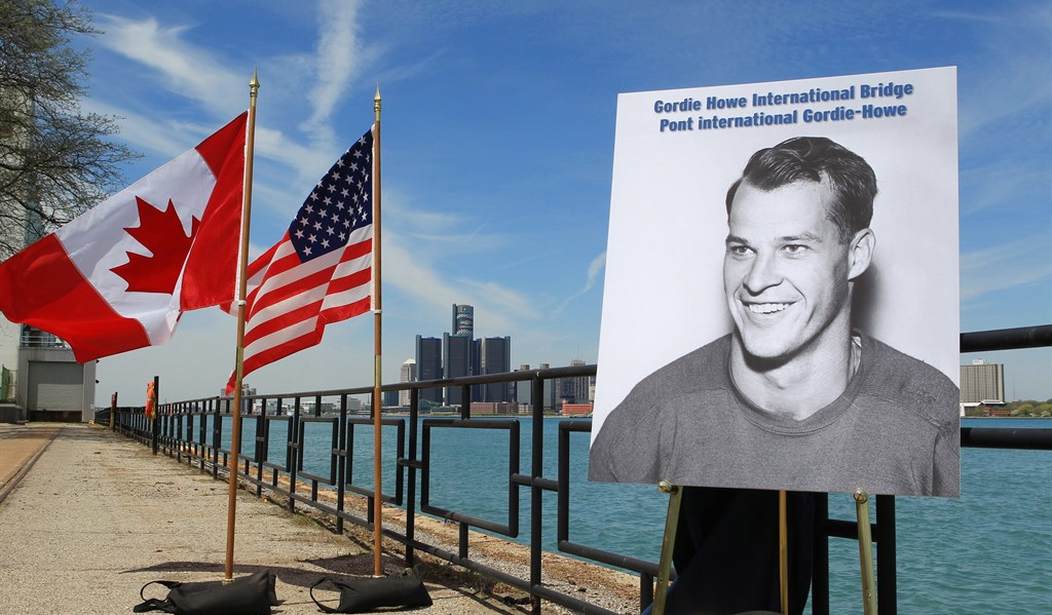
The Gordie Howe International Bridge should be the kind of project both countries brag about. According to the U.S. Department of Transportation, Federal Highway Administration, it connects Detroit and Windsor, adds six lanes over the Detroit River, and gives North America's busiest commercial land border crossing more capacity.
The new Canadian port of entry will be built on a 130-acre site and will be the largest Canadian port on the U.S.-Canadian border. It will include inbound border inspection facilities for both passenger and commercial vehicles, outbound inspection facilities, toll collection facilities, a maintenance facility, and parking. The U.S. port of entry will be developed on a 167-acre site and will be one of the largest border facilities in North America. It will include inbound border inspection facilities for both passenger and commercial vehicles, together with outbound inspection facilities, commercial exit control booths, and parking.
The Michigan interchange with I-75 will include connecting ramps to and from the U.S. port of entry and associated local road improvements. To accommodate the new ramps to the port of entry, modifications will be required along nearly two miles of I-75. They will include over a dozen roadway and pedestrian bridges ranging in length from 100 to 1,700 feet.
The Gordie Howe International Bridge is being developed by the Windsor-Detroit Bridge Authority (WDBA), a not-for-profit Crown corporation created in 2012 that reports to the Canadian Parliament through the Minister of Infrastructure and Communities. WDBA is wholly owned by the Government of Canada but is structured like a private company and operates independently from the government. WDBA is responsible for the delivery of the bridge, as well as construction oversight and the operation of the new crossing. WDBA will set toll rates on the bridge and collect all tolls.
The bridge even includes new ports of entry and a direct connection to I-75. After eight years of construction, the bridge is built, the ports are complete, and the Michigan interchange is finished. Yet the ribbon cutting was canceled, the road remains closed, and the public has no straight answer.
A bridge is a simple idea with hard engineering: move people, goods, trucks, and money from one side to the other. In practice, the Gordie Howe project became a test of patience, diplomacy, contracts, politics, and ego.
The Windsor-Detroit Bridge Authority, a Canadian Crown corporation created in 2012, signed a $5.7 billion Canadian fixed-price contract with Bridging North America on Sept. 28, 2018. The crossing was supposed to be in service by the end of 2024. It's now 2026, and the hard part no longer seems to be concrete, steel, cables, or pavement.
Windsor-Detroit Bridge Authority Interim Chief Executive Officer and Chief Legal Officer Chuck Andary announced on June 11 that Canada and the United States had agreed to delay the opening while “outstanding issues” were resolved. From the Engineering News-Record:
On June 11, the Windsor-Detroit Bridge Authority announced that Canada and the United States had agreed to postpone the opening to resolve unspecified "outstanding issues." Canadian Prime Minister Mark Carney later offered a partial explanation, saying the delay came at the request of the United States.
It is now opening day-plus-12, and neither the bridge authority, U.S. Customs and Border Protection, nor the Department of Homeland Security has publicly explained what those issues are or responded to ENR's request for comment.
That silence matters.
There is, however, an Easter egg buried in a Truth Social post by President Donald Trump from Feb. 9, where he declared he would not allow the bridge to open until the United States was "fully compensated." He asserted that America should own "at least half" of the asset and argued Canada was taking advantage of the United States.
Four months later, on the cusp of commissioning, the opening was postponed by Washington. Whether those events are connected remains unknown since federal officials have declined to explain either way.
Canadian Prime Minister Mark Carney later said Canada agreed to the delay at the request of the United States, while nobody in Washington has clearly explained what those issues are.
For a project built to move trade faster, the silence has become its own traffic jam.
The politics are impossible to miss. President Donald Trump threatened in February to block the bridge unless the United States was “fully compensated.” He also argued the United States should own at least half of the project.
Canadian officials pushed back by pointing to the project's long-standing structure: Canada funded the project, Canada expects to recover money through tolls, and ownership is shared between Canada and Michigan under the 2012 crossing agreement. From the Associated Press:
A new Canadian-built bridge across the Detroit River that U.S. President Donald Trump has threatened to block may take longer to open than anticipated, Canadian Prime Minister Mark Carney said Wednesday.
“Look, everyone’s working hard to make sure the bridge is open as soon as possible. There is no big drama. If it takes a little longer it will take a little bit longer, but this will benefit Canadians, Americans, business, tourists, residents for decades and decades to come,” Carney said on his way into Parliament.
A ribbon-cutting ceremony for the Gordie Howe International Bridge, jointly owned by Canada and the U.S. state of Michigan, is set to take place on Friday, while the bridge itself may not open to traffic immediately.
Carney said Tuesday that the second bridge between Windsor and Detroit would “be open at the end of the week.”
Friday’s ceremony will take place following a recent conversation between Michigan Gov. Gretchen Whitmer and White House Chief of Staff Susie Wiles, according to a person familiar with the matter who spoke on condition of anonymity to discuss private talks.
The bridge, which connects Windsor, Ontario, and Detroit, would be a vital economic artery between Canada and the United States. It is named after the late Canadian hockey great who spent 25 seasons with the Detroit Red Wings.
The building project was negotiated by Rick Snyder, the former Republican governor of Michigan, and paid for by Canada to help ease congestion at the existing Ambassador Bridge and Detroit-Windsor tunnel. Work has been underway since 2018.
Trump threatened the bridge as the United States-Mexico-Canada trade agreement is up for review this year, and Trump has been taking a hard-line position before those talks, including by issuing new tariff threats.
Trump's argument has a populist edge because Americans have grown tired of deals that seem to leave Washington holding the bill. In this case, though, the record is awkward for the White House.
Remember, Canada paid for construction, the U.S. port of entry, the Michigan interchange, and needed land acquisition in Michigan. The bridge also uses both Canadian and American labor and materials tied to both countries.
If Washington has a legitimate grievance, it's time to put the facts on the table.
None of this makes Canada pure or Washington villainous. Trade disputes are real, border policy is real, and so is the need to protect American workers and American leverage.
Yet leverage loses force when the reason for using it stays hidden. A completed bridge serving Detroit, Windsor, Michigan, Ontario, and cross-border commerce shouldn't sit idle because officials would rather posture than explain.
Former Michigan Gov. Rick Snyder, a Republican, helped negotiate the project years ago because the region needed another crossing besides the Ambassador Bridge and Detroit-Windsor Tunnel, while current Michigan Gov. Gretchen Whitmer supports getting it open.
Carney says the issue will be settled; the bridge authority says the project will help traffic, border processing, and commercial movement. All of those claims point in the same direction, which makes the delay look smaller in substance and larger in politics. From the Engineering News-Record:
Major infrastructure projects depend on trust that government commitments will survive changes in political leadership. The Gateway Hudson River Tunnel project raised similar concerns when a federal funding suspension introduced uncertainty into a project whose financing and approvals its sponsors believed were long settled.
Gateway officials said the interruption cost “millions of dollars” in site-maintenance expenses, delayed contract awards and disrupted production schedules. The lesson was straightforward: uncertainty carries a price tag.
More vexing, Gateway involved a project moving toward construction. Gordie Howe is complete.
The projects are different, but the concern is the same. Infrastructure investment depends on confidence that governments will act consistently, transparently and in accordance with established commitments. When officials reopen settled questions—or refuse to explain their decisions—that confidence atrophies.
The Gordie Howe bridge may open tomorrow. It may open next month. The explanation may ultimately prove routine.
But until federal officials explain why a completed bridge sits unused, the real story is not the delay, but the absence of a reason.
The Gordie Howe Bridge is named after a man Detroit and Canada both honored; he played hard, kept going, and made a living by crossing lines without losing sight of the goal.
The bridge carrying his name deserves better than a bureaucratic shrug and a political fog bank. If there's a technical problem, say so; if there's a security issue, explain what can be explained; if the problem is leverage, then own the fight.
The public can handle the truth. Truckers, manufacturers, border workers, and families can handle the truth. What they shouldn't have to handle is a finished $4.7 billion bridge acting like a hostage in a trade argument no one wants to spell out.