





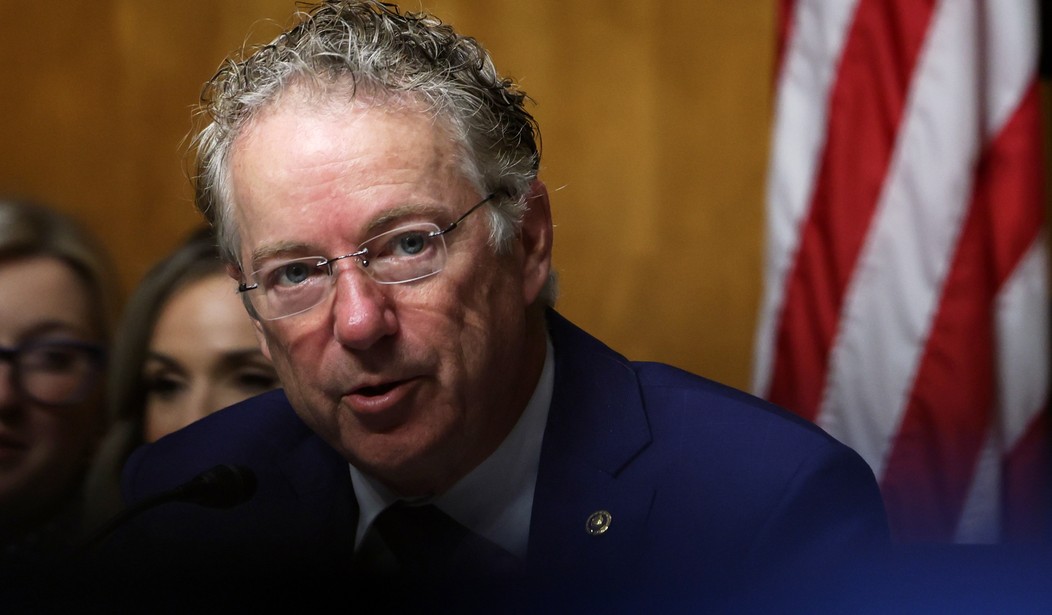
Sen. Bernie Moreno (R-Ohio) looked across the Senate dais and saw empty chairs. When he asked whether a Democrat should question the witnesses next, Senate Homeland Security and Governmental Affairs Committee Chairman Rand Paul (R-Ky.) replied, “If there were a Democrat here, yes.”
Only ONE Democrat Senator showed up to a Senate hearing on exposing fraud in America.
— RNC Research (@RNCResearch) July 15, 2026
MORENO: “Chairman wouldn’t a Democrat go next since a Republican just testified?"
PAUL: “If there were a Democrat here, yes.”
Shouldn't Democrats want to protect American taxpayers? pic.twitter.com/de0tED5elq
Only one of the committee's eight Democrats appeared during the July 15 hearing. By Moreno's turn, none remained.
Most Democrats couldn't make it to our hearing on government fraud. The empty chairs made their priorities pretty clear.
— Senator Rand Paul (@SenRandPaul) July 15, 2026
Hard to claim you're fighting waste when you don't even show up. pic.twitter.com/eTrVHpl0cH
The hearing was called “Exposing Fraud in America.” Witnesses Nick Shirley, James O'Keefe, and Dylan Hedtler-Gaudette testified about theft from public programs, weak oversight, and fraud involving voter registrations and ballot petitions. Seven Democratic committee members found somewhere else to be.
Senator @berniemoreno SLAMS Democrats for avoiding a Senate hearing on exposing fraud in America:
— RNC Research (@RNCResearch) July 15, 2026
"Literally the entire Democrat dais is empty…there is an entire party that does not care whether taxpayer money is burnt.” pic.twitter.com/en6lK6OAfs
O'Keefe described 28 recorded exchanges in Los Angeles involving petition circulators offering money, drugs, or other goods for signatures. One recording showed Brenda Brown Armstrong paying $2 for a voter registration. From O'Keefe's statement:
I later personally visited Brenda Brown Armstrong at her apartment in Marina Del Ray, where she voluntarily showed me completed petition packets and copies of voter registration forms she had collected.
The investigation ultimately contributed to a federal criminal prosecution. First Assistant U.S. Attorney Bill Essayli said, “Once we saw these videos, we went to work.”
And then came the irony: in a neighborhood full of organizations supposedly there to protect the vulnerable, the person being confronted by the organization was not the fraudster — it was the reporter exposing the fraud.
Just minutes after we caught these felonies on camera, I was approached by a man who identified himself as being with the Los Angeles Police Department — and he began to record me. When I pressed him, soon afterward, he admitted he was actually with the Los Angeles Homeless Services Authority. Under California Penal Code section 538d - impersonating a law enforcement officer is illegal. So, this is also a form of fraud, covering for the fraud happening across the street.
Federal prosecutors later charged Armstrong with paying someone to register and said she had agreed to plead guilty.
Today, I testified before the U.S. Senate at the “Exposing Fraud in America” hearing.
— James O'Keefe (@JamesOKeefeIII) July 15, 2026
I shared what OMG exposed on hidden camera: petition circulators paying homeless individuals cash and offering drugs in exchange for voter registrations and ballot petition signatures, forged… pic.twitter.com/8Fmw4weu6S
The hearing didn't establish that a federal election result had changed. The verified conduct was damaging enough: paid registrations, forged petition signatures using real voters' names and addresses, and homeless people treated as tools in a cash operation.
Fraud doesn't become harmless because someone failed to carry it all the way to a stolen election.
Election abuse was only part of the record. Federal prosecutors recently charged 15 defendants in Minnesota schemes involving more than $90 million in intended losses.
One Medicaid autism case involved $46.6 million in alleged fraud, including claims for services that weren't provided and kickbacks used to attract families.
Money stolen from public programs comes from people who work, pay taxes, and obey the law. It also leaves less help for children, elderly people, and families facing real need.
Democrats call themselves champions of the common man, but most couldn't spend a morning hearing how his money and vote can be exploited.
Their election record deepens the concern. In March, every Democratic senator voted against cloture on an amendment requiring photo identification for federal voting. Democratic senators have also attacked the SAVE America Act, which includes proof-of-citizenship requirements, as voter suppression.
Nobody needs to claim millions of illegal votes to support basic verification. Citizenship determines eligibility in federal elections, and identification helps confirm that the person casting a ballot is the registered voter.
When a party resists both protections, then skips evidence of paid registrations and forged signatures, suspicion naturally follows.
The political message becomes hard to miss. Illegal immigrants receive constant advocacy from Democratic leaders, while American citizens asking for secure voter rolls are treated as though they're attacking democracy.
A party can't keep placing noncitizens at the center of its moral concern while waving away the citizens who fund government and choose its leaders.
Ranking Member Gary Peters (D-Mich.) submitted a statement discussing fraud, then devoted much of it to President Donald Trump, inspectors general, DOGE, pardons, and the Trump family. His response captured the broader habit: redirect the subject toward Trump whenever the evidence becomes politically uncomfortable.
Fraud crosses all party lines, yet Democratic leaders still answer it with a familiar pattern: resist safeguards, attack investigators, redirect blame, or leave the room.
The July 15 hearing became a small picture of a much bigger problem.
The empty seats didn't prove criminal guilt; they revealed political priorities. A party that claims to speak for working Americans should defend their tax dollars, their legal status as citizens, and the integrity of their ballots.
At a minimum, its senators should maybe stay in the room.
Fraud survives when powerful institutions expect people to stop asking questions. Join PJ Media VIP and save 60% with promo code FIGHT while supporting independent commentary that follows the evidence wherever it leads.


Join the Conversation
VIP members get the ability to comment on articles.