





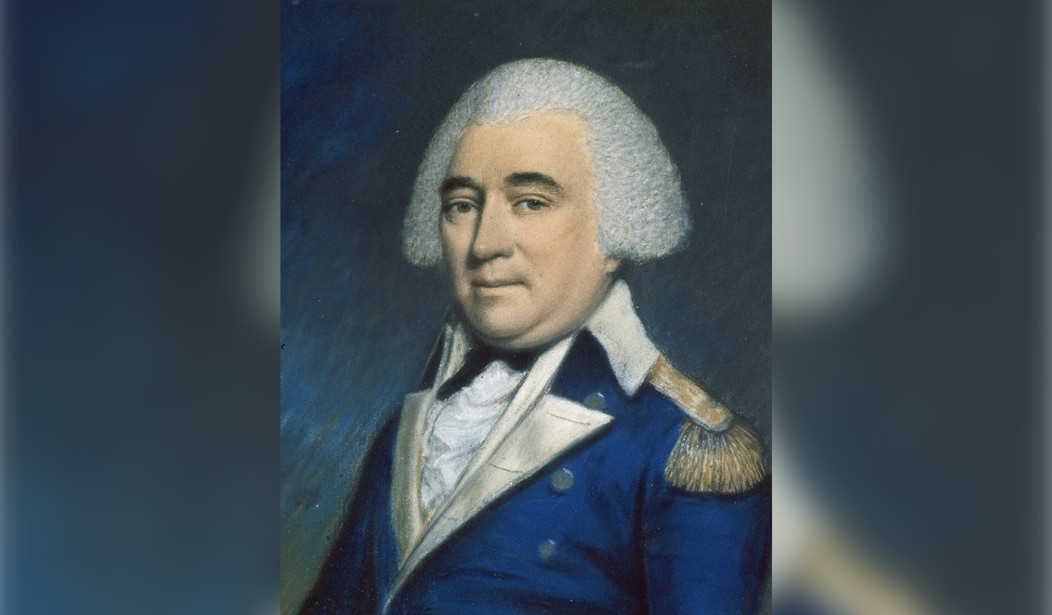
On the night of July 15-16, 1779, Gen. George Washington sent “Mad Anthony” Wayne and his men on a mission to take a British fort, a mission that the British thought suicidal and that many of the Americans involved were almost certain would end in their deaths. And yet the Americans attacked the fort anyway, winning an amazing victory and earning themselves lasting fame.
Gen. Anthony Wayne had been in charge of the Americans whom the British surprised and butchered at the Paoli massacre, and he was so disturbed by the bloody event that he requested his own court martial. Cleared of any guilt, Wayne went on to distinguish himself at Monmouth, and in 1779 began to press Washington to let him take Stony Point, a strategic part of the British Hudson defenses. Over at West Point, now the location of the U.S. Military Academy, the Americans knew they needed a win. Wayne would deliver that win, and his men would display such courage and daring that Wayne praised them as “men who are determined to be free.”
Experienced British Lt. Col. Henry Johnson with a force of 564 men — including Loyalist colonials and many seasoned veterans — was in charge of the Stony Point fortifications, which earned the nickname “Little Gibraltar” from apparent impregnability, according to The Army Historical Foundation. Allan McLane, a daring young Patriot, managed to gain access to the fort, and his report was daunting. Firstly, nature had fortified the point with a steep and rocky peninsula with a height of 150 feet. At high tide, the marsh surrounding it flooded and cut it off from the New York mainland. The British had first cut down trees to give themselves a more open line for firing on potential attackers, and then used the logs to build two abatis lines (a type of defensive barrier in front of their breastworks). There were three artillery emplacements and a total of fifteen large guns. To top it off, there were two British ships guarding the surrounding waters. One British officer who spoke with McLane at the fort sneered, "If Gen. Washington ... should ever have the presumption to attempt [an attack], he will come to rue his rashness, for this post is the Gibraltar of America, and defended by British valor, must be deemed impregnable." McLane did not say it out loud, but he disagreed — he thought there were a few minor weaknesses that could make the fort's capture attainable.
The British must have thought only a madman would attack Stony Point, but Wayne didn’t earn the nickname of "Mad Anthony" for nothing. Washington was frustrated at British raids destroying Connecticut towns and looking for a decisive action, so Wayne carried his point. Historian Tara Ross says that Washington himself drew up the initial plan for attacking, aiming to exploit the flaws in the formidable fortifications, and planning the attack for nighttime. This would give the British less visibility for accurate firing, but also hamper the Americans. So great was Washington's confidence in Wayne that the commander-in-chief assured Wayne he could alter the original plan "in every instance where you think they may be improved or changed for the better." It was not the least of Washington's geniuses in war that instead of autocratically commanding every detail, he could identify talented men and allow them free rein for their talents.
Wayne and Washington were so concerned about the plan leaking that even the men who went on the expedition did not know about their mission until it was unavoidable, according to Ross. Washington had asked the men to carry unloaded muskets, as marching on rough terrain in the dark could cause an accidental misfire, so the men were to launch the attack with bayonets. There's a rumor that the Americans shot some local dogs to prevent barking, but Ross says this is unsubstantiated and quite possibly false. Wayne did send patrols to detain civilians on the road. Because the night would be so dark, without any of the electric lights that now illumine New York, Washington told the Americans to wear white feathers or cockades in their hats "or some other visible badge of distinction" so there would be no friendly fire incidents. The Americans reportedly used white paper.
For Our VIPs: The Hamilton-Burr Duel, and How Corrupt Men Exploit Nobility to Destroy People and Nations
Some of the Americans who knew about the attack enough in advance to write letters drew up their wills. Among them was Wayne, who wrote his friend, "I know that friendship will induce you to attend to the education of my little son and daughter. I fear their tender mother will not survive this stroke," i.e., his possible death. By morning of the next day, Wayne expected to breakfast "within the enemy's lines in triumph, or in another world."
Wayne was to lead the main column against Stony Point's southern flank, while Richard Butler and Hardy Murfree were to hit the north and center, with three waves of attacks, according to The Army Historical Foundation. Wayne's orders were, "If any soldier presumes to take his musket from his shoulder, or to fire or begin the battle until ordered by his proper officer he shall be instantly put to death by the officer next to him; for the misconduct of one man is not to put the whole troops in danger or disorder, and be suffered to pass with life … The General has the fullest confidence in the bravery and fortitude of the corps that he has the happiness to command.” As extra incentive, per The Army Historical Foundation, the first man to enter the fort would receive a promotion and $500 (worth $13,000 today) while the men right behind him would receive lower bounties.
As they neared the first line of abatis, pickets from the 71st Regiment detected the approach of either Murfree’s or Butler’s men near the northern neck of the peninsula and fired several shots in their direction. The dark, windy night, however, played to the Continental’s advantage. The lieutenant in charge of the pickets dismissed the attack as “wind rustling amongst the bushes.” Moments later, Murfree’s column began its diversionary attack, opening fire on the British center. The gunners in the southernmost battery in the outer works quickly responded by firing their 12-pounder cannon at the causeway crossing the swamp, which they had been ordered to do as a means of sounding the alarm in case of an enemy attack. The bright flashes of cannon fire revealed Wayne’s column advancing on Stony Point’s southern flank. The cannon, being confined to an embrasure, could not be turned on Wayne’s men, but the defenders did begin to fire upon them with their muskets. Despite this fire, Wayne’s men continued their advance. Wading around the first abatis, the forlorn hope [advance group] under Lieutenant George Knox dashed up the slope and began hacking a path through the second abatis. Meanwhile Butler’s column, attacking from the north was taking heavy casualties. As its forlorn hope under Lieutenant James Gibbon was clearing the first line of abatis, the defenders blasted away at them with a 3-pounder cannon and musket fire. Undeterred, Butler’s column continued up the northern slope and rushed toward a gap the British had left in the second line of abatis. This gap was on a rocky area of the slope, known as the precipice, which the British thought was too difficult for an attacking force to navigate. Butler’s column proved them wrong.
Wayne's column broke through both lines of abatis, though Wayne received a bullet wound to the head. Undeterred, "Mad Anthony" roared, "Forward, my brave fellows, forward! Carry me into the fort. If I am to die, I want to die at the head of my column!" His men refused to move him with blood gushing from his head, but they did surge forward under his directions. Frenchman Lt. Col. Francois de Fleury became the first in the American force to enter the fort, and he seized the British flag. "The fort's our own!" cheered the Americans wildly.
In fact, the British defenders continued to fight hand-to-hand for some 15 minutes, but the British soon acknowledged the inevitable and laid down their arms. Despite the recent vicious British raids on Connecticut civilians, Wayne and his men did not kill any Brits who asked for quarter. Wayne later praised the "humanity of our brave soldiery, who scorned to take the lives of a vanquished foe calling for mercy". It was especially noble given the Brits' Paoli massacre which Wayne had witnessed. British Commodore George Collier grudgingly admitted, "The Rebels [Americans] had made the attack with a bravery they had never before exhibited, and they showed at this moment a generosity and clemency which during the course of the rebellion had no parallel." The Americans proved again they had the moral high ground over the British.
Wayne wrote Washington with the glad tidings, and Washington arrived the next day to deliver his personal congratulations. I think it is appropriate to end on Wayne’s message: “Dear Gen’l: The fort and Garrison with Col. Johnson are ours. Our officers and men behaved like men who are determined to be free.”
Editor’s Note: Every single day, especially in this 250th year of America’s existence, here at PJ Media, we will stand up and FIGHT, FIGHT, FIGHT against the radical left and deliver the conservative reporting our readers deserve.
Help us continue to tell the truth about the Trump administration and its successes. Join PJ Media VIP and use promo code FIGHT to receive 60% off your membership.


Join the Conversation
VIP members get the ability to comment on articles.