





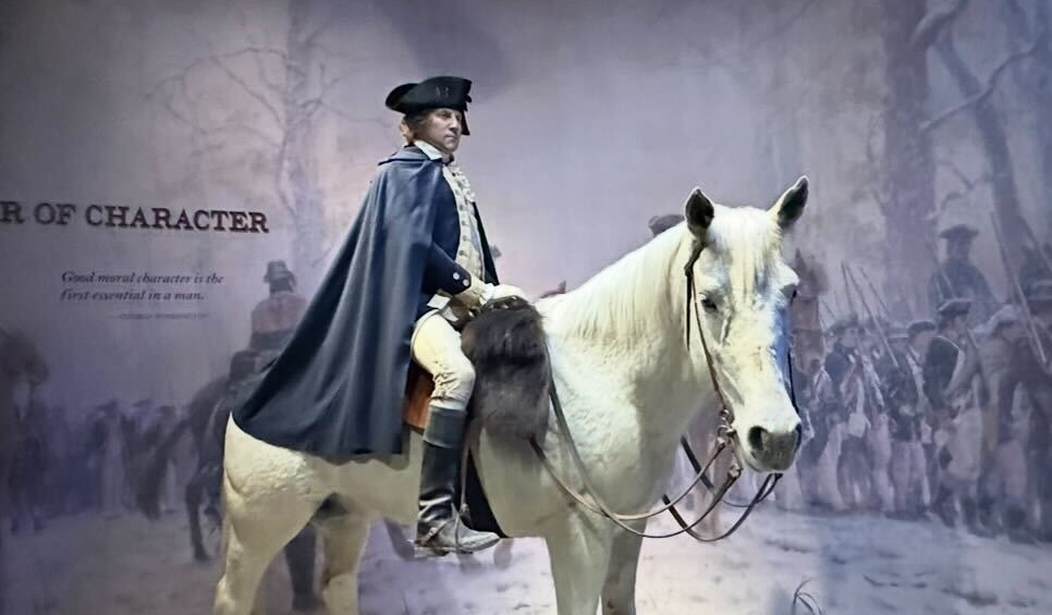
Today (June 28) is the anniversary of the 1778 Battle of Monmouth, a battle which displayed both the worst and the best of the Revolutionary Army's leadership. As we are only a few days away from America's 250th birthday, it's the perfect time to investigate and celebrate the split-second decisions on which U.S. independence depended.
It is sometimes too easy in retrospect to look back on the America Revolution through the lens of the success with which it ended, and imagine that after some initial difficulties there were a long series of victories with our independence practically guaranteed. Yet throughout almost a decade of conflict with the British, time and again American independence was one officer's decision or one battle's outcome away from death. And other times, even if a single battle loss wouldn't have killed the cause, it still could tip the balance of initiative from one side to the other in a significant way. Monmouth was not a major battlefield victory for the Americans, but it illustrated how vital a single man could be, and was, to the cause.
Following on a harsh winter, the American Army needed to take on the British and secure a win. Nathanael Greene, who would go on to lead one wing of the Patriot troops at the Battle of Monmouth, opined to Washington, "If we suffer the enemy to pass through the Jerseys without attempting anything upon them, I think we shall ever regret it… People expect something from us & our strength demands it."
Gen. Charles Lee has more than one failure on his record, partly because he had a most alarming weakness toward cowardice and indecision that prove fatal in a commanding officer. But Lee was still George Washington's second-in-command on the June 1778 day when Washington sent Lee and his troops to launch an attack from behind on Sir Henry Clinton's British soldiers. Lee was essentially leading the first wave of the attack as Washington marshaled his other forces to march from the Valley Forge winter encampment.
Related: Emily Geiger and Charity Ferris: Patriot Women of the Revolution
After a series of tactically foolish moves, Lee suddenly decided in the middle of the battle with Clinton's men that he and the Americans should retreat back to Valley Forge. His erratic and fearful example panicked the Americans who were all too soon in ignominious and disorderly retreat. It was during this embarrassing retreat that Washington arrived with reinforcements.
Multiple sources testify to the fact that George Washington, a man of naturally hot temper, was generally speaking proud of exercising great control over his speech and expecting his officers to do the same. At Monmouth, in a shattering exception, Washington let loose his full wrath on Lee for what could have been a fatal defeat for the Continental Army. Washington, who was unusually tall and broad for the era, and mounted on a striking white horse, dashed straight up to Lee in a thunderous rage. Gen. Charles Scott recalled with awe that the outraged tongue-lashing which Washington gave Lee practically caused the leaves on the trees to shake.
But Washington didn't waste too much time cursing Lee's incompetence. The commander-in-chief, who always preferred to lead from the front, galloped through the ranks of the retreating Americans, rallying the troops and turning the retreat into an assault. The heat of the summer day was intense, the fighting was desperate, but the looming American defeat turned into a draw. That night, the British rushed off under cover of darkness, leaving the Americans holding the battlefield.
Related: Samuel Fletcher, the Teen Union Soldier Who Survived Against All Odds
Other individuals showed exceptional courage that day that has gone down in history. Henry Knox and his artillery men used their guns to good advantage. Brig. Gen. Anthony Wayne and 400 Americans ended the battle by marching toward the British and ensuring the latter would retreat. A woman whose real name was probably either Mary Ludwig Hays or Margaret Corbin, but whose monument at West Point uses her famous nickname of "Molly Pitcher," took over firing her husband's cannon after he passed out from the heat.
As we celebrate 250 years of American independence, we recognize that George Washington was the indispensable man in the Revolution. And yet we can also recognize that Washington needed an Army, and that every man and woman who contributed to the victory at Monmouth and other battlefield wins — whether they're famous like Molly Pitcher and Anthony Wayne or not — was also necessary to securing independence.
Editor’s Note: Every single day, especially in this 250th year of America’s existence, and just before this historic July 4, here at PJ Media, we will stand up and FIGHT, FIGHT, FIGHT against the radical left and deliver the conservative reporting our readers deserve.
Help us continue to tell the truth about the Trump administration and its successes. Join PJ Media VIP and use promo code FIGHT to receive 60% off your membership.
Join the Conversation
VIP members get the ability to comment on articles.