





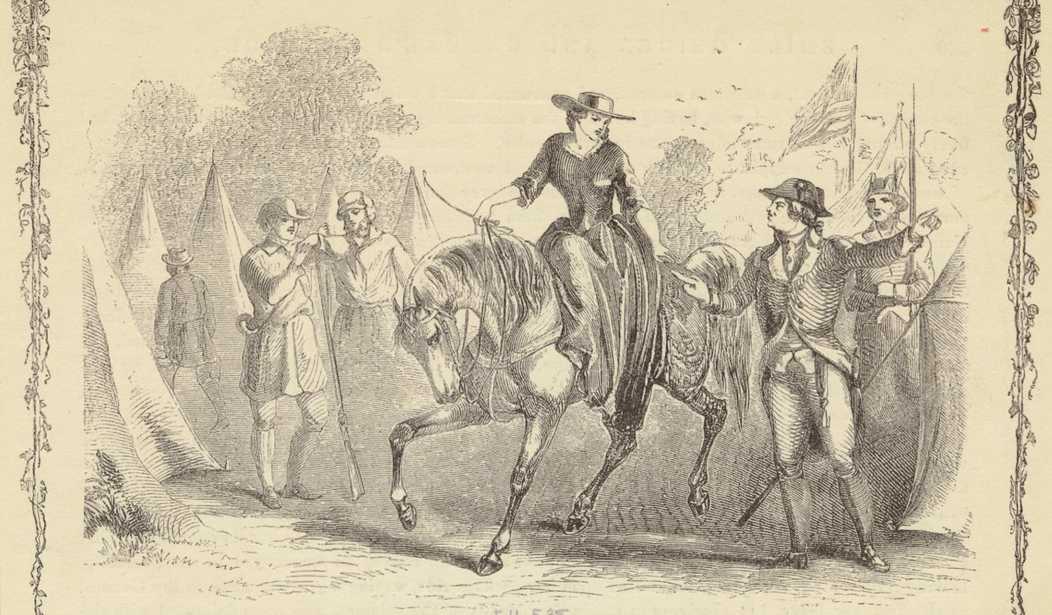
Emily Geiger and Charity Ferris did not take up arms and serve in the Continental Army, but they did put their lives at risk to support the cause for independence.
Americans should rediscover the great men of our history. But that also includes reading the stories of men and women who did not receive famous monuments or holidays, though they did contribute in some small but essential way to American independence. Among these little-known Patriots are Emily Geiger (pictured above) and Charity Ferris.
In his book The Indispensables, historian Patrick K. O’Donnell describes the Oct. 1776 Battle of Throgs Neck, New York, arguing it was a key battle that helped save the Revolutionary army, even if it is little remembered. The Americans were fighting for the very survival of their cause, while the British were in a hurry to crush this upstart rebellion. O'Donnell explains:
The British landed near the estate of James and Charity Ferris, who owned a mansion at the tip of the peninsula. James had fought for the Patriots, and the British captured him and sent him to Sugar House Prison in New York, where he would spend the next five years. His wife, Charity, also strongly supported the cause of the Revolution, and this intrepid, unsung heroine would play a minor role in the battle.
Before invading, the British ships commenced naval gunfire support against Throgs Neck. According to legend, Mrs. Ferris bravely walked back and forth on her veranda during the attack until the Royal Navy, perhaps not wanting to kill a civilian woman, ceased fire.
The British might have stopped firing, but Mrs. Ferris had made herself a target. When the British disembarked, the officers occupied the mansion. Mrs. Ferris sent her daughters and a slave woman secretly to safety but refused to vacate her home. While cooking for the Redcoats, she reportedly listened to their conversations, urged a servant to memorize any important intelligence he heard also, and sent their combined gleanings to Gen. George Washington.
The risky efforts of Mrs. Ferris and her servant paid off. British Gen. Howe made multiple unsuccessful attempts to “traverse the bottleneck” the Patriots had created. But ultimately, he had perforce to change his plans. “The Americans halted an amphibious landing—an exceptionally rare occurrence in history," O'Donnell declared proudly.
For our VIPs: Juneteenth, Andrew Johnson, and Democrats Who Rewrite History
As for Emily Geiger, the Facebook account Wonders Untold shares a photo of Geiger's memorial and states that patriotic South Carolinians still honor her, even though (per the post) she is little known outside the area where she lived. Like Sybil Ludington and Paul Revere, Geiger dashed through the night and dangerous enemy territory to deliver an important message, in this case from Gen. Nathanael Greene. Untold Wonders indicated it was important that a girl or woman take the message, apparently because the British would have been more suspicious of any male rider. Judge William D. James, in his 19th-century account, claimed instead that Greene "could find no man in that part of the State who was bold enough to undertake so dangerous a mission."
Whatever the reason, teenager Emily Geiger took the message instead. Greene wanted his nearby Patriot allies, particularly Gen. Sumter and his men, to join him in fighting British commander Lord Rawdon. There are slightly conflicting accounts about the details of Geiger's ride. Author Lyman C. Draper, for instance, who attributed his account to a Maj. Theodore Starke, wrote that another teenager, Rebecca Starke (aunt of the major), accompanied Geiger and ended up imprisoned with her in British custody. The two girls ripped their message from Greene in two, but Rebecca could not bring herself to swallow one half, so Emily supposedly exclaimed, "Blast your dainty stomach, Rebecca Starke; give it to me, & I’ll eat it," before consuming the entire note herself.
The different accounts seem to agree on the fact that Emily did certainly eat the message. James recounted that a Tory (Loyalist) matron and her daughter searched Emily thoroughly, but found nothing, leading the British to allow Emily to be on her way. The young Patriot had memorized the message and was able to deliver it. Sumter did join Greene, though a little later than originally hoped. It is not clear what happened to Emily Geiger after the Revolution, as several sources suggest different men's names as her husband's, and her death is only tentatively placed around 1825. But despite the obscurity of her later life, Geiger's early service to her country gave her lasting fame in South Carolina.
Countless Patriots like Geiger and Ferris made American independence possible 250 years ago.
Editor’s Note: Every single day, especially in this 250th year of America’s existence, here at PJ Media, we will stand up and FIGHT, FIGHT, FIGHT against the radical left and deliver the conservative reporting our readers deserve.
Help us continue to tell the truth about the Trump administration and its successes. Join PJ Media VIP and use promo code FIGHT to receive 60% off your membership.



Join the Conversation
VIP members get the ability to comment on articles.