


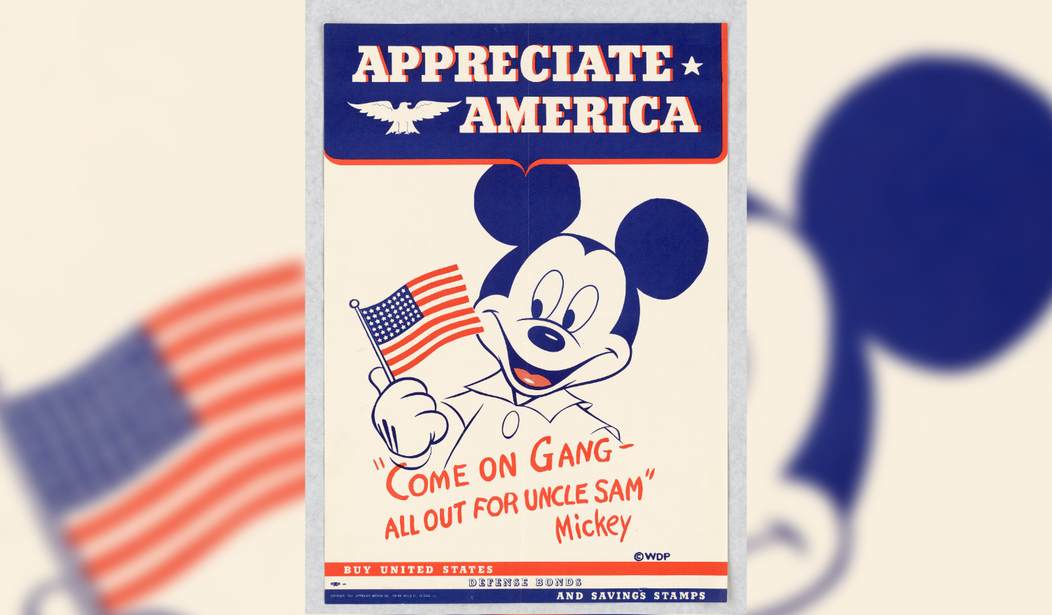
On Nov. 18, 1928, the first ever sound cartoon introduced a new character to American audiences: Mickey Mouse. Already by the 1940s, Walt Disney’s Mickey and other animated characters were so tremendously popular that the government commandeered Disney Studios and characters for the war effort.
Walt Disney was an ardent patriot. He once said, “Actually, if you could see close in my eyes, the American flag is waving in both of them, and up my spine is growing this red, white, and blue stripe.” When he was still a teenager, he tried to run away and enlist in the military during WWI, before his mother stopped him. He did alter his birth year on his passport application so that he could join the Red Cross Ambulance Corps in France and he was always very proud of having assisted the war effort. When the second global conflict loomed, Walt was ready to do his part again, and he enlisted Mickey and friends to help.
Posters, gear, training films, and patriotic cartoons all featured Walt's animated cast. "From the quick-tempered Donald Duck to the loveable Dumbo, Walt Disney Productions created some 1,200 designs during World War II. Such recognizable characters were used for aircraft nose art, flight jacket patches, pins and other memorabilia for American and allied military units," says the Department of War. Donald Duck was the most requested mascot from soldiers at over 200 unit design requests, and Pluto was second at 45, but Mickey featured in 37 unit designs. And in the government commercial below, you can spot Mickey pictured in uniform.Happy birthday, Mickey Mouse! Walt Disney provided over a thousand unit designs and numerous poster and postcard designs during World War II (credit: Cartoon Research) https://t.co/kORF6U8eRB
— Catherine Salgado (@CatSalgado32) November 18, 2026
The little mouse went to war. Just as Adolf Hitler censored Mickey Mouse cartoons in Germany, Americans adopted him as a mascot.
In fact, Mickey was so iconically American that a group of Navy officers used "Mickey Mouse" as their password when going into an invasion briefing for the famous D-Day operation.
Related: Veterans Day: Disney's Voice of Bambi Became a Three-Time Purple Heart-Winning Marine
Happy birthday, Mickey Mouse! Disney provided unit designs and numerous poster and postcard designs during World War II (credit: Cartoon Research) https://t.co/0eAeCcEkET
— Catherine Salgado (@CatSalgado32) November 18, 2026
Some people will point to the fact that the government essentially seized Walt’s studios as proof that there wasn’t anything particularly special about what Walt did. But that isn’t true. Military and veteran publication We Are the Mighty explained that all of the war projects from Disney Studios during World War II were done at cost, meaning that Walt didn’t expect or receive profits from them.
The young man who had wanted to run away to join the military during World War I was now a studio executive trying to make his own sacrifice to support the boys overseas. And, of course, the studio put a great deal of time and effort into the specialized unit designs.
From We Are the Mighty:
Immediately after the Japanese sneak attack on Pearl Harbor, Disney and the Government began talks on how the Mouse can defend the homeland. The U.S. Army subsequently commandeered Walt Disney Studios for their use, but rooms were not the only resource Disney could offer the troops. The government assigned Walt Disney himself a very important task; to create military training films. Disney Studios aided the war effort by enlisting Mickey Mouse and several other prominent role players. Several military training films were aired by Disney in the early 1940s, providing education concerning the war to millions of Americans. Disney, along with other government initiatives, educated and invigorated Americans to promote the war effort. Museum exhibits show a series of posters aimed at teaching children the value of preserving stamps for war bonds… In addition, protective masks were issued to the residents of Hawaii after the attack. Children’s protective masks were specially made with an image of Mickey Mouse to make them more appealing.
As Mickey Mouse turns 98 during America's 250th year, we remember that not only did Walt and Mickey completely transform American entertainment starting with “Steamboat Willie,” but they were among the most enthusiastic patriots during the fight against Nazism, fascism, and genocidal imperialism.
MICKEY MOUSE WAS BORN FROM WALT DISNEY'S WORST BUSINESS SETBACK 98 years ago today, on Nov. 18, 1928, "Steamboat Willie" premiered in New York, marking Mickey Mouse's official public debut. But Mickey was born out of a business disaster. Earlier that year, Walt Disney traveled to New York to negotiate a new contract for Oswald the Lucky Rabbit, his first major animated character. Instead, his distributor, Charles Mintz, wanted to pay him less and had already recruited most of his animators. Worse, Disney discovered that Universal owned the rights to Oswald. He returned to California without his most successful character and with much of his animation team gone. Disney later recalled coming up with a new character, a mouse, on the train ride home. Animator Ub Iwerks developed the design, while Walt's wife, Lillian, suggested the name Mickey instead of Mortimer. But success didn't come immediately. The first two Mickey cartoons, "Plane Crazy" and "The Gallopin' Gaucho," were silent and failed to secure distribution. So Disney took another gamble. Inspired by the arrival of talking pictures, he made a third cartoon with synchronized sound and even supplied Mickey's squeaks himself. That cartoon was "Steamboat Willie." It premiered at the Colony Theatre on Broadway, which was leased by Universal, the very studio that owned Oswald. The audience loved it. Mickey became a hit, and the struggling Disney studio finally had its breakthrough. The story has an even stranger ending. Disney didn't regain the rights to Oswald until 2006, when NBCUniversal transferred the character to Disney as part of a deal allowing sportscaster Al Michaels to leave ESPN/ABC for NBC. And in 2024, the original "Steamboat Willie" entered the U.S. public domain. Today, Disney is worth roughly $205 billion. All because Walt lost a character he didn't own and created another one he made sure he did.
— WOLF (@WOLF_Financial) November 18, 2026
Editor’s Note: Every single day, here at PJ Media, even after a discouraging midterm election, we stand up and FIGHT, FIGHT, FIGHT against the radical left, and deliver the conservative reporting our readers deserve. Help us continue to tell the truth about our great nation and how to save it. Join PJ Media VIP and use promo code FIGHT to receive 60% off your membership.
Join the Conversation
VIP members get the ability to comment on articles.