





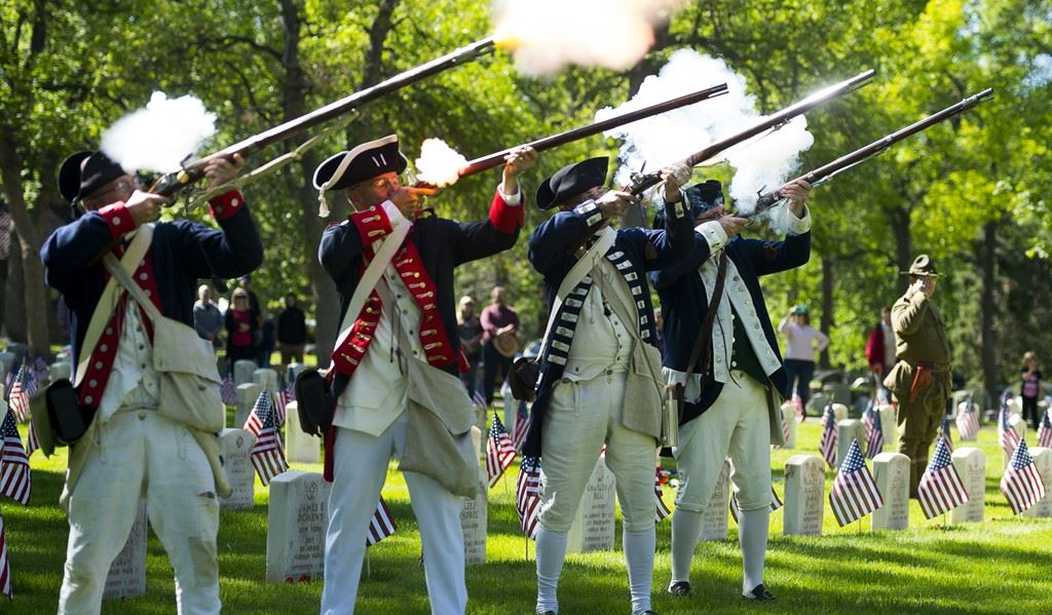
John Callender's commanding officers cashiered him in disgrace out of the Revolutionary Army. He had abandoned his post, helped spread panic among his men, and left his fellow Americans to die. But that court-martial and dishonorable discharge were not the end of Callender's story. He would go down in history for extraordinary courage in the midst of battle.
Very few Americans have heard of John Callender, but ahead of America’s 250th birthday, it behooves us to remember not only the famous heroes who led the Revolution and our nascent Republic’s government, but some of the many “ordinary” soldiers and civilians who contributed to independence. And when we do, we find them not ordinary at all.
Capt. John Callender’s company had been at the Battle of Bunker’s Hill in 1776. He was commanding a group of artillery and had his guns trained on the British when the battle became heated, and he and his men panicked. They abandoned their position and their fellow American soldiers. While a number of men were dangerously cowardly that day, Capt. Callender ended up taking all the official blame.
New commander-in-chief George Washington inaugurated his command by overseeing Callendar’s court-martial and determining his punishment. Washington aimed, not unreasonably, to use the case as a setting for a standard of discipline in the Army, as it was composed largely of volunteers and raw recruits. Washington didn’t order Callender executed, which would have been an extreme but possible punishment, but he did cashier Callender from the Army, removed him from rank, and publicly shamed him. Cowardice such as Callender’s was too dangerous a crime.
John Callender, had he been like most men, would have been bitter and eschewed the Patriot cause. But despite his tragic mistake at Bunker Hill, Callender valued the cause of liberty above his own pride. In a remarkable display of humility, Callender re-enlisted — and not only re-enlisted, but in the very artillery company where he had been the captain.
About a year later, at the Battle of Long Island, Callender and his fellow artillery soldiers were trying to hold off the British. The British kept making headway up the hill where the Americans were. The enemy killed Callender’s lieutenant and then all the men around them. There were Hessians with the British, Hessians infamous for massacring surrendering or captured Americans in the most brutal ways. John Callender stared down the Hessians as he loaded and fired the cannon by himself.
For Our VIPs: Patriotic Challenge: Read a New Story of American Heroism Every Day in July
The enemy charged with bayonets. They found Callender by his gun, defiant, unafraid. A British officer was so impressed at the courage of this lone American that he stopped the Hessians from thrusting their bayonets into Callender. He became a prisoner-of-war.
George Washington, who had once had to punish Callender for his dangerous cowardice, now saw how much the disgraced former officer had redeemed himself. Eventually, the Americans were able to do a prisoner exchange and receive Callender back. They restored his previous rank. John Callender served honorably throughout the rest of the American Revolution, respected and trusted by his fellow Patriots.
The story of John Callender reminds us that a man’s life is not defined by one failure, even such a major failure as being drummed out of the Army in disgrace. Just as we believe that God offers redemption to every sinner, so Callender’s tale reminds us that every coward can become a patriot and a hero if he chooses.
(George Washington’s Mount Vernon was the main source for this article.)
Editor’s Note: Every single day, especially in this 250th year of America’s existence, here at PJ Media, we will stand up and FIGHT, FIGHT, FIGHT against the radical left and deliver the conservative reporting our readers deserve.
Help us continue to tell the truth about the Trump administration and its successes. Join PJ Media VIP and use promo code FIGHT to receive 60% off your membership.


Join the Conversation
VIP members get the ability to comment on articles.