



The Battle of Bunker Hill — or, more accurately, Breed’s Hill — cost the life of a prominent figure of the American independence movement, but it also proved that volunteer patriot militia could stand up to professional British soldiers. The names of Joseph Warren, Peter Salem, Salem Poor, and other heroes of that day still ring down the centuries.
The battle, which took place on June 17, 1775, was a "Pyrrhic victory" for the British, who technically carried the day but who sustained twice as many casualties and lost many officers, among them Maj. John Pitcairn, whom rumor labeled as the man who started the Revolution by ordering his men to fire on the Patriots at Lexington Green. And Pitcairn's death brings me to the first of the three heroes I will highlight today.
Peter Salem was born a slave, and his last name was simply the name of his owner, Jeremiah Belknap's hometown. Peter himself was born in Framingham, Mass., according to the American Battlefield Trust. Belknap later sold Peter to Lawson Buckminster, who received a commission as a major in the Continental Army. Buckminster decided to free Peter so that he could become a minuteman. Peter Salem fought during the Battles of Lexington and Concord, witnessing the opening shots of the Revolution. And when the British advanced up Breed's Hill later that year, Peter Salem was there again, musket at the ready.
Eyewitness Samuel Swett identified the man who shot Pitcairn as Peter Salem. Below is Aaron White's description of the shooting from years later, but again based on an eyewitness account:
The British Major Pitcairn had passed the storm of our fire and had mounted the redoubt, when waving his sword, he commanded in a loud voice, the rebels to surrender. His sudden appearance and his commanding air at first startled the men immediately below him. They neither answered or fired, probably not being exactly certain what was to be done. At this critical moment, a negro soldier stepped forward and, aiming his musket at the major’s bosom, blew him through.
Naturally, this was a proud moment for the Americans not only because Pitcairn was an important officer, but because of his role in the massacre at Lexington. Perhaps Peter Salem had that scene in his thoughts as he fired; after all, Peter had seen Pitcairn in action on that earlier date. The former slave eliminated the arrogant British officer. Peter Salem served throughout the war, fighting in such memorable battles as Trenton, Saratoga, and Monmouth, per the American Battlefield Trust. Sadly, he struggled financially after the war, but years after his death, the people of Framingham erected a monument to him, and John Trumbull famously painted a depiction of Pitcairn dying from Salem's shot.
John Trumbull's painting of British Maj. Pitcairn dying after Patriot Peter Salem shot him at the Battle of Bunker Hill pic.twitter.com/ZvH7pofums
— Catherine Salgado (@CatSalgado32) June 17, 2026
Related: America's 250th Birthday and the Shot Heard Round the World
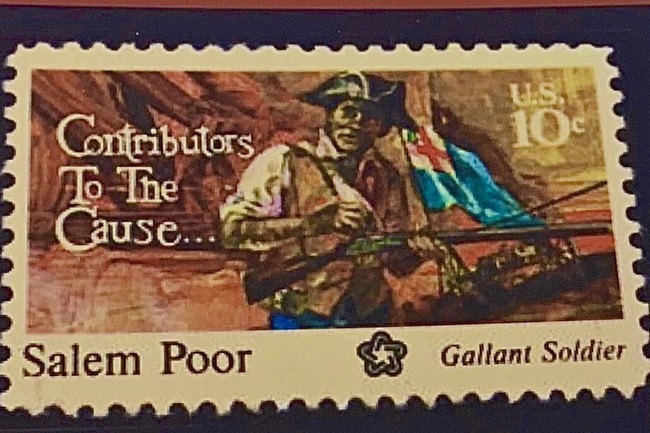
Another soldier at Breed's Hill, born into slavery and bearing the name "Salem," proved to the Americans that their cause was not one exclusive to any race or social class. Salem Poor was born a slave in Andover, Massachusetts, but in 1769, he managed to purchase his freedom for the equivalent of a laborer's annual salary. He then enlisted in the interim Massachusetts Army in May 1775 and found himself in the Battle of Bunker Hill. The National Park Service explains:
During the battle, Salem Poor served in an Andover unit commanded by Capt. Thomas Drury, whose company included several other African American minute men: Titus Coburn, Peter Salem, and Seymour Burr.5 Poor's unit arrived as a secondary force, in order to "assist in the building of fortifications." Instead, due to dire circumstances, they covered the retreating units that had constructed the redoubt on Breed's Hill and had run out of ammunition. His unit received heavy fire; the British Regular Army killed five Andover men near him on the spot and leaft another six seriously wounded. As he helped the wounded, Poor slowly retreated and fired one last shot that killed British Army Lt. Col. James Abercrombie. The British Regular army successfully drove the New England forces off the Charlestown Peninsula, but not without paying a heavy price in losses themselves.
In mid-December, Continental Army regimental commanders who had seen Salem Poor’s conduct at Breed's Hill petitioned the General Court of the Massachusetts Bay Colony to recognize Poor's exemplary service there. The regimental commanders cited that he had "behaved like an experienced officer" and that in Poor "center[ed] a brave and gallant soldier." One secondary source notes that "(o)f the thousands of American soldiers at Bunker Hill no other was given such recognition."
Salem Poor, like Peter Salem, served throughout the American Revolution. Not much is known of his after-war life, except that he married several times and had at least one son.
Unlike Salem Poor and Peter Salem, Joseph Warren was already famous when he went to Breed's Hill. A key figure in the Sons of Liberty and the independence movement of Boston that led to the Revolution, there were some who expected Warren to become the most influential and powerful leader in the Revolutionary military. Tragically, the Battle of Bunker Hill cut his promising and brilliant career short.
A physician, "de facto spymaster," inspirational speaker, and talented organizer, according to the Smithsonian Magazine, Warren was thrilled when he saw his fellow Americans making the move for independence. He arrived to fight the British in person with a satin-and-silver waistcoat, a sword, a musket, and a Bible. Warren suffered injury in hand-to-hand combat with the British at Breed's Hill, but never slackened his zeal, using his musket as a club when he ran out of ammunition. Dr. Warren was covering his comrades' retreat when a bullet pierced his face and killed him. An eyewitness recalled, "[Warren's] whole soul seemed to be fill’d with the greatness of the cause he was engaged in, and while his Friends were dropping away all around him, gave his orders with a surprising calmness, till having seen the enemy in the breast work he unwillingly left the front and then fell amid heaps of slaughter’d enemies."
The price of freedom was the blood of Patriots. At the Battle of Bunker Hill, both the men who died, like Joseph Warren, and the men who survived to fight another day, like Peter Salem and Salem Poor, taught the British that putting down this Revolution would be no easy task. The American spirit was unconquerable.
Editor’s Note: Every single day, especially in this 250th year of America’s existence, here at PJ Media, we will stand up and FIGHT, FIGHT, FIGHT against the radical left and deliver the conservative reporting our readers deserve.
Help us continue to tell the truth about the Trump administration and its successes. Join PJ Media VIP and use promo code FIGHT to receive 60% off your membership.



Join the conversation as a VIP Member