







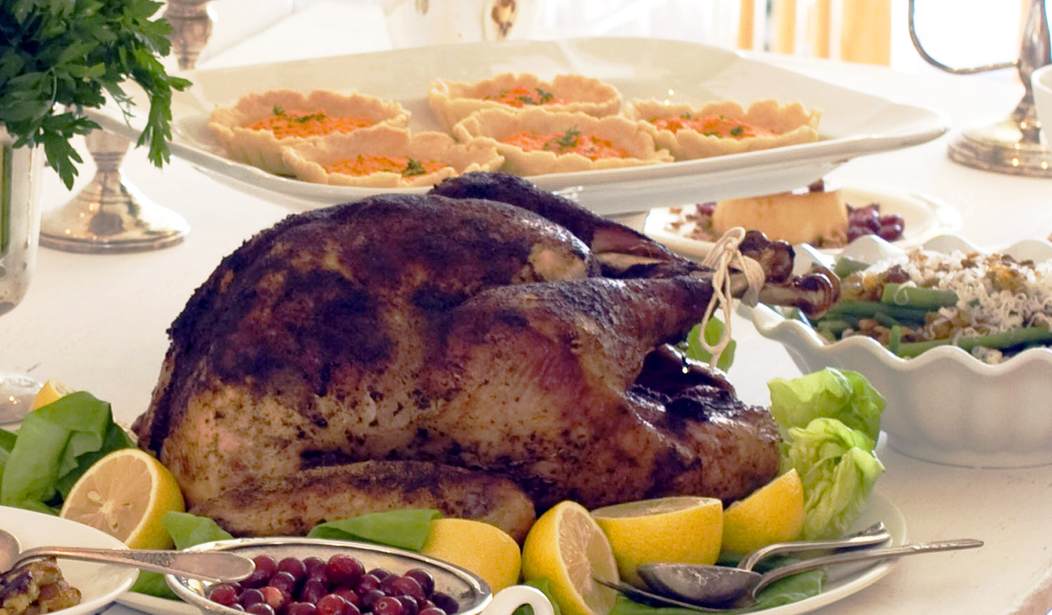
Another year, another reason to be truly thankful. We live in the greatest nation in history, at a time of embarrassing abundance. We enjoy liberty and equality. We possess wealth beyond measure, with the average American enjoying a higher standard of living than did most emperors. We have very little, if any, contact with poverty or disease. And we enjoy the right to worship God in ways not dictated by the state, but by our consciences.
To witness the leftists possess all this, along with their midterm sweep, and still be bitter is a sight to behold. Don’t expect any expressions of gratitude from them at the Thanksgiving table tomorrow. You’re more likely to get a few bumper sticker axioms about “colonialism” and “genocide” and “stolen land.”
So here is a compilation of quick talking points about the Pilgrims and the first Thanksgiving – all based in historical fact rather than revisionist ideology – with which to retort:
Lie #1: The Indians were peaceful, communal people before the Pilgrims arrived
Nope. Indian tribes were in a near-constant state of war with one another, with methods for handling prisoners of war that would make the Nazis blush. One of the pressing concerns for the Pilgrims who arrived in the middle of this intertribal warfare was navigating a neutral path through the Byzantine web of alliances.
At the time of the Pilgrims’ arrival in 1620, the Narragansett tribe was the bully on the block. The Pokanoket, Massachusetts, and Nauset tribes were in a loose alliance in opposition to their rule. It was with this group, particularly the Pokanoket, that the Pilgrims forged friendships.
Lie #2: The Indians were happy to live in peace with the Pilgrims until the latter waged war against them
Nope. The first instance of violence — indeed, the Pilgrims’ first encounter with Indians — was when Indians attacked Pilgrims as they ate breakfast. At the time, arrows were better weapons, more accurate, and could be fired much faster than matchlock muskets. Taken by surprise, the Pilgrims were nevertheless able to ward off the attack, with miraculously zero casualties for either side.
Even though they signed an alliance with the Pokanokets which included military aid in times of attack from hitherto unknown third parties, the Pilgrims continued to remain neutral in inter-Indian affairs and wars as much as possible.
Lie #3: The Pilgrims stole the Indians' food
Nope. The only recorded instance of the Pilgrims taking food that didn’t belong to them was upon their initial arrival at a spot which came to be known as Plymouth Rock. Spending days looking for inhabitants and finding nobody, the Pilgrims accidentally came across a buried basket of Indian corn. They took the corn on the understanding that they would compensate whoever owned it once they discovered who that was. Their own written accounts acknowledge that they took the corn without permission and that they intended to repay it.
True to their word, upon discovering a few months later that the corn belonged to local Wampanoag Indians, the Pilgrims compensated them in full.
Lie #4: The Pilgrims were starving before the Indians rescued and fed them
Nope. The vast majority of deaths among the Pilgrims of this time were attributed to disease and exposure. Though food was never in abundance for the first two years, the Pilgrims were never in danger of starving. They arrived in November with enough provisions to hold them over into and beyond the beginning of farming season in spring.
Because of the communal system of farming, the first two harvests were unimpressive. However, any danger of food shortage ended in 1623, when the Pilgrims switched the ownership of their farming lots from communal to private. Whatever each Pilgrim family was able to grow, they kept for themselves.
And gee whiz, wouldn’t ya know? Food production soared, and from that summer on, the Pilgrims never wanted for food. Capitalism — funny how it works every single time.
Lie #5: The Pilgrims were white supremacists and treated the Indians with contempt
Nope. In fact, the first written descriptions of Indians from the Pilgrims don’t even mention their skin color. The only aspect of Indians that the Pilgrims openly disapproved of was their habit of walking around naked.
The Pilgrims’ first peaceful encounter with the Indians is when an English-speaking Abenaki Indian named Samoset (he had learned the language from English fishermen off the coast) traveled to their settlement to introduce himself. Seeing him cold, the Pilgrims immediately fed and clothed him.
This interaction led to peaceful relations with local tribes, to which the Pilgrims sent a stream of gifts and food. One of the reasons for the Pilgrims’ food shortages was that, over the next few months, steady streams of curious and friendly Indians from nearby villages kept coming to visit them (during which time they were fed and treated respectfully and hospitably).
Even once the colony was up and running, the Pilgrims continued to treat Indians as equals, both in practice and in deed. In 1638, Arthur Peach and three other Englishmen robbed and murdered a Nipmuc Indian named Penowanyanquis. One of them escaped. But a jury of white male Christians convicted Peach and the other two, who were promptly hanged.
Lie #6: The Pilgrims intentionally spread disease among the Indian tribes
Nope. It is true that disease, most likely the bubonic plague, reached American shores and decimated large swathes of the Indian population. But this took place decades before the Pilgrims’ arrival, and was no more intentional than was the spread of that very same plague from Asia to Europe a couple of centuries prior.
The only time disease factored into Pilgrim/Indian relations is when the Pilgrims helped Indians to fight it. When Massasoit, chief of the Pokanokets, fell ill with typhus, Pilgrims Ed Winslow and John Hamden sent a runner to Plymouth Colony at 2 a.m. for food and medicine. By the time it arrived, Massasoit had lost his sight and was hours from death. Under the care of the Pilgrims, he made an astonishing recovery and returned to full health in a matter of days. Upon his request, the Pilgrims also checked for and treated typhus in other Pokanoket Indians.
Because of their efforts, a grateful Massasoit informed them of an imminent Massachusetts attack on the two Pilgrim settlements of Plymouth and Wessagussett, which they were subsequently able to prepare for.
Lie #7: Pilgrims forced the Indians to convert to Christianity
Nope. The Pilgrims made neither threat nor bribe to any Indian to convert them. Masses of them converted on their own. Tribal sachems (chiefs) didn’t like this because it diminished their own authority, as well as a source of material tribute.
This reflected what largely occurred over the next 250 years. Yes, there were Indian wars, forced displacements, and the shameful breaking of treaties. But war and violence account for approximately 1% of the decline in Indian population. Over the centuries, most Indians simply preferred the Western way of life and assimilated into American society.
Their descendants, by the way, still exercise that choice on a daily basis. Despite all the hullabaloo about the sacred, revered Indian “way of life,” none of them have left their houses and grocery stores to go live in wigwams and hunt dinner with arrows and spears.
Lie #8: The Indians lived communally and never understood the idea of “owning” land
Nope. There was no “communistic” idea of land ownership among the Indians. The land belonged to the local sachem, who was free to distribute it to his tribesmen as he saw fit.
Apart from the local territorial wars that characterized Indian America around the area of Plymouth Rock, land theft and forced displacement were a way of life across much of the continent. The Iroquois, Sioux, and Apache tribes were particularly notorious for this.
Beyond owning land, the Indians also believed in owning people. Slavery existed in Indian life before the Pilgrims, after the Pilgrims, and even after the American Civil War.
Lie #9: Pilgrims either stole Indian land outright or tricked them out of it
Nope. The Pilgrims didn’t take an inch of land through force.
Regarding land sales, the sachems were fully aware of the Pilgrims’ understanding of what it meant to purchase and own land. And this they did freely. Indians traded for clothing, farm equipment, cooking equipment, and weapons, items they valued far greater than the uncleared land they traded away.
The Pilgrims even established a court system, through which all land deals required approval. This was done to prevent unscrupulous individuals from tricking or cheating Indians out of their land.
Lie #10: Thanksgiving is a celebration of genocide
Nope. The first Thanksgiving took place in late September or early October of 1621, and was held to celebrate the Pilgrims’ first harvest. The Pokanokets were invited, and Chief Massasoit and about 100 Indians arrived with five freshly killed deer to complement the Pilgrims’ feast of corn, squash, beans, barley, peas, bass, bluefish, cod, ducks, geese, and, of course, turkeys.
The Pokanokets outnumbered the Pilgrims roughly 3-to-1. No table in the Pilgrims’ meager possessions could seat so many guests, and most stood, squatted, or sat. Games were played, competitions were held, and the celebration was a much more rambunctious, playful affair than the solemn paintings would have us realize.
Did it last? No. The next generation of both Indians and English settlers were more arrogant and less accommodating. The Pequot War of 1837 was the first of a number of wars that erupted, which would have inevitably erupted anywhere on the planet among any race and color of people, of which one was on the cutting edge of modernity and the other halfway through the Iron Age.
But the first generation of Pilgrims and their Indian allies were, indeed, friends. They truly viewed each other as equals, and both sides displayed this consistently with generosity and loyalty. Their harvest feast, which we refer to as Thanksgiving, was a reflection of that friendship.
In fact, isn’t this event – where people of different races, tribes, and religions gather to share a meal as one community – the exact display of “diversity” and “multiculturalism” that the left claims it supports?
Ask your leftist relatives at Thanksgiving: If they support diversity and multiculturalism, then why do they oppose Thanksgiving? Don’t let them pivot to Wounded Knee. Bring it back to Thanksgiving.
Ask again: If you support diversity and multiculturalism, why are you so opposed to Thanksgiving?
We know the answer. They don’t actually care about diversity or multiculturalism, just like they don’t care about the Pokanokets or Massachusetts or Wampanoags.
They care about virtue signaling. They care about feeling morally superior. And they’re using Thanksgiving as a way to do it, regardless of how it affects the gathering.
We spent the last three weeks after midterms revving each other up about how we need to fight back. Well, it’s more important here than at the ballot box. This, here and now, is how the leftists win. They attack our history, our culture, and our values, one lie at a time, one outburst at a time, one condescending lecture at a time. They do it at Thanksgiving and other family get-togethers. And because the rest of us are decent and don’t want to further cause a scene, we just roll our eyes and don’t speak up. We tell ourselves that it’s not worth an argument, that we’re just keeping the peace.
But going along to get along is not keeping the peace. Allowing lies to go unchallenged is not keeping the peace. Allowing arrogant leftist relatives to hijack our gatherings and force us to walk on eggshells around them isn’t keeping the peace. Allowing our history to be corrupted is not keeping the peace.
Related: Activist Judge Rules That Referencing Jesus in a Christmas Email Is Unconstitutional
If Braeden and Madison don’t like Thanksgiving, that’s fine. They can leave. This is our holiday. This is our celebration of history, culture, and gratitude to God. You should give them no more leeway to ruin it for everyone else than you would let them ruin your kid’s birthday party.
Call them out on their BS. Stay calm, cool, and collected. Respond to every emotional, hand-waving challenge with monotone facts and logic. If anything, slow down and speak more softly in response to their escalation. Let them be the ones throwing the hissy fit. If they need to go have a time-out, let them.
You’re not starting the trouble; you’re ending it. Children, especially adult children, need to be patiently but consistently taught humility, manners, and critical thinking skills.
Make the peace and speak the truth. And to all PJ Media readers, conservatives, and patriotic Americans – Happy Thanksgiving!
Help us continue to tell the truth about our history as we usher in the Golden Era of America. Join VIP and use promo code FIGHT to get 60% off your membership.


Join the Conversation
VIP members get the ability to comment on articles.