





We can walk and chew gum at the same time. C’mon, folks.
Yes, the midterms are just 29 days away. Yes, MAGA’s fate depends on turnout. Yes, 2028 is far down the road (politically speaking, at least).
But we’re big boys. We’re capable of multitasking.
And much more importantly, 2028 is shaping up as a turning point election. The 2016 MAGA movement triggered a national realignment, and we’re still only waist deep. It’s affecting both parties: The Democrats have their hands full with the burn-it-down DSA revolutionaries, and the GOP’s pot is also unsettled, with traditional conservatives, populists, MAGA diehards, isolationists, Christian Zionists, Groypers, “Conspiracy Bros,” and others battling for supremacy.
So yes, the midterms matter enormously — but 2028 is for the whole dang enchilada. It’ll define the future of America’s two major parties.
That means the 2028 election will determine which ideas are mainstream and which ones are destined for the ash heap of history. (Gulp.)
A smorgasbord of ideas — capitalism, socialism, communism, Zionism, AI/tech doomerism, and international alliances — is on the chopping block. The ideologues are drooling; on the left AND the right, this is a generational opportunity.
So don’t tell me it’s too early to talk about 2028. The opposite is true: The stakes are so high that we’re actually not talking about it enough!
And it all begins at the top. Whoever heads his/her party’s ticket is the odds-on favorite to also win the realignment war: If AOC or JD Vance wins, so does their ideology. Their supporters will write their party’s platform, control the purse strings, and leverage party machinery for their own ideological purposes.
‘Cause that’s how the game is played. Like President Donald Trump said, “To the victor go the spoils.”
Today, Vice President JD Vance is the undisputed 2028 Republican frontrunner. He’s at the helm of the bobsled. If Trump’s GOP popularity holds, most serious Republicans will decline to challenge his veep, because what’s the point?
Which will put Vance on cruise control, giving him the nomination with minimal effort. It’ll mirror the Democratic presidential battle of 2000, when Vice President Al Gore won in a cakewalk over token competitor Bill Bradley.
The Republicans would benefit from this outcome by sidestepping uncomfortable debates that could demotivate voters. Vance inherits an unwounded Republican Party; the Trump loyalists are delighted — as are the other blocs that see Vance as “their guy.”
And the blocs that view Vance with ideological suspicion will feel marginalized and depowered. They lost — and they didn’t even have an opportunity to argue their side. Their political party was stolen from them.
If this happens, Vance will inherit the MAGA movement, minus however many disenfranchised, demotivated ex-GOP voters have abandoned it.
Which, alas, may also include Latino voters. If the Latinos return to the Dems in the midterms — which is being projected in the polls — regaining Latinos in 2028 will be a hot GOP topic. (But more on that in a sec.)
Maybe MAGA will grow so big by 2028 that we will be able to shrug off these losses. Maybe success begets success; maybe, because of Trump’s policies, we’re on the cusp of exponential growth.
But it’s also possible that the “charisma dropoff” from Trump to Vance — coupled with the loss of at least some GOP voters — means Vance will inherit a smaller, weaker, more marginalized MAGA movement.
And just as importantly, he won’t have a platform for growing it ‘til the Republican convention.
Without a serious, credible, national rival to drive media coverage, Vance will be ignored. The mainstream media will focus near-exclusively on the Democratic race.
That could be a good thing, but it probably won’t be. Showcasing Democratic dysfunction (and/or lunacy) helps Republicans, of course, but the media isn’t an unbiased actor: It keeps its thumbs on the scales — while carrying water for leftists.
More likely than not, the media would use its coverage to “normalize” the Democratic nominee, no matter how radical or extreme he/she actually is.
This doesn’t mean that Vance can’t win. If the Democrats are dysfunctional enough, Vance is persuasive enough, and GOP defections are minimal, Vance could absolutely win.
He could win in a landslide. Even bigger than Trump in 2024.
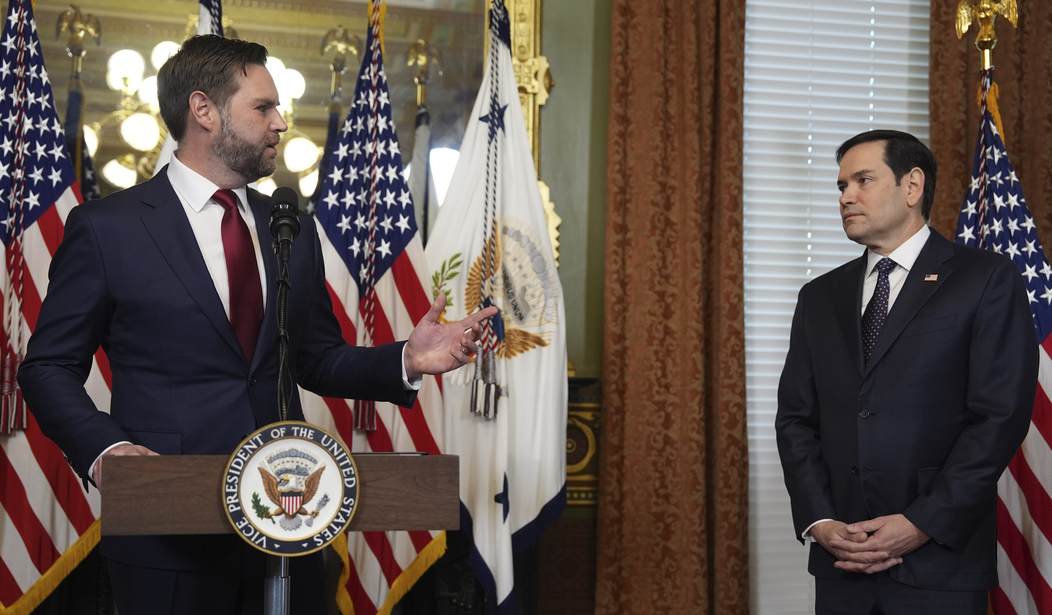
But those are quite a few ifs. So, as a thought experiment, let’s strategize what might happen if Marco Rubio challenges JD Vance for the Republican nomination:
First, Rubio would resign as secretary of state (and national security advisor, USAID administrator, U.S. archivist, yada yada) shortly after the midterms. Rubio needs to separate himself from the administration — and build his own identity on the campaign trail. He can’t do that as secretary of state.
Rubio’s greatest asset is his competence: From Venezuela to Greenland, he always got things done. (And Trump’s one foreign policy hiccup — the still-unfinished Iran War — is more closely connected to JD Vance and his failed MOU.) Chances are excellent that Rubio’s star-studded successes won’t be replicated by his successor(s).
Because realistically, how could they be? The Dems are rising in Congress — and the final two years of an eight-year presidency aren’t exactly conducive to big policy wins.
Rubio’s stature will likely grow even larger by comparison, thus enhancing his “competency” brand.
Rubio is young, but he’s already a seasoned politician. He knows Iowa and New Hampshire like the back of his hand. He can raise money with the best of ‘em. And he also understands that building himself up isn’t enough — he must also tear the frontrunner down.
Which doesn’t necessarily mean backstabbing and dirty tricks. Hey, this is major league politics — negative attacks are part of the gig: Friends fight friends on Crossfire, scream and rant like lunatics, and then shake hands when the interview ends. That’s life in D.C.
You can go negative without going ugly.
But when you go negative, you must always justify your attack. (Otherwise, you look like a jerk.) And Rubio has the perfect excuse to justify attacking Vance: He legitimately disagrees with the veep over America’s role on the global stage.
It’s not personal. It’s simply two competing visions.
The Republican Party, after all, has the right to decide what kind of party it wants to be. This is democracy in action!
And then, Rubio should tie JD Vance to Tucker Carlson.
Every action has a cost, and the cost of associating with Tucker Carlson — who continues to peddle ridiculous pro-Hitler propaganda — is increasing. Carlson’s GOP support has already crashed; he’s become the Hasan Piker of the horseshoe right.
Rubio doesn’t need to demonize Vance. It’d be better if he feigned sadness and confusion: “I don’t understand why the vice president believes it’s America First to attack allies like Israel. We have an honest disagreement: He thinks it’s ‘absurd’ to suggest Tucker Carlson ‘has no place in the conservative movement.’ I believe the exact opposite — that after this much Jew hatred, anti-Israel conspiracies, and Hitler apologism, it’s ‘absurd’ to include him.”
Because the Republican Party is still an overwhelmingly pro-Israel party. A whopping 70% of Republicans sympathize with the Israelis more than the Palestinians. (Just 17% of Democrats agree.) Another 69% have a favorable opinion of the Jewish state.
For Rubio’s purposes, Israel and Tucker Carlson are the perfect wedge issues.
But here’s where the math gets fascinating: To offset Rubio’s numeric advantage on the Israel/Carlson issues, Vance would have to expand his constituency. This means picking up new GOP voters — including younger voters who tend to have negative opinions of Israel.
Meanwhile, Rubio will double down on activating Christian Zionists, traditional Republicans, and Latino voters. He has to, because those are his natural constituents.
And they’re the same constituents that Vance would struggle to retain if he ran unopposed in 2028!
The answer to Vance’s problem is Rubio. And because Vance represents voters who are suspicious of Zionist/interventionist politicians, the answer to Rubio’s problem is Vance.
But they need to run against each other to build these constituencies.
It won’t work if Vance runs unopposed. And it won’t work if his only competition is a no-name congressman or senator. Or some ham-and-egger like Thomas Massie.
Because Vance doesn’t need Bill Bradley 2.0. He needs Rubio — and Rubio needs Vance. For the good of the GOP, they need to run against each other.
And then they need to come together again.
One man wins; one man loses. Then both men reunite at the convention — perhaps as the Republican nominees for president and vice president.
Imagine that: A Rubio-Vance ticket — or a Vance-Rubio ticket — with both sides boosted by a high-profile, coast-to-coast, get-out-the-vote campaign that grew the MAGA coalition. It’s the best possible outcome for the GOP.
It’s why the MAGAverse should cross its fingers and pray that Rubio challenges Vance.
Anyhoo, thus ends our thought experiment. Back to your regularly scheduled midterms.
(Hope nobody swallowed their gum.)
One Last Thing: 2026 will reach a crescendo with the midterm elections. Nothing less than the future of our country teeters in the balance.
Never before have the political battle lines been so clearly defined. Blue wave or red wall, the 2026 midterms will transform our country.
We need your help to win the information war!
As a PJ Media VIP member, you’ll receive exclusive access to our behind-the-paywall content, commenting privileges, and an ad-free experience. VIP Gold gets you the same level of “insider access” across our entire family of sites (PJ Media, Townhall, RedState, twitchy, Hot Air, and Bearing Arms). That means: More stories, more videos, more content, more fun, more conservatism, more EVERYTHING!
And if you CLICK HERE and use the promo code FIGHT you’ll receive a Trumpian 60% discount!
Thank you for your consideration.

Join the Conversation
VIP members get the ability to comment on articles.