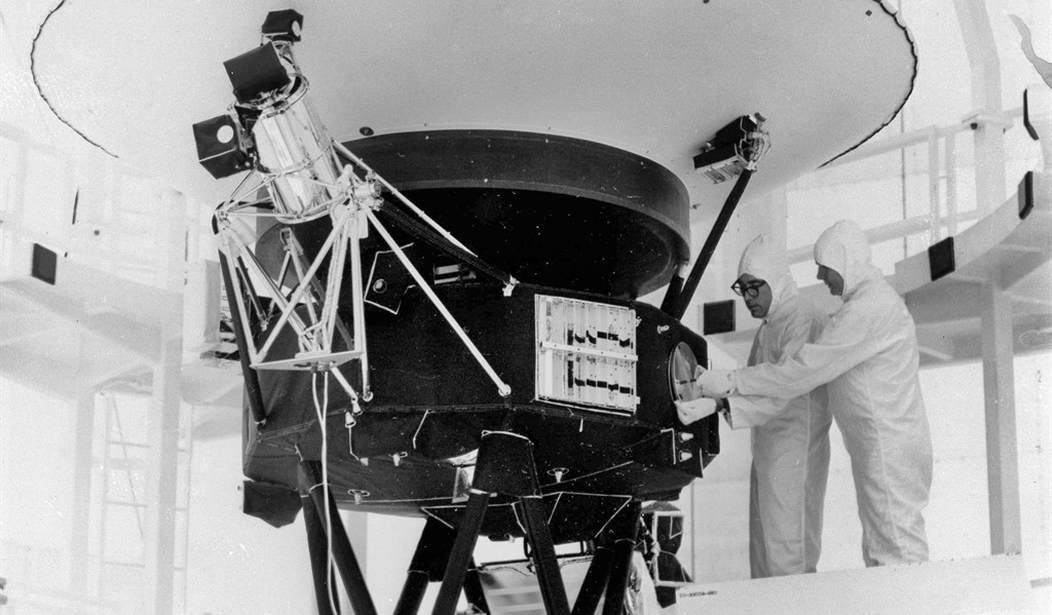

At 5:06 a.m. ET on November 18, the Voyager 1 spacecraft achieved a milestone no one who was present at its launch on Sept. 5, 1977, could have ever imagined. Voyager 1 is now 16.1 billion miles from Earth. At that distance, it takes a signal sent from the spacecraft 24 hours to reach Earth.
It's still working, after a fashion. Most of its 10 instruments were built to study Jupiter and Saturn, giving humans the most spectacular views of the outer planets to that time. But Voyager is still faithfully reporting information like the speed of the sun's charged particles (solar wind) and radiation readings as it races at 38,000 mph on a parabolic course out of the solar system.
So what will Voyager 1 do for an encore? And what will be its ultimate fate?
"Current science is continuing our investigation on magnetic field strength and direction, plasma density, and energetic particle detection. What is important is to measure how these phenomena change as the spacecraft travels further away from the sun," Suzanne Dodd, project manager for the Voyager missions at NASA's Jet Propulsion Laboratory (JPL), told Space.com in an email.
Voyager 1 "officially" hit interstellar space in 2012. But scientists have found that there's no hard edge to interstellar space and the probe's instruments are writing a news textbook on what's out there.
"Key Voyager science going forward includes observing the extent to which our sun continues to affect interstellar space, all the way out to Voyager 1," said Linda Spilker, a Voyager 1 project scientist. "Where does the sun's influence end and pristine interstellar space begin? Perhaps Voyager may last long enough to answer that question."
Space.com:
Each Voyager continues to lose 4 watts of power a year; their launch power was 470 watts in 1977, and the nuclear power source continues to dwindle, requiring harder choices as the missions approach their 50th years of operations. Instruments have had to be shut off, and both the spacecraft were directed to perform a "Big Bang" of power redistribution earlier this year to preserve as much power as possible without sacrificing science.
Looking forward, Dodd says the team does not anticipate having to make any major changes to spacecraft operations until after the 50th anniversary passes for each spacecraft next August and September (as Voyager 2 launched a few weeks before Voyager 1).
A JPL representative added that the "Big Bang" should keep the remaining science instruments going until that point, although "there is also the thermal state of the spacecraft to balance." The representative added that the margins for power remain "very thin," especially as the spacecraft are quite cold in interstellar space.
"Then there are the things the team can't predict, such as the unexpected loss of contact that happened recently," the spokesperson added. That refers to a recent 48-hour period where Voyager 1 was not responding to commands. How do you fix a spacecraft when each side of a conversation lasts a day?
You don't fix it. The spacecraft fixes itself.
According to NASA's Voyager mission updates, the spacecraft switched its thrusters and stabilized on its own during the gap, though mission engineers noted it was the first time they had seen that kind of behavior in the probe's nearly 50-year run. There are some other minor glitches that engineers are still trying to work through.
Twenty-four hours at a time.
“Voyager 1 crossing the light-day threshold is yet another historic feat on an extraordinary voyage of discovery,” Dave Gallagher, the director of NASA’s Jet Propulsion Laboratory, said in an emailed statement to Popular Science. “Above all, this milestone stands as a testament to the exceptional teams who built, programmed, and fly these spacecraft today, and who have overcome countless challenges to keep them connected to Earth across the vastness of space.
NASA may have its problems when it comes to manned missions. But these robotic "voyages of discovery" are awesome achievements of science, engineering, and technology that only America has attempted.