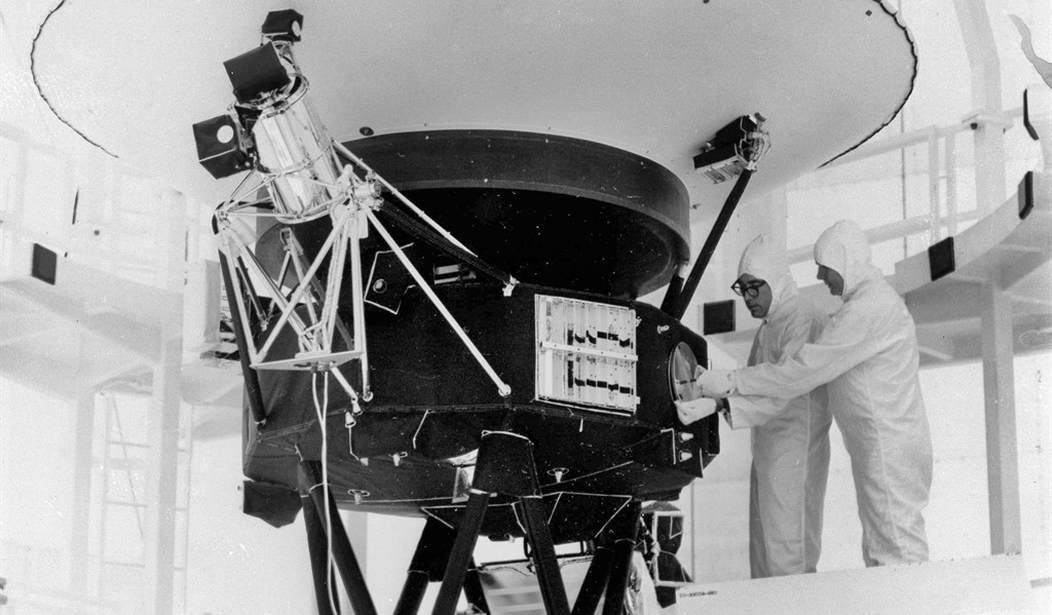

On November 18 at 5:18 a.m. ET, the Voyager 1 spacecraft, which NASA launched in 1977, will be exactly one light-day from Earth, or 16.09 billion miles away. Communications with the spacecraft will take 24 hours to reach the huge NASA Deep Space Network dishes located in the Mojave Desert, outside of Madrid, and the Australian Canberra Deep Space Communications Complex.
The signal is so weak that three dishes spread about 120 degrees apart on Earth's surface are needed to hear the 23-watt radio transmitter (about the power output of a small lightbulb) aboard Voyager.
The satellite, traveling at nearly 40,000 mph on a parabolic course taking it out of the solar system, is still making astonishing discoveries. We are mapping the boundary between our solar system and the interstellar medium, a far more complex boundary than first believed. The spacecraft is still measuring the density, temperature, and structure of interstellar plasma (the gas between stars) and cosmic rays. Its instruments have captured the faint, steady "hum" of interstellar plasma, giving scientists their first direct measurements of what the galaxy looks like just outside our solar bubble.
If NASA wants to send an instruction to one of Voyager's two remaining powered instruments, it will take 24 hours to reach it. Sorry, trekkies: no subspace communications are possible. Yet.
Princeton University research scientist and heliophysicist Jamie S. Rankin tells Popular Science it's “a pretty incredible endeavor" to communicate with a craft so far away. “In my mind, the fun is receiving a signal back from the Voyager, a light-day away," she says.
“Right now we’re trying to figure out how far out are the influences of the sun felt,” she says.
The sun continuously spits out charged particles in a stream of solar wind that extends into space. That wind pushes back against the gas and other interstellar stuff surrounding our solar system, sculpting a bubble in space known as the heliosphere. “There will be some part farther out, some distance away [where the] interstellar medium has no idea that the heliosphere is even there,” she says. Rankin adds that she thinks Voyager 1 is right on the edge of this “undisturbed, pristine interstellar medium.”
“This is the first time we’ve seen the spacecraft do something like this, but we are also at a point in the mission where we have to expect the unexpected,” Kareem Badaruddin, Voyager mission manager at NASA’s Jet Propulsion Laboratory (JPL), said in a news release. “We’re relieved to be back in contact with Voyager 1 and are eager to understand what happened.”
When Voyager 1 launched in September 1977, there were 10 operational instruments. After flybys of Jupiter and Saturn, Voyager kept recording huge amounts of data, including the first hints that Jupiter's moon Europa may have an ocean of water underneath its icy crust. After the spacecraft passed the orbits of the outer planets, NASA began turning off most of the instruments on board to study the gas giants and conserve power.
But even with the reduced power load, there is a high probability that Voyager 1 will succumb to one of the numerous threats it faces so far from home. NASA thought it had lost the probe for good a few weeks ago when NASA lost contact with the craft. It regained contact 48 hours later after sending a series of troubleshooting commands to the spacecraft.
The team has so far determined that one group of thrusters went offline and their backups turned on. Such a swap is programmed to occur automatically if the spacecraft computers detect something amiss with the active thrusters. This automatic response is known as fault protection and directs the spacecraft to put itself in a safe, or stable, configuration and pause normal operations, giving engineers time to diagnose the issue and take action.
The Voyagers get their power from radioisotope thermoelectric generators, which convert heat from decaying plutonium into electricity. This ingenious method of generating power was first used by the U.S. Navy in a navigation satellite in 1961.
"NASA estimates that the Deep Space Network will lose contact with Voyager 1 around 2036, long before it travels to its two-light-day milestone," says Popular Science. "The probe may also freeze, unable to point properly back at Earth." Or its power supply will finally stop working.
“We know that’s coming at some point. It’s probably not 20 years from now,” Rankin says. “It’s probably not 10 years from now.”
A shout-out to NASA and especially the dozens of technicians and engineers who have kept Voyager alive and still sending us invaluable data all these years.