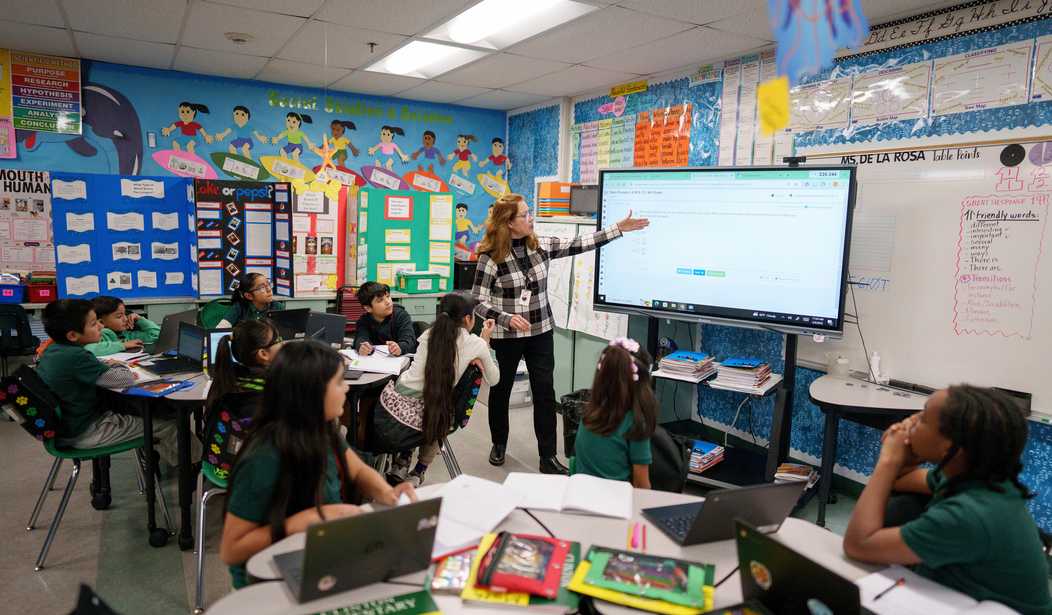

American public schools are a hot mess. In addition to teaching a curriculum that fails to instill American values in students, schools address discipline problems in the absolutely worst way imaginable.
At the beginning of this century, radical left educators argued that suspending and expelling unruly kids was creating a “school-to-prison pipeline.” A "disproportionate" number of black and Latino children were being disciplined in this fashion.
The leftists' proposed solution didn't address the problem and, in fact, made it worse. Instead, unruly students were largely given a pass. They were given mental health-oriented interventions like “restorative justice,” "social-emotional learning," and “trauma-informed” practices.
Writing in City Journal, Jennifer Weber and Carolyn D. Gorman say that the Los Angeles school board ended suspensions for "willful defiance" in 2013. As the Los Angeles school district went, so went the nation, as most school boards adopted the "disparate impact" rationale and stopped suspending unruly kids.
Barack Obama made the policy virtually mandatory when his Justice Department, along with his Department of Education, sent a “Dear Colleague” letter to every school district in the country, warning "that they could face federal civil rights investigations if their suspension rates differed by race—even when discipline policies were race-neutral and applied consistently," write Weber and Gorman.
That's the absolute beauty of "disparate impact" that I've written about more than a dozen times over the last decade and a half. Being punished for something of which you are not guilty, except numerically, is the most insidious policy ever created by the federal government. Trump has been trying to abolish "disparate impact" formulations in government, but it's a long, tedious process, given that the concept is so entwined in American law that finding and rooting it out will take years.
Obama's Education Secretary Arne Duncan made the ludicrous argument that the adults were at fault due to bad training in handling problem children. “It is adult behavior that needs to change,” he said. This led Washington to focus on the way kids were disciplined (suspension and expulsion) rather than differences in behavior.
This view overlooks a basic behavioral principle: that consequences shape what children do next. Some consequences make a behavior less likely—that’s punishment. Others make it more likely—what B. F. Skinner called reinforcement. It doesn’t matter whether the reward is getting something good or merely escaping something bad.
Much classroom misbehavior is motivated by the desire to escape. The student is trying to get out of something he finds unpleasant, whether it’s work he can’t do, a subject he’s failing, or an audience he’d rather not face. For that student, a suspension acts as a reward—it gets him exactly what he wants, reinforcing the behavior. The harm is what the days outside of the classroom bring––disengagement and the growing sense that school is not where he belongs. Other misbehavior is motivated by desire for attention; in those cases, pulling the student aside for a one-on-one discussion is unlikely to be an effective deterrent.
The restorative-justice practices that have replaced suspension, such as mediation circles or discussion with a teacher, distribute the same kinds of unintentional rewards. A child escaping a math worksheet doesn’t care whether he gets a suspension slip or is placed in a restorative circle; either way, the worksheet is gone. Likewise, a child who seeks adult attention doesn’t care whether it’s punitive or therapeutic; either way, he got it.
The "mental health" approach to child disciplinary problems only serves to reinforce the bad behavior by rewarding the kid by giving him what he wants: to get out of class or school.
"Escape works the same way in reverse," write Weber and Gorman. "The trip to the counselor’s office ends the math lesson just as surely as a suspension does."
They add, "For the student acting out to avoid work that he cannot do, an effective response must ensure that the work does not go away."
An analysis of 69 studies found that behavior change didn't depend on whether an intervention by the school was called "punitive" or "restorative." In fact, it depends on whether the intervention changes the reinforcement that affects the behavior.
Yes, but the word "restorative" makes lefties feel all gooey inside.
The bottom line, according to Weber and Gorman, is "Discipline tied to the function of behavior is the only approach that keeps a student in school engaged—and engagement is what keeps him out of the justice system."
If schools genuinely want to break the cycle and keep kids out of trouble, they need to stop prioritizing comforting educational buzzwords over proven behavioral science. True restorative practice isn't about letting a child dodge responsibility under the guise of compassion — it's about holding them accountable so they can actually succeed.
Recommended: GOP Midterm Convention Will Be an Anti-Socialism Hatefest