





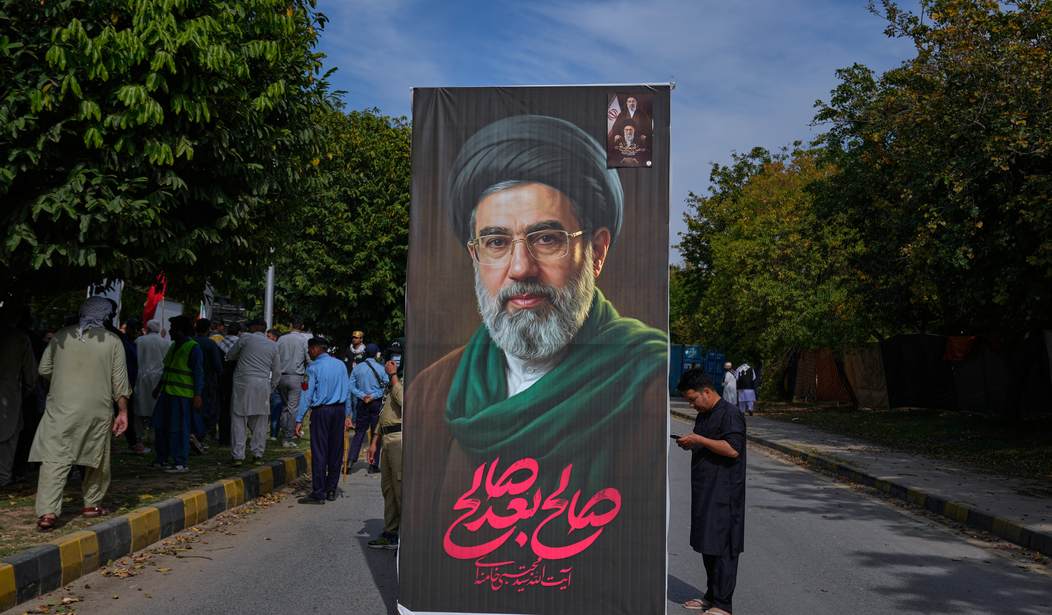
Where is Mojtaba Khamenei?
Iran's new Supreme Leader did not attend the funeral processions or prayers for his father, Ayatollah Ali Khamenei, on Thursday.
While three of his brothers (Mostafa, Meysam, and Masoud) were shown on state television attending the ceremonies, Mojtaba was notably absent. Iranian officials and state media stated that he skipped the multi-day funeral due to high-stakes security concerns.
While that may be true, other high-ranking clerics and officials showed up, including Masoud Pezeshkian, the President of Iran; Mohammad Bagher Ghalibaf, the Speaker of the Parliament, and Tehran's chief negotiator; Gholam-Hossein Mohseni-Eje'i, the Head of the Judiciary; and Foreign Minister Abbas Araghchi.
If he's still alive, Khamenei the Younger is either horribly disfigured or in a coma. Whatever his condition, his absence has set off an extremely serious clan and factional war that, so far, has remained bloodless, but could easily spiral into open warfare.
The major factions fall generally within the "pragmatist" and "radical" camps, with both invoking Mojtaba Khamenei's name to justify their actions. The Islamic Revolutionary Guard Corps (IRGC) commander, Gen. Ahmad Vahidi, a radical hardliner who opposed the ceasefire, is in nominal (if unofficial) control of the government, with President Pezeshkian and Foreign Minister Araghichi heading up the pragmatists. Despite how Western media portrays them as "moderates," they are not, in any way, less radical in their beliefs than Vahidi and the IRGC and other factions in the clerical, business, and mercantile clans that all have a slice of Iranian wealth.
"In other words, they all subscribe to the core tenets of Shia Islamism in Iran: the forceful imposition of Sharia law domestically, support for the so-called Axis of Resistance militia network, anti-Americanism, and the goal of eradicating the Israel (driven by innate anti-Semitism)," writes Saeid Golkar and Kasra Aarabi in Middle East Forum (MEF).
While all the players may have the same core beliefs, their conflicts are about protecting their power and economic interests.
Recently, the conflict came out in the open when the powerful Assembly of Experts criticized the Memorandum of Understanding (MOU) that led to a temporary ceasefire. The Assembly is a body of 88 clerics who appoint the supreme leader and theoretically oversee his authority. They weighed in on the MOU, opposing it on the basis that the current Supreme Leader, Mojtaba Khamenei, opposed it.
In the statement, they claimed the deal crossed several red lines set by Khamenei.
“All officials should respect that, in the system of Velayat-e Faqih (Guardianship of the Islamic Jurist), the opinion and directives of the Supreme Leader are decisive. Once informed of the Leader’s definitive view, no official may act contrary to it," the statement said in Farsi.
After its publication, Ayatollah Hashem Hosseini Busheri, chairman of the Assembly of Experts’ secretariat and spokesperson, immediately stated that he was completely unaware of the statement and that, while he did not oppose its content, its signatories had broken convention and published it without coordination with him.
Remarkably, however, senior members of the secretariat – including Ayatollah Movahedi Kermani, Ayatollah Arafi, Ayatollah Araki and Ayatollah Rajavi—were amongst the signatories of the statement. In fact, only three members of the secretariat had not signed the statement, including Hosseini Busheri.
The very fact that such elite infighting is now unfolding openly within the regime’s most important clerical body is particularly telling.
The dispute shows that Khamenei the Younger has nowhere near the power and influence his father had. When Ali Khamenei was alive, there was never a question about what state policy was and who was directing it. Now, the factions are making policy recommendations and invoking the name of Mojtaba, sometimes contradicting themselves in claiming his support.
"Their statement therefore reveals not only in-fighting between the different oligarch clans of the Islamist regime, but also that the clerical class is scrambling to preserve its political and economic privileges in the face of an increasingly uncertain succession," the authors write.
Ali Khamenei's cult of personality was based on his physical presence at meetings and conferences. No one would dare go against him. His word was absolute, made that way by his physical presence.
Khamenei the Younger's absence has raised the anxiety level of the elites to critical levels. It's only going to get worse the longer Mojtaba Khamenei remains invisible.
Join the Conversation
VIP members get the ability to comment on articles.