





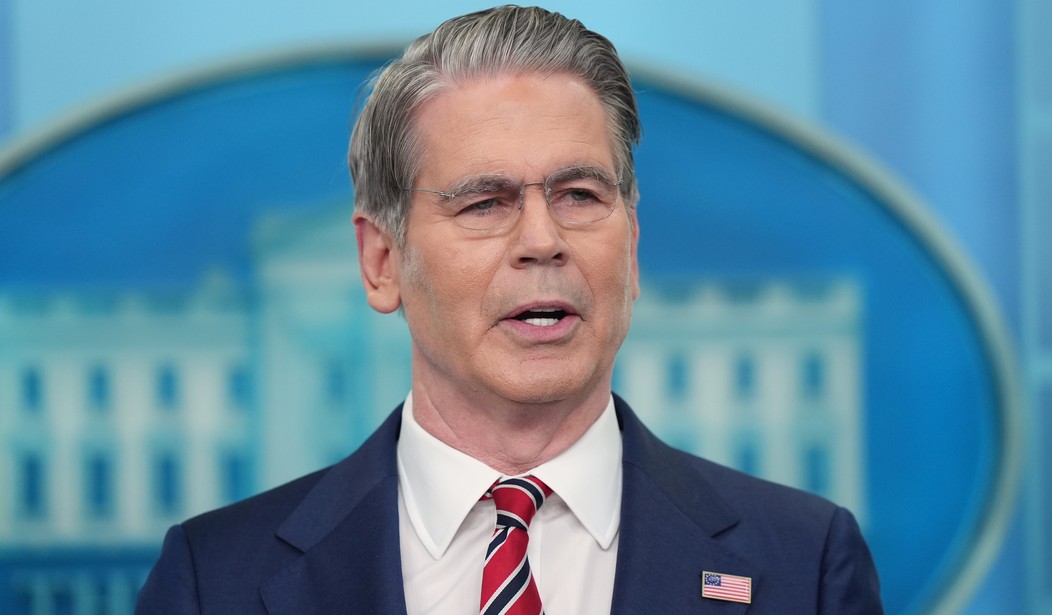
President Donald Trump tells the American people not to worry about the U.S. national debt reaching the unprecedented level of $40 trillion because “It’s been a problem for 35 years and what we have now that we’ve never had before… is we have tremendous growth — and the way you take care of debt is with growth."
Treasury Secretary Scott Bessent put it even more directly, telling CNBC, “...there’s nothing magic about the 40 trillion number. We can grow our way out of that.” Bessent also said there is a "very good chance" that the national debt will begin declining as the Trump administration's economic policies spur the economy, waste and fraud are eliminated, and the government becomes more efficient.
So there we have the conventional GOP wisdom about the national debt — "we can grow our way out of it."
On the Democratic side of the aisle, the conventional wisdom ever since the New Deal era of Franklin D. Roosevelt has been variations on the maxim that we need not worry about the national debt because "we owe it ourselves."
Actually, that formulation predates the New Deal era by several centuries, as Adam Smith, the Scots father of capitalism, who in his classic The Wealth of Nations, ascribed it to the pre-capitalist Mercantilist perspective:
"In the payment of the interest of the publick debt, it has been said, it is the right hand which pays the left. The money does not go out of the country. It is only a part of the revenue of one set of the inhabitants which is transferred to another; and the nation is not a farthing the poorer.
"This apology is founded altogether in the sophistry of the mercantile system, and after the long examination which I have already bestowed upon that system, it may perhaps be unnecessary to say any thing further about it. It supposes, besides, that the whole publick debt is owing to the inhabitants of the country, which happens not to be true; the Dutch, as well as several other foreign nations, having a very considerable share in our publick funds. But though the whole debt were owing to the inhabitants of the country, it would not upon that account be less pernicious."
More recently, variations of the "we owe it to ourselves" argument have been more common among economists on the Left, as exemplified by New York Times economics columnist Paul Krugman, saying "because debt is money we owe to ourselves, it does not directly make the economy poorer (and paying it off doesn’t make us richer)."
Note that with both the GOP and Democratic conventional wisdom, the essential message is "hey, not to worry! We can grow ourselves out of the debt, and even if that fails, it's still not a problem because we owe it to ourselves."
This is why Republicans and Democrats in power at both ends of Pennsylvania Avenue in the modern era are responsible for America having a $40 trillion national debt, much of which we owe to China and other foreign nations.
Curious about whether or not we can actually outgrow the $40 trillion national debt, I asked Grok4 what would be required to eliminate that burden if the economy grew at a rate that enabled the federal government to repay $500 billion each year. Yes, that is a simplistic way of framing it, but bear with me. Here's the Grok4 response:
"80 years, under the simplest assumption of a flat $40 trillion principal paid down at a constant $500 billion per year with no new borrowing and no interest. $40 trillion ÷ $500 billion = 80. That is the arithmetic if the entire existing stock of debt is retired through fixed annual principal repayments and nothing else changes.
"In practice, the calculation does not work that way. Net interest on the debt is already well above $1 trillion per year (and rising with the $40 trillion stock and higher rates). Ongoing deficits remain large. A $500 billion 'payback' that does not first cover interest and close the primary deficit would leave the debt still growing.
"Even a genuine surplus large enough to produce a $500 billion net reduction each year would require enormous, sustained cuts in spending or tax increases far beyond anything currently projected. As principal declined, interest costs would fall, so the later years would become easier, but the early years would be far harder than the simple 80-year figure implies.
"The hypothetical therefore describes a mechanical payoff schedule, not a feasible fiscal path. Actual retirement of the debt would take far longer (or never occur) without much larger and politically difficult changes in the budget."
Next, I posed the same question to ChatGPT and was again told it would require 80 years to pay it off at $500 billion a year, but achieving that would require:
- No new borrowing
- The existing budget is balanced
- Interest is paid separately
- The entire $500 billion goes toward principal every year
Plus, there was this hugely significant qualifier:
"Currently, Washington is running an annual deficit of roughly $1.8 trillion, while annual interest costs are approaching or exceeding $1 trillion. Therefore, simply finding an additional $500 billion would not reduce the debt; it would only reduce the size of the annual deficit.
"To produce an actual $500 billion annual paydown, Washington would initially need to improve its fiscal position by approximately: $1.8 trillion existing deficit+$0.5 trillion repayment = $2.3 trillion annually.
"Assuming federal revenue remains approximately 17.5% of GDP, generating $2.3 Trillion entirely through additional economic output would require $2.3 trillion÷17.5% = $13.1trillion.
"That means GDP would initially need to rise from approximately $32.5 trillion to $45.6 trillion—about 40% larger than today—with federal spending held essentially flat. If spending rose alongside GDP, the necessary economic expansion would be considerably greater."
The U.S. economy would have to be 40% bigger than it is today just for the federal government to be able to sustain an 80-year campaign to eliminate the $40 trillion national debt at $500 billion a year.
Now, I am from out of town and all, but I don't think that will ever happen. Which means it is inevitable that the U.S. will default. Our grandchildren will not be thanking us.
Editor's Note: Do you enjoy PJ Media's conservative reporting exposing the radical left and woke media? Support our work so we can keep bringing you the truth.
Join PJ Media VIP and use promo code FIGHT to receive 60% off your membership.

Join the Conversation
VIP members get the ability to comment on articles.