







Greetings, and welcome to Wednesday, Nov. 25, 2026. It's the day before Thanksgiving, the busiest travel day of the year, so if you're on the Thruway this afternoon, may the Lord have mercy on your soul. If you're on one of the east coast runs, say, 95, you'll have a storm to contend with by what they're saying as this is written. The rest of us will be home peeling potatoes and trying not to eat the pie before tomorrow.
I should add that I had a friend call me from North Carolina this morning, on a rather fuzzy connection, annoyed that I hadn’t mentioned that yesterday was what he called “The Awning of the Cage of Asparagus,” whatever that is. Then he started in about a song and the Fifth Dimension. I have no idea what he was on about, but it seemed important to him, so I’ll pass it on to all of you.
My calendar says it's Tie One On Day, Parfait Day, and Shopping Reminder Day. Tie One On Day is an old tradition that has nothing to do with the bar. You tie on an apron and bring a homemade dish to someone who needs it. That's a fine way to spend the day before Thanksgiving. Whip up a parfait for the kids to keep them out of the kitchen. And here's your shopping reminder: there are only 30 days until Christmas.
Today in History:
1783: The last British troops leave New York City, and George Washington leads the Continental Army back into Manhattan. New Yorkers celebrated "Evacuation Day" for more than a century.
1867: Swedish chemist Alfred Nobel patents dynamite.
1915: Albert Einstein presents the final equations of his general theory of relativity to the Prussian Academy of Sciences in Berlin.
1920: Gimbels department store stages a Thanksgiving Day parade in Philadelphia, an early forerunner of the big holiday parades.
1947: Hollywood studio executives announce they won't employ the "Hollywood Ten," beginning the blacklist.
1952: Agatha Christie's The Mousetrap opens in London. It runs for decades, the longest run in theater history.
1963: President John F. Kennedy is buried at Arlington National Cemetery. His son, John Jr., salutes the casket on his third birthday.
1986: Attorney General Edwin Meese announces that profits from secret arms sales to Iran were diverted to the Contra rebels in Nicaragua, opening the Iran-Contra scandal.
2002: President George W. Bush signs the law creating the Department of Homeland Security.
Birthdays Today include: Andrew Carnegie, steel magnate and philanthropist; Carry Nation, temperance crusader famous for smashing saloons with a hatchet; Joe DiMaggio, Hall of Fame center fielder for the New York Yankees; Ricardo Montalbán, actor from Fantasy Island; Percy Sledge, soul singer from "When a Man Loves a Woman"; Ben Stein, economist, speechwriter for Nixon and Ford, and actor from Ferris Bueller's Day Off; John F. Kennedy Jr.; Amy Grant, singer from "Baby Baby"; and Christina Applegate, actress from Married ... With Children. If today's your birthday, too, happy birthday from all of us here.
* * *
This probably doesn’t qualify as the most astute comment:
Abdul El-Sayed: "The version of Medicare-for-all I'd like to see is somewhat like thinking about health insurance like public schools." https://t.co/qqdCDn6vIy
— TheBlaze (@theblaze) November 23, 2026
Regular readers of this column will know that I've argued for years — including just this week — that the best prescription for our education system is to get government the bleep out of it. So when Sen.-elect Abdul El-Sayed (D-Mich.) holds up public schools as the model for American healthcare, I'm tempted to send him a thank-you note for making my case for me.
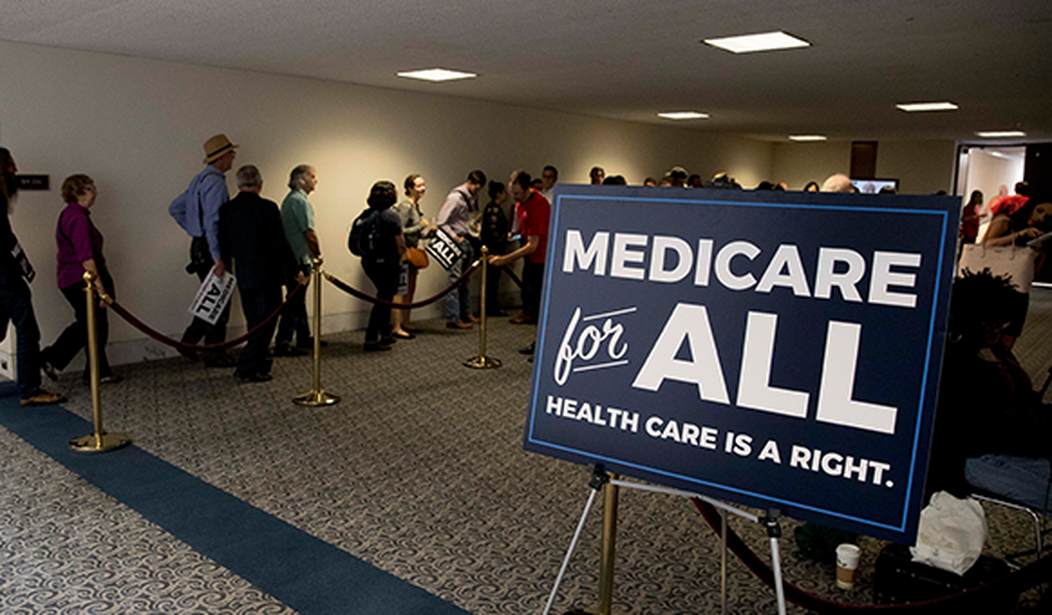
El-Sayed, a physician who once ran Detroit's health department, has built his political career on Medicare for All. He's now taking it to the Senate, and he's asking Trump and RFK Jr. to help deliver a system with no deductibles and no co-pays. In October, he told his followers on Bluesky that he believes in Medicare for All the way he believes in public schools: It's there no matter what.
[SFX: A big sigh, and mumbling under my breath.]
Fine. Let's take the analogy seriously.
Picture health insurance run like a public school. The government assigns your doctor by your home address. You pay for it through taxes whether you use it or not. If you don't like the care, you can go somewhere else — after you've paid the government anyway. And when the results stink, the answer is always more money.
Now check the results. On the 2024 Nation's Report Card, only about 30% of eighth graders read at a proficient level. A third of them couldn't reach the Basic level, the largest share ever recorded. Defenders blame COVID, but reading scores started sliding around 2017, and six states lost ground despite piles of pandemic stimulus money, according to Georgetown University's Edunomics Lab. More money didn't fix it. Let's face it: it never does.
That's the system El-Sayed wants as the template for your cardiologist.
And the price tag? A 2018 analysis by Charles Blahous, a former public trustee for Medicare and Social Security, estimated that Bernie Sanders' version would add $32.6 trillion in federal spending over 10 years. That's a lot of money to spend on a model that can't teach a third of eighth graders to read.
To be fair, El-Sayed's pitch lands because the guarantee sounds comforting, at least to folks who don't make the connections we make here every day, between government and whatever it's got its sticky fingers into. It's always the same pitch. Everybody gets in, nobody gets turned away. If you like your doctor, you can keep your doctor. Yeah, we've heard that one before, Abdul.
Truth is, a "guarantee" of access isn't a guarantee of quality, and the education system is one of the best proofs we have. Public schools are "there for you" the way the DMV is. The government healthcare experience is the same, regardless of where you go. I wrote about Canada's experience just recently . If you've not seen it, you'll want to.
Voters told pollsters this month they want relief from the cost of living. That's what the Democrats promised. What they didn't ask for was a new federal bureaucracy modeled on the one that has spent decades failing their kids, any more than they demanded massive investigation of anything to the right of Karl Marx. But that's what Democrats are pushing, now that the election is past.
Maybe the connection between government and expensive deserves a closer look. One of the best-known works on the subject is Mark Perry's "Chart of the Century," an American Enterprise Institute economist's update to a chart that has circulated at the Federal Reserve. Perry doesn't oversell it, but the data does the talking. Since 1997, hospital services, college textbooks, college tuition, and childcare have skyrocketed. The government both heavily controls and subsidizes every one of them.
Recommended: Welcome to the Political Singularity: Let’s Brand the Democrats as the Stupid Party!
Now look at what Washington pays less attention to: cellphone service, software, TVs, and other electronics. Their prices fell. Imagine that. The trends speak for themselves. Obviously, these industries aren't identical, and technology and international competition play a role in the differences. But that only strengthens the question: Why are the industries most insulated from market competition also the ones experiencing some of the most dramatic price increases?
Perry spelled it out himself:
a. The greater (lower) the degree of government involvement in the provision of a good or service the greater (lower) the price increases (decreases) over time, e.g., hospital and medical costs, college tuition, childcare with both large degrees of government funding/regulation and large price increases vs. software, electronics, toys, cars and clothing with both relatively less government funding/regulation and falling prices. As somebody on Twitter commented:
Blue lines = prices subject to free market forces. Red lines = prices subject to regulatory capture by government. Food and drink is debatable either way. Conclusion: remind me why socialism is so great again.
b. Prices for manufactured goods (cars, clothing, appliances, furniture, electronic goods, toys) have experienced large price declines over time relative to overall inflation, wages, and prices for services (education, medical care, and childcare).
c. The greater the degree of international competition for tradeable goods, the greater the decline in prices over time, e.g. toys, clothing, TVs, appliances, furniture, footwear, etc.
Notice that education is one of the victims of government control. And now Abdul El-Sayed wants to use that very system as his model for healthcare.
Maybe somebody should explain to him that the problem with government-run education isn't that we haven't spent enough money on it. The problem is that we've spent decades confusing government involvement with actual results.
Now he wants to apply that same philosophy to your health.
What could possibly go wrong? If he and the Democrats in Congress get their way, I fear that we're going to find out.
= = =
Thought for the day: The surest way to make something expensive is to promise from government that they're going to make it affordable.
VIP members: What think you? Your voice matters.
Take care today, gang. Thanksgiving tomorrow. Get to bed a bit early; you've got a long day ahead of you tomorrow. I'll have a special piece on Thanksgiving I'd like you to share, too. See you then.
Editor’s Note: Every single day, here at PJ Media, we stand up and FIGHT, FIGHT, FIGHT against the radical Left and deliver the conservative reporting our readers deserve.
Help us continue to tell the truth about the Trump administration and its successes. Join PJ Media VIP and use promo code FIGHT to receive 60% off your membership.

Join the Conversation
VIP members get the ability to comment on articles.