I’m going to start here with something I’d like you to think about tomorrow, which is Easter Sunday.
The Easter story is a completely unlikely story, if you think about it, and it’s even unlikelier that the story would continue to be retold a little over 2000 years later. But so it is retold, and continues to become stronger in the retelling.
There’s an awful lot in the story which is hard for some people to believe; the Jesus lived to begin with, that he died and God raised him up, all on our behalf, and that by our being bonded to Christ through baptism we too, are raised up. That his resurrection has given us victory over sin, so that death and evil cannot finally triumph. Because of the resurrection, death has lost its sting, as Paul told us.
But these are the amazing convictions that make up what we know as the basic tenets of Christianity. And those points, that faith, and that conviction, are why we celebrate.
It is easier for us to focus on Easter and the empty tomb while passing over lightly the story of Good Friday. Pain avoidance, after all, is a natural thing. It is far easier to view the famous picture of the young couple on VE day in Times Square, in wild celebration of that day, than it is to view pictures of people fighting to secure that victory. Thing is, you can't have that celebration without having fought to win it.
By the same token, then, it's easier to celebrate Easter, than it is to go through Good Friday. Remember, however, that there can be no Easter without Good Friday. They are, therefore, of precisely equal import. I am not a Catholic, having been raised in the Lutheran tradition, but I cannot speak to these issues fully without invoking a better wordsmith than myself. I can’t think of a better way to address these issues, nor a harder timeframe, and so I’ll offer this for your thought for today:
With the all-too present world war as a backdrop on Easter Sunday, April 5 of 1942, Archbishop Fulton J Sheen, during his radio show that day, said:
Friends, celebrating Easter in a world that is more like a Good Friday and hearing the chance of peace amidst the explosions of war makes us wonder what lesson this blessed feast could have for these tragic days?
[...]
Evil has its hour, but God has his day. And that evil hour is inseparable from God’s day
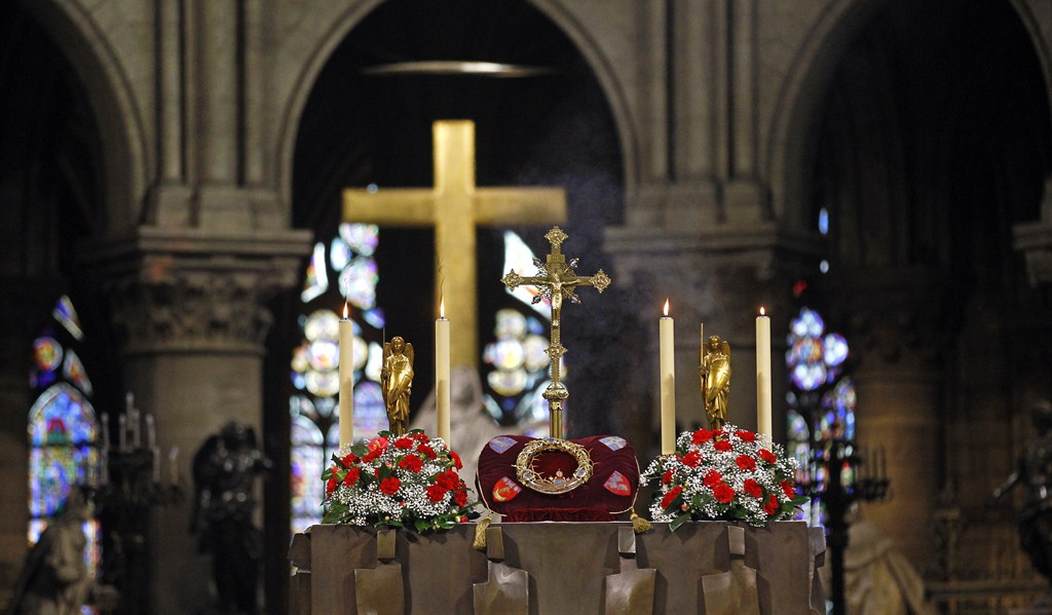
Without the war with evil in its hour, there will never be the day of peace. Unless there is a Good Friday in our lives, there will never be an Easter Sunday. Unless there is the crown of thorns, there will never be the halo of light. Unless there is the scourged body, there will never be the glorified body. And there is the answer to the question of Easter.
As the Easter season rolls around, we as Christians are often asked, how can we support the violence of war? Obviously, and rightly, that question focuses on Iran these days. Sheen, on that Sunday long ago, spoke up in the midst of another, arguably more violent and bloody war to remind us:
Our Blessed Lord never said, ‘Blessed are the peaceful.’ But he did say, ‘Blessed are the peacemakers.’ Peace must be made. It must be won in a battle. Good Friday was not the day of appeasement. Therefore, Easter was not a day of false peace.
No, indeed, it was a battle won, a peace created by overcoming evil. Put another way, I think it was Gordon Lightfoot who sang “To wear the Crown of Peace, you must wear the Crown of Thorns.”
As I have said often enough, peace, real, lasting peace, is not a product of disavowing war, or of thinking peaceful thoughts. Nor is it the product of negotiated settlements. Peace, real peace is the product of winning the war brought against you, with sufficient force to prevent any ideas of trying it again. Christ accomplished this.
To those who decry the violence being shown us at the moment in Iran as being “hateful,” I suggest this is backwards. The Islamic Republic, as I’ve written just recently, has been at war for its entire existence, a bit over 47 years, if you count the revolutionary period. Our current efforts there are to put an end to that war by overcoming the violence that the Iranian regime has been inflicting on the rest of the world, and taking away the option of ever breaking that peace again.
I also offer the thought that G. K. Chesterton expressed, and which applies to our current situation: “A real soldier does not fight because he has something that he hates in front of him. He fights because he has something that he loves behind his back.” The Islamic Revolutionary Guard Corps desperately hiding behind Iranian civilians, as if they were hostages, graphically represents that concept, and that juxtaposition.
Are the our people in uniform, over in Iran and the surrounding area, Christlike heroes? I think so, since those who create real peace always are, but let’s define the attitudes of the people creating the peace, shall we? I said on Veterans Day last year:
These people loved, they laughed, they cried. They had a favorite food, a favorite color. A particular bit of music or of poetry stirred their souls like none other, just like we ourselves. Every bit as much as you and I love our lives, they loved theirs. Their lives were as precious to them as yours is to you. Their loss was as keenly felt by their loved ones as yours would yours. And yet, they put their lives at risk, and in the end, many lost them, for something they saw as bigger, something larger than themselves.
I had a neighbor, years ago, whose father needed a liver transplant. This neighbor willingly gave up part of his liver to be transplanted into his father. A noble action, certainly, commendable, and impressive. His family has since moved on, but to this day, I happen to think the world of the guy. But with all respect to my neighbor, the choice to do that is comparatively easy to make. He knew and loved his father, and the sacrifice was fairly light by comparison. His father lived another five years, which was a blessing to them both and the rest of the family and friends surrounding them. Every time I saw his father, I smiled because I knew what it took to make his still being there, possible.
Now, stop and think for a moment: As noble as my friend's action was, how much more noble is a sacrifice of one’s life for people that one will never meet?
Well, here it is: The people we honor today, alive or dead, those who returned to civilian life or those whose lives were lost in pursuit of that service, gave of themselves for the benefit of people they would never know. You and I and countless others from many nations. If not for their sacrifices, you’d not be reading this, because I’d not have written it, and I don’t doubt for a moment that we’d be living in a very different world, most likely one not nearly as good to us as this one has been.
As I said opening my column yesterday, No greater love.
As important as those efforts were and are to us, the war that Christ fought was all the more important and vital. On Good Friday, Christ was in reality fighting a war against evil. In fighting that war, he was about creating the peace. That act of love, as Chesterton defined it, was a war he won for those standing behind him — as nobody else could — with the empty tomb.
Yes, you and I.
Happy Easter.