





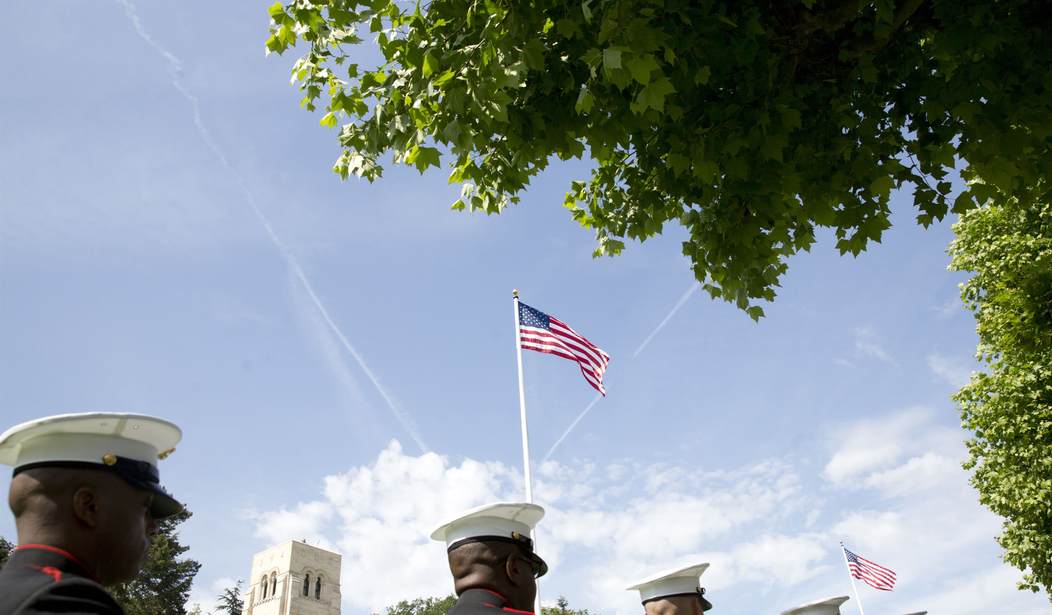
Memorial Day asks Americans to remember men and women who gave everything for our country, including some whose wars have slipped from common memory. The Mexican-American War of 1846 to 1848 rarely receives the attention given to the other major conflicts the United States fought. From Northern Illinois University.
The United States' armed conflict with Mexico largely emerged from Americans' eagerness to expand their nation westward to the Pacific Ocean. As American trappers and settlers poured across the Great Plains, many began to resent the fact that lands to the south and west of the Louisiana Purchase tract remained territories of Mexico, which had freed itself from Spanish colonial control in 1821. Americans' persistent attempts to settle these lands led to conflict with the Mexican government and, eventually, war.
The Mexican Republic had welcomed Americans to settle in their northern territory of Texas in the 1820s, but after a decade it became plain that the Americans disliked Mexican rule. In 1835 the American settlers revolted against Mexico and, in the following year, established their own Republic of Texas. Many Americans immediately began to demand that their nation make Texas a part of the United States. The Mexican government warned that this would mean war.
In 1844 American elected James K. Polk as the nation's new president. Polk had campaigned on the issue of national expansion, calling for the annexation of Texas, Mexican California, and the Oregon Territory that the United States and Great Britain had occupied jointly since 1818. Just before leaving office in early 1845 President John Tyler, a Virginian seeking to provide a new area into which slavery might expand, secured a joint resolution from Congress annexing Texas to the United States. Mexico responded by breaking off diplomatic relations.
Yet American soldiers marched, fought, suffered, and died in that conflict, often far from home, under conditions most modern Americans would struggle to imagine.
ICYMI: The Small Circle They Saved and the Life They Never Got
The War with Mexico is one of my favorite topics; Robert Leckie wrote a definitive guide on American expansion from the War of 1812 to 1848. His book, From Sea to Shining Sea: From the War of 1812 to the Mexican War, the Saga of America's Expansion, is an excellent book that reads more like a narrative instead of a history book.
President James K. Polk led the country through the war after Texas joined the United States and the border dispute with Mexico hardened into open fighting. From the University of Tennessee.
Polk’s desire for U.S. acquisition of Texas, New Mexico, and California proved more difficult to consummate. Anglo settlers in Texas, rebelling in 1836, had transformed that Mexican province into a nominally independent republic. Mexico, however, had refused to recognize the secession. The lame-duck president John Tyler, in April 1841, entered office as a Whig but soon became estranged from that party. He interpreted Polk’s November 1844 election to the presidency as a mandate to grant Texas’s desire for U.S. annexation. So, in early 1845, before Polk took office, Tyler engineered the passage of a joint resolution by the U.S. Congress that offered Texas immediate statehood. Texas accepted the offer. In July 1845, with Polk’s signature, a bill granting statehood became federal law. These actions of Tyler and Polk exacerbated already-troubled U.S.-Mexico relations. By spring 1846, under President Polk, war raged between the two nations. In 1848, under the terms of the Treaty of Guadalupe Hidalgo, signed that February, Texas, New Mexico, and California all came under uncontested U.S. dominion.
Maj. Gen. Zachary Taylor moved American troops into the contested region near the Rio Grande, where early clashes helped ignite the conflict. Taylor later won major victories at Monterrey and Buena Vista, while Maj. Gen. Winfield “Old Fuss & Feathers” Scott led a separate campaign from Veracruz toward Mexico City.
Scott duplicated Cortez's act of burning his ships so his men had no choice but to march and fight.
The war changed the American map. Diplomat Nicholas Trist negotiated the Treaty of Guadalupe Hidalgo, signed on February 2, 1848. Mexico recognized the Rio Grande as the border with Texas and ceded land that later became all or part of California, Nevada, Utah, New Mexico, Arizona, Colorado, and Wyoming.
The United States paid Mexico $15 million, and the agreement helped set the stage for a continental nation, but the land came attached with graves, grief, and questions Americans would keep arguing over for generations.
The Mexican War also served as a grim classroom for officers who later faced one another in the Civil War. Ulysses S. Grant, Robert E. Lee, Thomas “Stonewall” Jackson, George Meade, and Jefferson Davis all served in or around the conflict.
Many young officers learned war's mechanics there, then carried those lessons into a far bloodier struggle less than two decades later. History often moves that way, with one battlefield quietly training men for another. From the Constitution Center.
In the fighting that followed, the mostly-volunteer United States military secured control of Mexico after a series of battles, and the Treaty of Guadalupe Hidalgo was signed on February 2, 1848.
It was the first large-scale success of a United States military force on foreign soil.
Mexico received a little more than $18 million in compensation from the United States as part of the treaty.
The pact set a border between Texas and Mexico and ceded California, Nevada, Utah, New Mexico, most of Arizona and Colorado, and parts of Oklahoma, Kansas, and Wyoming to the United States. Their transfer to the United States’ control also cut the territorial size of Mexico in half.
On the surface, the war’s outcome seemed like a bonanza for the United States. But the acquisition of so much territory with the issue of slavery unresolved lit the fuse that eventually set off the Civil War in 1861. But the underlying issue was how adding new states and territories would alter the balance between free and slave states was critical.
On the battlefield, Robert E. Lee, Ulysses S. Grant, and Stonewall Jackson were among those who served in the war against Mexico who would later gain prominence in the American Civil War.
For ordinary soldiers, glory rarely looked glorious; disease killed many more Americans than combat. Heat, poor sanitation, long marches, thin supplies, and unfamiliar terrain wore men down.
Some left farms, shops, and young families because their country called. Others joined for pay, adventure, duty, or the restless pull of a growing nation. Their motives differed, but death treated them without ceremony.
Mexico City National Cemetery carries the deepest Memorial Day lesson from the war. Congress established the cemetery in 1851, and American remains from nearby battlefields were gathered there. A monument marks a common grave for 750 unidentified American soldiers; its inscription reads, “To the honored memory of 750 Americans known but to God.”
Those words land harder than any parade speech because they strip memory down to its most sacred form. No hometown, no family name, no final letter read beside a kitchen stove. Only sacrifice, known fully by God and partially by a nation willing to pause.
Memorial Day makes room for these soldiers, too. The war with Mexico brought expansion, victory, controversy, and consequences. It also brought young Americans to foreign soil, where some never rose again. Remembering them doesn't mean ignoring the arguments over the way; it requires letting those arguments bury the men who paid the final price.
A nation stays healthier when it remembers more than its famous battles. Memorial Day belongs to the known and the unknown, the celebrated and the forgotten, the soldier buried under a marble marker, and the soldier resting in a common grave far from the fields he once knew.
The Mexican War dead still belong to the American story. Their names may not fill schoolbooks, but their sacrifice still asks for a moment of silence.
Readers who value thoughtful historical reflection and independent analysis can become VIP subscribers. Use promo code FIGHT for 60% off and get full access here.


Join the Conversation
VIP members get the ability to comment on articles.