





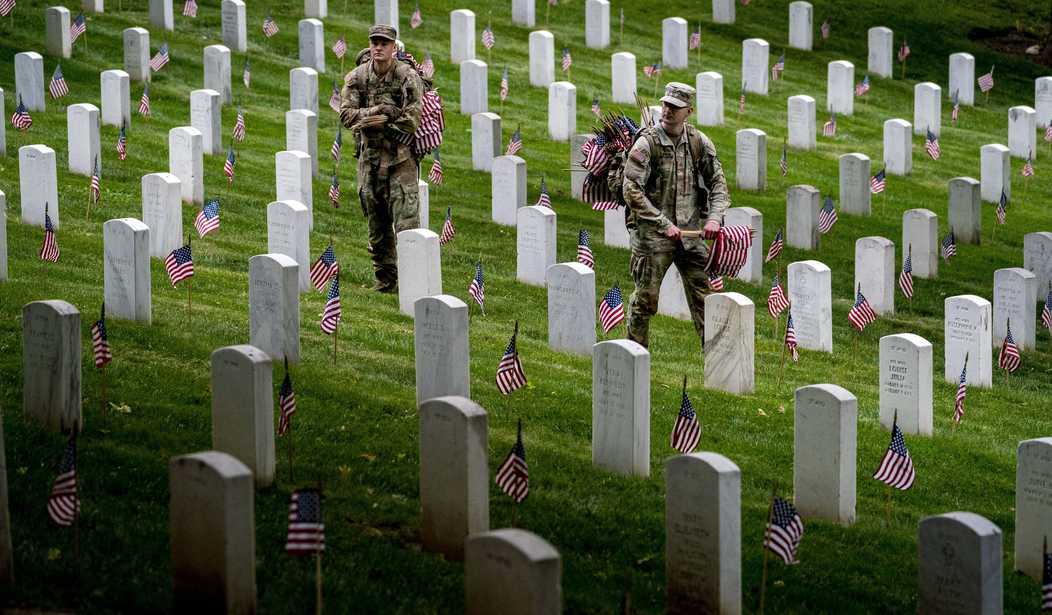
It's Memorial Day, and America does what America does: flags will move in the breeze, lawns will get mowed, and meat will hit the grill. Families gather beneath a sky that asks nothing from them except gratitude, and even then, it asks quietly.
Memorial Day began as Decoration Day after the Civil War, when Americans placed flowers on the graves of the war dead. The holiday still carries that first command: remember the men and women who died while serving their country.
Most Memorial Day columns lean on familiar phrases, because those phrases hold true: Sacrifice matters, freedom carries a cost, and the dead deserve honor. Nothing about those words is wrong; the trouble is that repetition sands down the meaning until it feels polished, proper, and painless.
Sacrifice was never painless; it wasn't a marble word carved into a courthouse well; it was a breath, a choice, a last look, a hand reaching toward a friend, a body moving before the mind had time to bargain.
The first circle of sacrifice was usually small. It wasn't an abstract speech about liberty or a civics lesson whispered beneath artillery fire. It was the man in the next foxhole, the Marine on the left, the soldier bleeding in the vehicle, the pilot waiting for rescue, and the corpsman crawling through smoke.
Men didn't always die with the whole republic arranged in their minds like a school map. Many died trying to save the few people close enough to hear them breathe.
Army Pfc. Ross McGinnis saw a grenade land inside his Humvee in Iraq on Dec. 4, 2006. He warned the others, then covered the grenade with his own body. The Army says he absorbed the blast and saved the soldiers around him.
He absorbed the blast and saved the soldiers around him.
That sentence is almost too clean for what it describes. A young man from Pennsylvania had a few moments to decide whether his friends would live, and he spent those moments giving them the rest of their lives.
Navy Lt. Michael P. Murphy made his choice on an Afghan mountain on June 28, 2005. His SEAL team had come under heavy fire, and Murphy moved into exposed ground to call for help. He was already wounded, yet he still made the call.
He still put the lives of his men ahead of his own chance to survive. The Navy's account of his Medal of Honor action preserves the facts, but facts can only carry us so far. Somewhere inside those facts stood a man who knew the circle around him was shrinking, and still refused to step outside it.
Marine Gunnery Sgt. John Basilone had already earned the Medal of Honor for heroism at Guadalcanal. He could've remained stateside as a living symbol, shaking hands, selling bonds, and accepting a country's applause.
Instead, he returned to combat and died on Iwo Jima on Feb. 19, 1945.
Basilone's life reminds us that courage isn't always one thunderclap. Sometimes, it returns after the parade, after the medals, and after the country has already said thank you.
That small circle is where sacrifice becomes visible. A man may love his country, but he can see his friend's face, he can hear panic in another man's voice, and he can feel the terrible speed of time narrowing to a single awful choice.
That choice is his; no committee writes it, no politician owns it, and a speech can't improve it. A fallen service member often dies first for the people beside him and, by extension, for the people behind him.
That second circle is much larger; it reaches past the battlefield, past the regiment, past the flag folded into a triangle and handed to a family that will never hear the front door open the same way again. It reaches into suburbs, farms, factories, churches, ballfields, and little towns where most people will never know the names carved into the stone.
The fallen gave their friends another morning; they also gave strangers a country where mornings could still arrive in peace.
That is the part Memorial Day should make harder to forget. The dead didn't only lose their lives; they lost the life they never got. No old age, grandchildren tugging at their sleeves, no second career, no worn recliner, no bad jokes at Thanksgiving, no quiet porch with a dog sleeping nearby.
They gave up every ordinary thing people spend most of their lives chasing, and they did it so others could keep living ordinary lives without thinking much about why.
America owes them more than a gesture, but gratitude begins with attention. Not guilt or politics, not even some heavy performance that makes the living feel noble for feeling sad. Attention is simpler and harder; it means seeing the grave not as a symbol, but as an interruption.
An entire future stopped there; a whole family line changed course there, and a friend came home because someone else didn't.
The small circle they saved became the larger circle we inherited. McGinnis saved the men in his Humvee. Murphy tried to save his team. Basilone returned to the fight when he had already given enough for any honest measure.
Their stories differ in place, war, and circumstance, but they meet in the same grave truth: Sacrifice begins close enough to touch and expands until it covers a nation.
Memorial Day shouldn't flatten the fallen into a slogan; it should restore them, as much as words can, to flesh and choice and consequence. They were sons, brothers, husbands, fathers, friends, and comrades. They were also guardians of a country full of strangers who would one day mow lawns, grill burgers, watch ballgames, argue politics, raise children, and sleep beneath the protection their sacrifice helped preserve.
The least we can do is remember both circles: the friends they saved in the moment and the country they saved beyond their sight.
At PJ Media, we don’t treat Memorial Day like another long weekend with better meat prices and worse traffic. We tell the stories that still deserve a place at the American table. Join PJ Media VIP today and use promo code FIGHT for 60% off.
Join the Conversation
VIP members get the ability to comment on articles.