







What do we mean by the Revolution? The war? That was no part of the Revolution; it was only an effect and a consequence of it. The Revolution was in the minds of the people, and this was effected, from 1760 to 1775, in the course of fifteen years before a drop of blood as shed at Lexington. The records of thirteen legislatures, the pamphlets, newspapers in all the colonies, ought to be consulted during that period to ascertain the steps by which the public opinion was enlightened and informed concerning the authority of Parliament over the colonies.
—John Adams to Jefferson, 1815
Pamphlets were cheap, could be mass-produced by anyone with a printing press, and were versatile. They could be high-brow or low-brow, with length varying from a couple of pages to around eighty. Americans could not match the witticism and skilled prose of famed English pamphleteers such as Locke, Swift, and Defoe, but they had no need of that. They were polemicists, not literary artists. There were arguments to be made, and the public to be convinced.
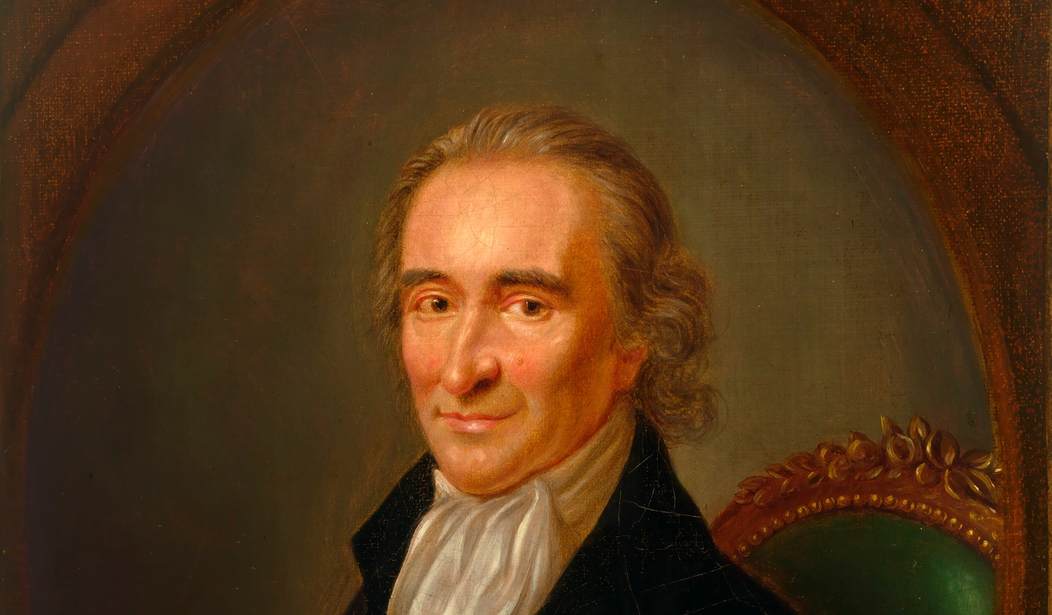
The most famous of these pamphlets, and one with tremendous effect upon raising revolutionary fervor, was Thomas Paine’s Common Sense, with its sweeping declaration that “we have it in our power to begin the world again.” It was not well-met by the more sober-minded such as John Adams, who, while accepting the reasoning leading to independence, was horrified by Paine’s proposition for one huge directly elected chamber with all powers combined.
Adams was convinced by Richard Henry Lee to publish a counter-pamphlet entitled Thoughts on Government. In it, he wrote that “a single assembly is liable to all the vices, follies and frailties of an individual… is apt to be avaricious… ambitious… and after a time will not hesitate to vote itself perpetual.” It would also be unqualified to exercise executive and judicial power. Here we see in this exchange of pamphlets the refining of what government should look like in the new United States of America.
Adams later recounted that Paine was upset by this and visited Adams, where he was lodging in Philadelphia. The two were cordial, but Paine expressed a fear that Adams’ pamphlet would undo his own and was “repugnant.” “I told him it was true that it was repugnant and for that reason I had consented to the publication of it,” Adams wrote, “for I was as much afraid of his work as he was of mine. His plan was so democratical, without any restraint or even an attempt at any equilibrium or counterpoise, that it must produce confusion and every evil work.”
Commemoration orations on March 5, the anniversary of the “Boston Massacre,” were mass-produced as pamphlets and were increasingly filled with the philosophical underpinnings that would find their way into the Declaration of Independence. (For the facts of the so-called “Massacre,” please see our And Justice for All, Even Redcoats.) In 1773, Dr. Benjamin Church was already holding forth that “when rulers become tyrants they cease to be kings,” and “to enjoy life as becomes rational creatures, to possess our souls with pleasure and satisfaction, we must be careful to maintain that inestimable blessing, LIBERTY.”
When Dr. Joseph Warren delivered his commemorative speech on March 6, 1775, in the Old South Meetinghouse, redcoats were once again occupying Boston and stood menacingly in the aisles and in front of the pulpit. Warren warmed up the crowd with the by-now well-known argument that Parliament is allowed to tax the British people because it was they who elected them. American colonists did not elect them. They are individuals with rights, and not the property of the British people. Warren went on to rhetorically splash his presentation with blood:
“The many injuries offered to the town, I pass over I silence. I cannot now mark out the path which led to that unequaled scene of horror, the sad remembrance of which, takes the full possession of my soul. The sanguinary theatre again opens itself to view. The baleful images of terror crowd around me, and discontented ghosts, with hollow groans, appear to solemnize the anniversary of the FIFTH of MARCH.” Practically daring the redcoats to arrest him then and there, Warren went on to point out that the revocation of the Massachusetts charter and the reoccupation of the town “has made every other colony jealous for its own.” Attempts to preserve both peace and liberty have been made:
“But if these pacific measures are ineffectual, and it appears that the only way to safety, is through fields of blood, I know you will not turn your faces from your foes, but will, undauntedly, press forward, until tyranny is trodden under foot, and you have fixed your adored goddess LIBERTY, fast by a Brunswick’s side, on the American throne.”
Demand for the pamphlet version of this speech was such that the printers, Edes and Gill, had to print multiple editions. They kept running out.
As we celebrate the 250th Anniversary of our founding, let us step out of our silos and echo chambers and, as our founders did, engage for the purpose of persuasion. Ignorance of our founding principles can sometimes be deliberate, but more often than not, it is involuntary and easily remedied by revelation.
Editor's Note: It’s America’s 250th birthday! Help PJ Media celebrate the greatest nation in history by honoring its past, defending its present, and preserving its future with reporting you can trust.
Join PJ Media VIP and use promo code AMERICA250 to receive 74% off your membership.


Join the Conversation
VIP members get the ability to comment on articles.