
The early summer of 1776 was brutally hot in Philadelphia. Thomas Jefferson sweated the nights away in his second-floor apartment at the Graf House, wishing he were back in Virginia. He was planning a trip to Monticello before the end of June if Congress would cooperate.
The faction in Congress that favored independence was growing by the day, but opponents were trying to force an early vote, knowing that at least two colonies would vote "nay." Any opposition to independence would kill the idea, since a colony that opposed independence would be forced to take up arms against its sister colonies.
In truth, the opposition by South Carolina and Pennsylvania was based on the need for assurances about a future United States. Both colonies originally voted against independence, but later changed their votes to make the vote unanimous.
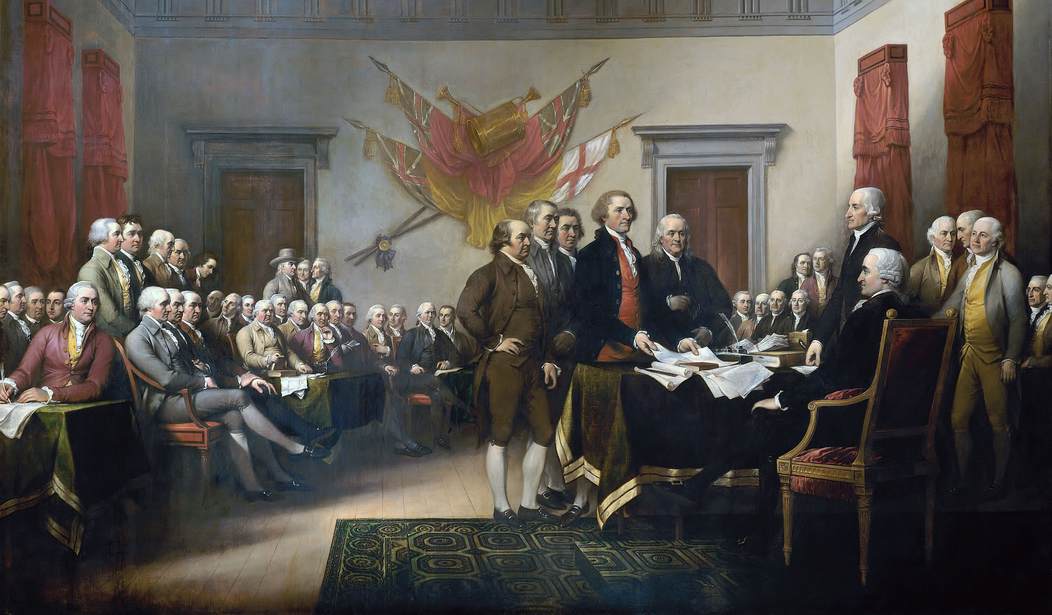
John Adams had been agitating for some kind of "declaration" that would put the case before the world for American independence from Great Britain. On June 11, Congress appointed the "Committee of Five"— consisting of Thomas Jefferson, John Adams, Benjamin Franklin, Roger Sherman, and Robert R. Livingston — to draft the document.
Jefferson was chosen to write the primary draft, which he did over the following seventeen days at the Graff House. He consulted primarily with Adams and Franklin, who made minor revisions.
Adams' focus was often more on the legal and political act of independence itself rather than just the rhetorical document we know today. Adams argued that no European power (specifically France or Spain) would treat with the colonies or provide military aid as long as they were seen as "rebels" against their legal sovereign. A formal declaration would signal that the colonies were now a sovereign nation capable of making treaties. He believed it was necessary to justify the overthrow of the established colonial governments and the creation of new state constitutions.
Why? Adams believed the rest of the world would want to know the why, and not just the rhetorical flourishes and flowery language about equality and "inalienable rights." Adams suggested specific, detailed reasons for why separation was absolutely necessary.
Adams and Jefferson listed 27 grievances against the crown to justify rebellion. Jefferson included a 168-word passage that fiercely attacked the King for "waging cruel war against human nature itself" by keeping open a market in which men are bought and sold. He accused the King of suppressing every legislative attempt to prohibit or restrain the commerce of slavery.
There were actually very few "legislative attempts" to prohibit or even limit slavery. Too much wealth in the South was tied up in slaves, and the shipping of slaves was a very profitable business for northern seaports and shippers. The entire 168 words were struck from the declaration.
Historian Robert Parkinson, author of Tyrants and Rogues: Understanding the Declaration of Independence, argues that the 27 grievances are "the real heart of the document."
"These grievances not only laid out the reasons for a revolution, but galvanized the American people to take up arms against the crown," notes Eli Lake of The Free Press.
Parkinson divides the grievances into three groups.
The first 12 are executive overreach. The next 10 are what’s referred to as “acts of pretended legislation,” meaning, If these legislative policies come out of a jurisdiction foreign to our constitutions, then they have nothing to do with us. And the last five are acts of war. The grievances grow in drama as you go further down. Looking just at the verbs, as we get into the acts of war, the language becomes much more passionate. Jefferson as an essayist is building toward a dramatic dismount.
"He has constrained our fellow Citizens taken Captive on the high Seas to bear Arms against their Country, to become the executioners of their friends and Brethren, or to fall themselves by their Hands. This was a very sore spot in the colony's relations with the crown. "Impressment" would continue until we fought another war against England to end it.
"He has excited domestic insurrections amongst us, and has endeavoured to bring on the inhabitants of our frontiers, the merciless Indian Savages, whose known rule of warfare, is an undistinguished destruction of all ages, sexes and conditions." Many Continental soldiers who lived on the frontiers of New York, Pennsylvania, and the Southern colonies lived in constant fear that their loved ones were exposed to native American depredations. Thousands of settlers were killed, including women and children. This was seen as one of the more legitimate grievances by Europeans who could empathize with the colonists, and not to mention, it angered other colonists who believed the King was capable of anything.
The grievances are often given short shrift on Independence Day because many of them are exaggerated, and some simply aren't true. Jefferson and Adams didn't necessarily care about accuracy as much as they wanted to inflame the passions of the people — just as any good political document would.
Also for our VIPs: The Problem Today is That Stupid People Are Sure of Themselves While Intelligent People Are Full of Doubt