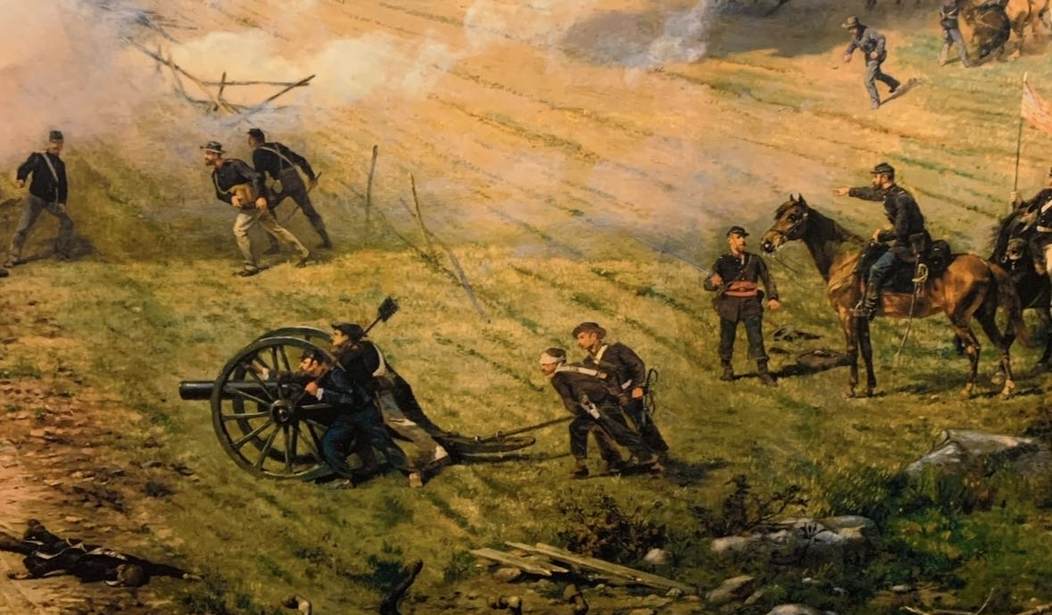

The Union victory at the key Battle of Gettysburg occurred on July 3, 1863. It was the bloodiest battle of the Civil War, with three days of killing that left 50,000 dead. It was also the turning point of the war, signaling the ultimate victory the Union would have over the traitors and slaveowners.
While Abraham Lincoln did not deliver his Gettysburg Address until November of that year, when he dedicated the cemetery to the soldiers who fell during the battle, the ending lines of that address seem particularly applicable as we’re about to celebrate this very historic Fourth of July tomorrow:
It is for us the living, rather, to be dedicated here to the unfinished work which they who fought here have thus far so nobly advanced. It is rather for us to be here dedicated to the great task remaining before us — that from these honored dead we take increased devotion to that cause for which they gave the last full measure of devotion — that we here highly resolve that these dead shall not have died in vain — that this nation, under God, shall have a new birth of freedom — and that government of the people, by the people, for the people, shall not perish from the earth.
The question or challenge I want to present to my fellow Americans as we celebrate the 250th birthday of America is whether we are dedicated to the cause of liberty to the point of sacrificing everything, even our lives, for it. Because it is terrifyingly and undoubtedly true that patriotism is at a low ebb and Democrats are as determined now to destroy this country as they were when they launched the Civil War. Too many Americans either hate America, are apathetic about America, or say they love America but are not willing to risk anything for her.
The spirit of the soldiers who fought during the revolution or during the Civil War was very different. So was the passion of patriotic civilians then. I think we absolutely can have a resurgence of such a fervor, but the renewal starts with each one of us. We can begin by enthusiastically celebrating July 4, no matter what the weather is like or how inconvenient it is to attend public events. We need to show the haters and the Communists that we love America tomorrow, heat wave or no.
During the Battle of Gettysburg, the weather was brutally hot, rather like it is this July 4 week. Fox Weather mentioned the fact that temperatures climbed into the high 80s during the battle. While that is not quite as high as the current temps in the Philadelphia area, when you add in the fact that most of the soldiers were wearing uniforms made of 100% wool, surrounded by firing weapons and crouched for long periods of time or charging across hilly terrain, the heat must’ve felt thoroughly miserable. But nothing would make the soldiers give up. I wish civilians merely running or attending America 250 celebrations in the East Coast now had the kind of stamina those soldiers did, because the Civil War battle went forward, but multiple events in 2026 are canceled.
Related: Trail-Blazing Black Politicians in the Reconstruction Era
I have previously highlighted the fact that the battle that took place at Gettysburg was very starkly a battle between those who wanted freedom for all Americans and those who were fanatically dedicated to slavery. The Confederate Army had been rampaging through Pennsylvania, rounding up and enslaving — or sometimes killing — all of the black men, women, and children whom they could find, including many who had been free their entire lives. This was a result of the official Confederate Retaliatory Act, which mandated the re-enslavement, abuse, or killing of supposed slaves in rebellion. In practice, especially among Robert E. Lee’s men, this meant the Rebs seized every black person they could get hold of in multiple states.
The Confederates even threatened to burn down the town of Greencastle because the white citizens there attacked a group of Confederates and rescued several dozen black women and children. Fortunately for Greencastle, whose citizens refused to comply with the Confederate demands, the battle at Gettysburg occurred to distract the would-be Rebel arsonists. This is the backdrop of the battle, the context that led to the fierce fighting just before July 4, the anniversary when Americans remembered a group of visionaries declaring that all men are created equal and endowed by their Creator with unalienable rights, including life, liberty, and the pursuit of happiness.
Do we believe, as the founding generation and the Gettysburg soldiers did, that all men are endowed with unalienable rights and that freedom is worth dying for? Shall we resolve that the honored dead of our past shall not have died in vain? Or will the government of the people, by the people, and for the people perish from the earth?