





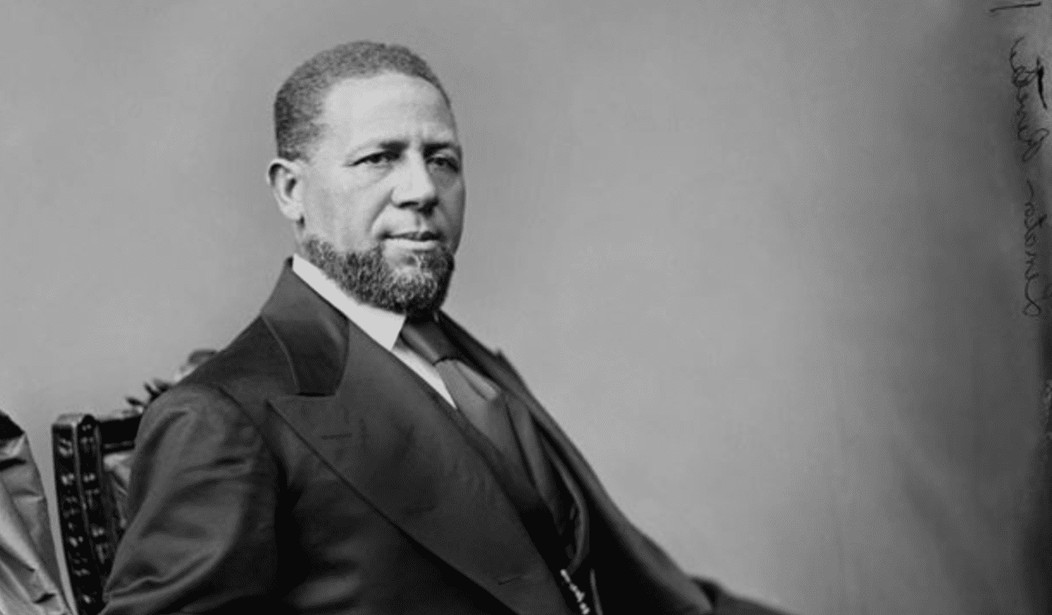
Hiram Revels (pictured) and Joseph Rainey made U.S. history as the first black men to sit in Congress, Revels as a senator and Rainey as a representative; both were Republicans. But many other black Americans also broke barriers and set new precedents during Reconstruction.
When the Democrats and Confederates lost the Civil War, they turned to domestic terrorism, election fraud, and racist legislation to continue pushing their anti-American, race-obsessed agenda. That made black Americans' quest for full legal equality all the more difficult. But it didn’t deter countless citizens — both white and black — from fighting to realize the full dream of the greatest Founders. As we prepare for America’s 250th birthday, we celebrate true civil rights warriors.
Prince Rivers went from being a slave in South Carolina, where he defied laws forbidding his becoming literate, to a runaway and then a sergeant in the U.S. Army.
“Now we can look our old masters in the face,” Rivers said. “They used to sell us and whip us, and we did not dare say one word. Now we ain’t afraid.”
After the war, he served in the South Carolina House of Representatives and then became a judge, presiding over the trials for the Hamburg Massacre, a deadly clash between violent racists and local black militia. Unfortunately, Democrat intimidation eventually forced Rivers out of office. The “old masters” didn’t give up easily on trampling black rights.
Jonathan Gibbs was the only black American whom Floridians elected to statewide office during Reconstruction, according to the National Constitution Center. Unlike many of his fellow black Republicans of that era, Gibbs was born free and received his degree from Dartmouth College. He was a Presbyterian minister in New York and Philadelphia and a delegate to the 1864 national colored convention before he moved to Florida after the Civil War.
An active Republican, in 1868, he became Florida's secretary of state, and in 1873, he received an appointment as the state's superintendent of education. Sadly, he died only a year later, but his legacy was breaking the race barrier in the southernmost state. He once said, "Give unto us the same guarantee of life, liberty, and protection in the pursuit of happiness that you so cheerfully award to others."
Related: A Reflection on Being at Independence Hall for the Independence Vote Anniversary
In Missouri, James Milton Turner was born a slave. His father, who worked as a "horse doctor," did succeed in purchasing the family's freedom in 1844, decades before the end of the Civil War, however. Turner first attended a "secret school" for slaves, according to the National Constitution Center, and then Oberlin College in Ohio. And in 1865, Turner assisted in organizing the Missouri Equal Rights League and schools for black people in the state.
Eventually, he served as Missouri assistant superintendent of education before, in 1871, President U.S. Grant appointed him ambassador to Liberia, an office he held until 1878. Turner helped further black Americans' search for full rights at both the state and national levels.
Another Reconstruction-era politician with the last name of Turner, Benjamin S. Turner, was born into slavery in North Carolina. His owner’s kids taught him to read and write. Turner became a merchant, farmer, school founder, and holder of multiple local offices in Selma before he became Alabama’s first black U.S. representative. He emphasized that he wanted to represent the poorest and/or most vulnerable Alabamans “regardless of caste or color.” He described his constituents as having “struggled longer and labored harder… than any people in the world.”
Willis A. Hodges, unlike all the above individuals, grew up in a family that was financially well-off. His mother paid a white neighbor to educate Hodges. “I glory in the fact that my grandfather fought in the cause of independence under Gen. Washington,” he said, per the National Constitution Center. Hodges helped slaves escape to freedom in the North, became an active abolitionist, and served as a guide for U.S. forces in Virginia during the Civil War. He spoke at the 1867-68 Virginia constitutional convention and served multiple local offices in Virginia, including the county board of supervisors and justice of the peace.
The struggle to uphold the founding ideals of America is ongoing, and every generation has to fight its political battles for freedom.
Editor’s Note: Every single day, especially in this 250th year of America’s existence, here at PJ Media, we will stand up and FIGHT, FIGHT, FIGHT against the radical left and deliver the conservative reporting our readers deserve.
Help us continue to tell the truth about the Trump administration and its successes. Join PJ Media VIP and use promo code AMERICA250 to receive 74% off your membership.

Join the Conversation
VIP members get the ability to comment on articles.