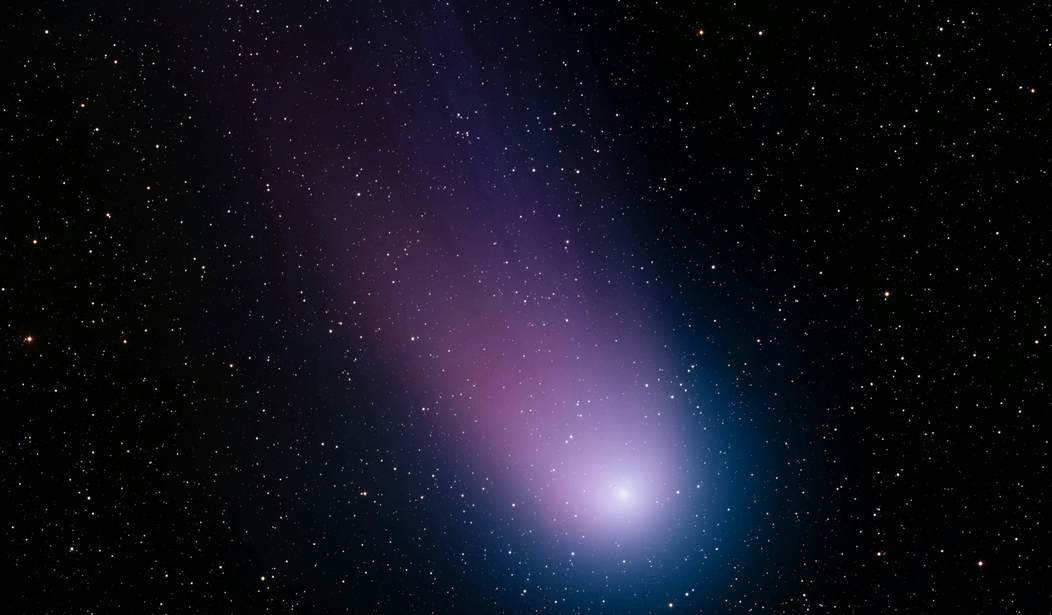

So, on Friday I did a Sky Candy that was all eclipse, and said I'd do a supplement today for some of the other pictures that I'd gathered that are cool astronomy pictures, but aren't eclipse pictures. Commenters were very enthusiastic, so that's going to be at least part of this.
I've also talked before about doing science posts, and even did one post that people seemed to like.
Then I chickened out.
So, this is where I screw my courage to the sticking place.
Here's the plan: I'm going to do some more astrophotography images here, but I'm also going to bring in some science stories. Many of them will be space-related because that's just the kind of nerd I am, but I'm also going to include some other topics as they come along. I imagine these will be weighted to astronomy/astrophysics, medicine and computers, and then anything else that comes along that looks interesting. So I hope you like it, and if you do please upvote and comment because that will make the editors happy so they'll let me continue.
Let's start with a soundtrack.
"If you want to build a ship, don’t drum up the men to gather wood, divide the work, and give orders. Instead, teach them to yearn for the vast and endless sea."–Antoine de Saint-Exupéry
Lots of gorgeous space stuff this week.
Globalstar / SpaceX Falcon 9 nebula pic.twitter.com/X33wW7KxH2
— Michael Seeley (@MikeSeeley) August 16, 2026
It happens that Uranus is tipped on its side relative to the orbital plane, and the pole is pointed in toward us. The James Webb Space Telescope got a great shot of the planet, its rings, and many of its moons. (I have an antique Merry Marvel No-Prize for anyone that can make a new joke about the Rings around Uranus. Comment below.)
This is what Uranus looks like in near-infrared, from the James Webb Space Telescope, showing the planet's ring system and 9 of its 29 moons.
— Wonder of Science (@wonderofscience) August 16, 2026
📸: NASA, ESA, CSA, STScI pic.twitter.com/C5TXLPQTi1
This is Uranus 20 years ago, with the rings edge-on. Pop orbits quiz: why is it edge on in 2007 and close to facing us now?
Hubble Space Telescope captured this rare edge-on view of the ring system of the planet Uranus on #TDIH in 2007.
— National Air and Space Museum (@airandspace) August 14, 2026
Astronomers on Earth can only see the rings' edge every 42 years due to the planet's 84 year orbit: https://t.co/bzjLF5M8DW pic.twitter.com/iy7FUDCCbB
I knew sort of intuitively what is going on in a microprocessor, and I even had a Z80 back in the day. But I never really saw it. Here's an animation.
A Z80 processor from 1976 computing 7*27. Slowed down 800000 times.
— Nicolas Loizeau (@Nicolas_Loizeau) August 15, 2026
Credit to the Visual6502 project for the circuit data.#retrocomputing #computerhistory #reverseengineering #creativecoding pic.twitter.com/i4O64tLXJw
The Vela Supernova has come up in Sky Candy before, but this is quite a collection.
A closer look at some of the most fascinating objects hidden within the extraordinary 1.3-gigapixel image of the Vela Supernova Remnant.
— World and Science (@WorldAndScience) August 15, 2026
(Credit: CTIO/NOIRLab/DOE/NSF/AURA - T.A. Rector, M. Zamani & D. de Martini) pic.twitter.com/BgUjYvnAQT
And now for something completely different. There are a lot of people who freak out at the mention of mRNA — that is, messenger RNA — which is essential in nearly all your cells. What ribosomes do is take mRNA from the genes and use transfer RNA to pull together the peptides that are assembled into proteins, a process called translation. When I was in grad school, I was fascinated by this process, which is a coding problem very much like what we do in computer science. So, in this video, a group at UC San Francisco have modified a cell to be able to see this going on in a live cell.
How can one measure the speed of a ribosome?
— Niko McCarty. (@NikoMcCarty) August 15, 2026
One option is to use a microscope. Take some human cells and add 'loops' of RNA to them. Each loop has 321 codons and encodes ten copies of a small peptide, called a SunTag.
These RNA loops do not have a stop codon. Ribosomes in the… pic.twitter.com/8c51SWwrle
One of the great puzzles in cosmology right now is what exactly happened shortly (in cosmology time, just a billion or so years) after the Big Bang. The JWST can see things that happened within a billion years or so of the Big Bang, and they don't add up with the models that we thought were pretty much settled science just a few years ago.
JWST has discovered three supermassive black holes in a single distant galaxy.
— Black Hole (@konstructivizm) August 14, 2026
Astronomers have observed three actively growing black holes in one galaxy for the first time. This suggests that mergers may have rapidly increased their mass in the early Universe.
Galaxy… pic.twitter.com/rojjAsJAs6
“The most exciting phrase to hear in science, the one that heralds new discoveries, is not ‘Eureka!’ but ‘That’s funny…’” — Isaac Asimov, at least according to /usr/bin/fortune.
Another great planetary nebula. These things are always gorgeous.
Our #HubbleTopImage features a moth-like marvel! 🦋
— HUBBLE (@HUBBLE_space) August 13, 2026
This is the planetary nebula NGC 2899, which lies approximately 4,500 light-years away in the southern constellation Vela. Its diagonal outflow of gas is propelled by radiation and stellar winds from a nearly 22,000 degree… pic.twitter.com/6jBWLq0AV5
How is Musk going to fuel Starship on the Moon and Mars without shipping fuel all the way uphill from Earth?
And that's probably enough. Thanks for coming to the new Sunday Supplement, and comment if you like it or have any suggestions. And expect a new supplement every Sunday until someone makes me stop.