







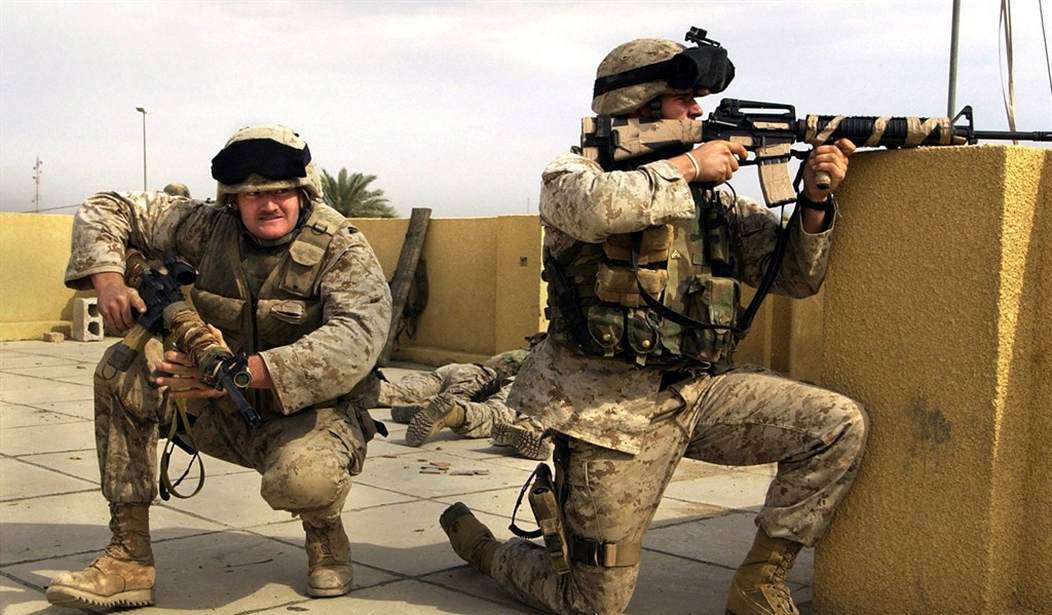
There are things in life you can understand by watching a documentary, reading a book, or listening to someone describe them. And then there are things you can only begin to understand by living through them. Combat belongs firmly in the second category.
I have never served in the military. Although my family currently does. I have never worn the uniform, carried a rifle into battle, or had to make the decisions that young Americans are asked to make when the shooting starts. I won't pretend otherwise. Verbal bullets don't count. But I have enormous respect for those who have, and I believe their stories deserve to be heard, especially in a country that can move on from a war long before the men who fought it have had a chance to come home from it.
That is why I invited Major Scott Huesing, USMC (Ret.), to Dangerous Laughter to discuss the 20th anniversary of the Battle of Ramadi. Huesing spent 24 years in the Marine Corps, serving in ten combat deployments across Iraq, Afghanistan, and the Horn of Africa. In Ramadi, he led Echo Company, Second Battalion, Fourth Marines, through one of the bloodiest and most punishing battles of the Iraq War.
Ramadi was not some distant battlefield where the enemy conveniently wore a uniform and stood in the open. It was a city of more than 300,000 people, and insurgents were embedded among the civilian population. They hid weapons in homes, threatened residents who cooperated with American forces, and turned ordinary streets and buildings into killing zones. Marines had to fight their way through the city while protecting the very civilians the enemy was using as cover. It was urban warfare at its most brutal, house by house, room by room.
During our conversation, I tried to get across something that I suspect most Americans have never really considered. Imagine fighting your way through a city like Ramadi, except the streets and buildings look more like Georgetown in Washington, D.C., That gives you some sense of how close the danger could be to ordinary life. Huesing described days when the Marines were in contact with the enemy five, six, even seven times, with firefights that could stretch for hours. This wasn't a scene in a movie. It was the daily reality for the men under his command.
The timing of the battle makes the anniversary especially sobering. In 2006, while Washington was consumed by midterm elections and the political argument over Iraq, Marines were trying to survive one of the most dangerous assignments imaginable. Americans at home were debating the war's direction and the administration's decisions. In Ramadi, the questions were immediate and unforgiving: Where is the enemy? Is that building occupied? Who is covering the next street? How do I get my people through this alive?
I asked Huesing what courage actually feels like under fire. We toss the word around rather casually, often treating it as the absence of fear. But that sounds like an idea invented by someone who has never been shot at. Huesing's answer was grounded in the reality of the moment. When the fighting is intense, you are focused on the mission, your fellow Marines, and the next task in front of you. You don't have the luxury of contemplating your own bravery. You rely on your training, your team, and the trust built through months and years of preparation. Courage is often simply doing what must be done while knowing exactly how much is at stake.
One of the most difficult parts of our conversation came when we discussed the calls Huesing had to make to families whose Marines did not come home. He had written about those calls years earlier, and the subject still carries a weight that is difficult to convey. Behind every casualty is a family whose world has been permanently changed. A Marine's death is not confined to a battlefield report or a line in a history book. It follows parents, spouses, children, and friends for the rest of their lives. There is no clever line that makes that easier. There is only the responsibility to remember.
Huesing's book, Echo in Ramadi: The Firsthand Story of the U.S. Marines in Iraq's Deadliest City, gives readers a window into that experience. What makes the account meaningful is not simply the description of firefights or military operations. It is the attention to the men who endured them, the bonds they formed, and the families who supported them. The dedication itself honors the Marines of Echo Company who fought and died, along with the families whose unwavering support sustained them. Those are not ceremonial words. They are the people behind the history.
There were also moments in the conversation that reminded me how far the consequences of that service can reach. Huesing spoke about an Iraqi interpreter known as Big Sam, whose relationship with the Marines became something much larger than a wartime partnership. Sam eventually became an American citizen and went on to serve in the U.S. Navy. His story is a reminder that the relationships forged in war can continue long after the shooting stops, and that the people who stand alongside American service members sometimes make extraordinary sacrifices of their own.
Today, Huesing has carried that commitment into a different mission through Solid Copy Media, helping veterans tell their stories and bring them to readers. It is a fitting next chapter for a man who understands that the history of war is ultimately the history of the people who lived it.
We also touched on a harder question: What did winning in Iraq and Afghanistan actually mean? The men on the ground could accomplish their missions, defeat an enemy in a particular fight, and protect the people beside them. But the larger political objectives were often less clear. That tension deserves honest discussion.
Sound familiar?
Asking what our country hoped to achieve does not diminish the service of those who were sent to achieve it. If anything, it makes our obligation to understand their experience even greater.
The 20th anniversary of Ramadi should remind us that history is not just a collection of dates, maps, and political arguments. It is made by people. It is made by young Americans who walked into streets where danger waited behind every door, by commanders who carried the responsibility for their Marines, and by families who waited at home, hoping the next phone call would bring good news.
I cannot claim to know what Scott Huesing and the Marines of Echo Company experienced. I can listen. I can ask questions. And I can try to help make sure their stories are not swallowed by election talk, the next salacious headline, or some partisan argument in Washington.
Twenty years ago, while much of America went about its ordinary life, these men were in Ramadi doing a job most of us will never be asked to do. We owe them more than a passing thank-you. We owe them our attention, our respect, and the simple decency of never taking their sacrifices for granted.
Editor's Note: Do you enjoy PJ Media's conservative reporting exposing the radical left and woke media? Support our work so we can keep bringing you the truth.
Join PJ Media VIP and use promo code FIGHT to receive 60% off your membership.

Join the Conversation
VIP members get the ability to comment on articles.