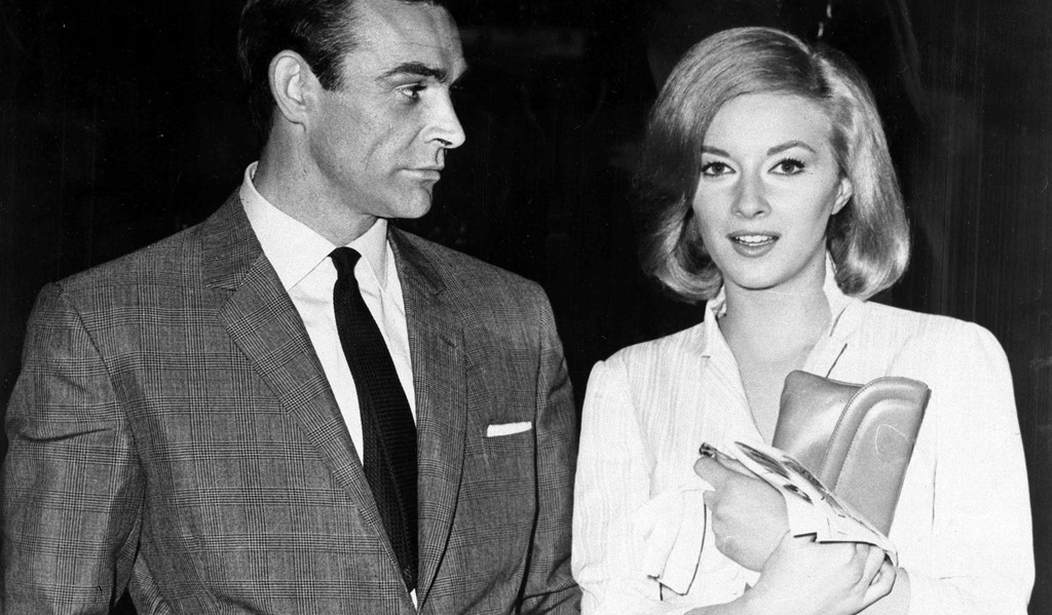

“I think you’re a sexist, misogynist dinosaur. A relic of the Cold War, whose boyish charms, though wasted on me, obviously appealed to that young woman I sent out to evaluate you.” —Judi Dench as M to Pierce Brosnan's James Bond in GoldenEye, 1995
Note: Most Thursdays, I take readers on a deep dive into a topic I hope you'll find interesting, important, or at least amusing. These essays are made possible by — and are exclusive to — our VIP supporters. If you'd like to join us, take advantage of our 60% off promotion.
After years of speculation and rumors, Amazon MGM Studios revealed The Batman star Robert Pattinson on Monday as the new James Bond. Dune director Denis Villeneuve will helm Bond 26, with screenwriter Steven Knight (Peaky Blinders, Eastern Promises) attached and a release date sometime in 2028.
Everyone from Idris Elba to Henry Cavill to Aaron Taylor-Johnson (I had to look him up — he's good) was considered before Pattinson snagged the job. "James Bond is one of the most legendary characters in cinema, and to be entrusted with 007 is the honour of a lifetime," the 40-year-old Englishman said in a statement on Monday. "To say this role is a dream come true is an understatement."
If you only know Pattinson from his "sparkly vampire" days in the young-adult Twilight series, maybe it's time to let it drop. He's come a long way since then, particularly opposite Willem Dafoe in Robert Eggers's The Lighthouse — one of the best descent-into-madness films of all time. And in The Batman (2022), he demonstrated a presence and physicality that ought to serve him well in the Bond franchise. What I haven't seen enough from him is the roguish charm the role requires.
I've put aside all the Twilight snark and am keeping an open mind about Pattinson ordering his martinis shaken, not sparkly. Perhaps more importantly, both Villeneuve and Knight are serious talents, and hopefully understand what the franchise requires.
However...
Execs at Amazon MGM must wonder if there's still an audience for the franchise, given that it's already been 14 years since we got a good Bond movie with Skyfall in 2012.
The last Bond movie — No Time to Die starring Daniel Craig — came out in 2021, following COVID-related delays and other issues. Seven years will mark the longest stretch between Bond movies, just beating out the six-year spread between Licence to Kill (1989) and GoldenEye (1995), and also between Spectre (2015) and No Time to Die.
But my question isn't whether there's an audience for Bond. While snappier production schedules from days gone by generally led to snappier Bond movies, audiences don't mind waiting for a beloved franchise. No matter what you think of Star Wars: Episode I — The Phantom Menace (I try not to), it proved to be a mega-hit, even after a 16-year wait.
And Another Thing: When I'm president, I'll allow movie titles with one colon or one dash, but never both. Choose wisely.
A few years ago, when I wrote a series of VIP columns ranking the Bond movies, I wrapped up with a little advice to EON Productions at the end of the Craig era, back before Amazon took control. They "shouldn’t start making new movies right away," was my suggestion. "They ought to let some of this woke madness subside before they reboot."
What I left mercifully unsaid is that we needed some time away for our hearts to grow fonder. Craig started with such promise in Casino Royale, but ended with two overwrought, overlong, and increasingly dour movies unworthy of the character. Bond is supposed to be, above all things, fun, and in the end, there was very little fun to be had from Craig's Bond.
But it's been five years. It'll be seven before we see what Villeneuve, Knight, and Pattinson do with the character.
That is time enough.
But since I wrote a moment ago that my question wasn't whether there's still an audience for Bond, it's time we got to what my actual question is: Is there still a world for Bond? Or more properly, a Britain?
And Another Thing: My wife writes action-y romance novels in her spare time, and always puts something on the big TV to get her in the correct mood for whatever part of a book she's working on. It can be anything from Lord of the Rings to Indiana Jones to Jerry Maguire. But sometimes I'll catch her with one of those awful Twilight movies playing. Once, I succumbed to the urge to make fun of her for it. That's when she told me she puts on a Twilight movie when she's unhappy with what she's written, and needs inspiration for what not to do. True story.
I've spent the years since No Time to Die much like Amazon MGM hopefully has, thinking seriously about what direction the new movies should take. Sometimes I feel like I did at the end of my Ranking the Bond Movies series, hoping the next era would "get away from the gadgets and the trillionaire supervillains trying to take over the world," and give us "a grown-up movie with grounded villains, and real-world spy/assassin thrills."
But other times, I look back at the mixed success of the post-Cold War Bonds, Brosnan and Craig, and wonder if the movies shouldn't be period pieces, closer to Ian Fleming's novels. Maybe the Bond we need is the one we had. Put Bond back in the early years of the Cold War, when the West was good, commies were bad, men were manly, and womanly women liked them that way.
Where does any of that fit into today's Britain?
Writer and analyst Nic Carter concluded on X this week that Bond is nothing less than "incoherent" in 2026, because "the UK has neither the desire nor the ability to project power abroad or influence global affairs."
When Carter added that Britain is "busy shedding the last of their colonial possessions," and that the country's "main law enforcement priority is criminalizing dissent domestically," I found myself sadly nodding along.
I trust everyone involved is too smart to give us woke Bond, presented here for your eyes only:
INT. MI6 HEADQUARTERS - M’s OFFICE - DAY
A tastefully gender-neutral office. A succulent sits on the desk. BOND (40s, brooding) strides in wearing a KEFFIYEH. He tosses it onto the hat rack, revealing a vivid PURPLE UNDERCUT.
M
(not looking up)
You're late, Bond.BOND
I was at a listening circle. Very healing.M slides a folder across the desk labeled “OPERATION SAFE SPACE.”
M
Your assignment. A dangerous network operating on Facebook.BOND
Spectre?M
Far more dangerous. Your uncle Gary.BOND
(waits a beat)
My uncle from Swindon?M
He shared a post about "the good old days" and a Minion meme with a typo. Your colleague, double-oh five, says zhe found evidence Gary might have voted Reform.BOND
(deadpan)
Ah, a shoot-to-kill assignment.M
(visibly irritated)
Don't be ridiculous, Bond. You have a licence to report. Respectfully. And through the proper channels this once, will you?BOND
(exits, fumbles another brief apology to Moneypenny on the way out for any suggestive comments he might have made in the past)
Look, I know the guy who created Peaky Blinders would never subject Bond to such humiliation. Knight seems to have a genuine fondness for old-school British bulldog masculinity, which of course is an essential element of what makes Bond, James Bond.
But where does the Bond we know and love fit in today's Britain? EON had a hard enough time figuring out what to do with Craig from 2006-2019, when writers completed the script for his final outing. And by then, they'd run out of ideas except for one: Bond is a danger to everyone around him and has to be killed off.
And so at the end of No Time to Die, Commander James Bond, CMG, RNVR, dies in a missile barrage launched by his own Royal Navy.
There's a delightful bit of backstory to Fleming's Bond, who "served" in the Royal Naval Volunteer Reserve during World War II. Bond left home at 17 in 1941, lied about his age to enter the service, and ended up doing some secret and nasty stuff for king and country. The rank of commander and his RNVR "service" were mere cover for his actual wartime activities.
Today's Bond would join the Royal Navy due to bad job prospects in the Cameron-era economy, then spend a decade doing desk work because there aren't enough ships for all the officers. Finally, he'd apply to MI6 just to relieve the boredom.
But what would Bond do once he got there? Britain's national ambitions are now almost purely parochial, and even those are increasingly authoritarian. I was joking earlier about Bond looking into Uncle Gary for those Facebook posts, but it's no joke at all that today's Britain can't even effectively patrol the English Channel.
Lord Nelson would weep at the sight of French warships keeping the Channel safe from Russian drones, but today's audiences might rightly laugh at a British secret agent saving the world from a supervillain in some exotic locale.
The sun has set on the British Empire — or, to be a bit more on the nose, Britain's elites drew the blinds and closed the shades. Bond as we knew him is at best a novelty, a historical relic of a once-great empire now embarrassed by its past greatness.
The irony is that by the time Dr. No hit theaters in 1962, Britain had already lost the Raj, suffered humiliation at Suez, and begun its retreat from Africa. But even shorn of its empire, Britain was still undeniably great — and Fleming's Bond knew that, represented that, fought and killed for that.
If I may humbly suggest a title for the first Bond movie of the Pattinson era: The Last King of England. You look at London today — or even Manchester, or the small towns stuffed full of "migrants" the locals never asked for — and you wonder if it might come to that.
But I'm getting too down on all this. After all, it's only a movie.
So here's where I get my hopes back up for Bond's future, if not Britain's.
Bond is an unmistakably British character, but he's also a global phenomenon, and has been for more than six decades. We don't go see a Bond movie for the gritty so-called realism that finally consumed the Craig-era movies.
We go to escape.
We go to see Bond drive exotic cars, shoot the bad guys, blow up their lairs, seduce their women — all with unapologetic flair so manly that he could down seven martinis and still fly a helicopter.
You know where the Craig movies started going wrong? When they showed Bond not just drinking, but getting drunk and suffering real consequences. Hell, Craig even managed to knock up a Bond girl. What's next, Bond reports to the MI6 infirmary for an STD? I don't know about you, but I prefer my spy thrillers consequence-free. Except for the bad guys, of course — they need to get "blowed up real good," to borrow a phrase.
Having written all that, I now have to wonder if the Villeneuve/Knight/Pattinson team isn't a bit too serious to give us the escapist Bond the world really needs — and that Britain needs most of all.
In two years, we'll know. Until then, I highly recommend three measures of Gordon's gin, one of vodka, and half a measure of Kina Lillet. Shake very well until it's ice-cold, and garnish with a large, thin slice of lemon peel.
Last Thursday: Slipping Off America's Leash