





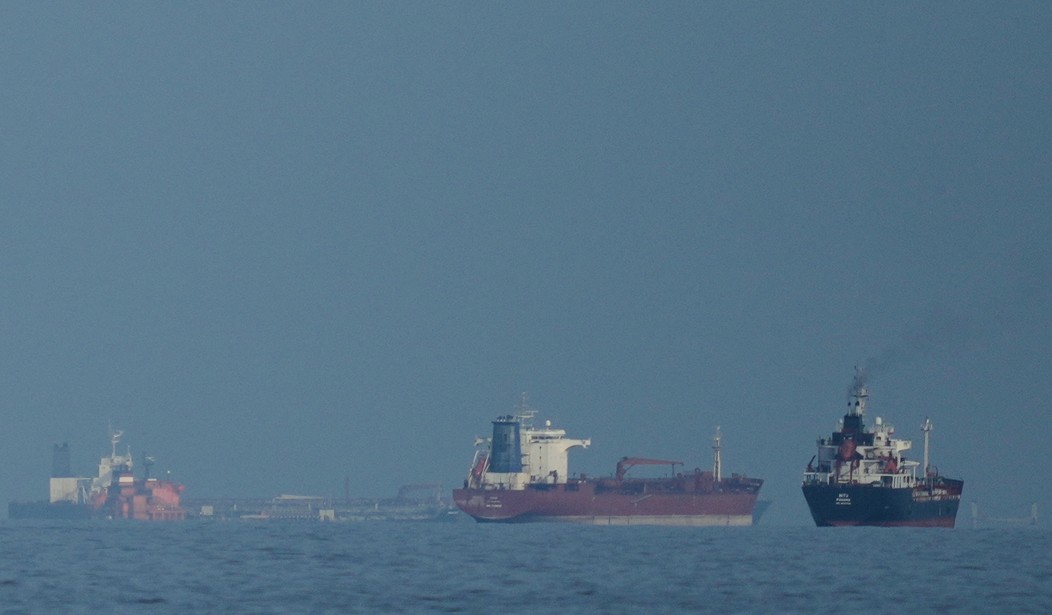
Which country has at least 50 ships loaded up with oil and other petroleum products for sale but just lets them stay moored along its coast?
Well, Iran — of course.
It's been a while since I did an Iran War update, and there's a fair amount of ground to cover. But what caught my eye this morning was a Bloomberg report claiming that our naval blockade has "dozens of laden tankers bottled up along the nation’s coast, while others outside the Gulf are holding off Sri Lanka."
"At least 50 tankers carrying Iranian oil remain backed up near the country," nonprofit United Against Nuclear Iran told the outlet, "broadly unchanged from two months ago." In other words, it's been several weeks since Iranian tankers dared to challenge the United States Navy.
"Iran loaded no crude oil onto tankers in September, according to preliminary vessel-tracking estimates compiled by Bloomberg," according to the report, and "loadings fell to zero last month in the first such instance since the war began in February."
Bloomberg's reporting backs up Treasury Secretary Scott Bessent's claim on X last week that "Iran loaded ZERO crude oil onto tankers in September," and that the administration "is cutting off the Iranian regime’s most critical source of revenue."
"Operation Economic Outcast is severing the economic lifelines that have allowed Tehran to finance its terrorist agenda."
I hate to seem ungrateful, but could we maybe do that a little faster, please? Because Tehran doesn't seem to have gotten the message that the regime is out of options.
GCaptain's Mike Schuler reported "five separate incidents involving commercial shipping in or near the Strait of Hormuz on Monday, including four tanker attacks and an incident in which Iran’s Islamic Revolutionary Guard Corps threatened another vessel with attack."
"The reports follow an already violent stretch in the Strait," since October 1, including "four confirmed tanker attacks between October 2 and October 3, all involving unknown-projectile strikes on vessels transiting Hormuz."
So when I see posts like this one that fail to take into account the risk premium now priced into Middle East energy flow, I indulge myself in a bitter little laugh.
The US has basically won the battle of the Hormuz https://t.co/VoODvXu4H4
— Andreas Steno Larsen (@AndreasSteno) October 6, 2026
The battle is far from won, and now there's been at least one Houthi attack on a Saudi oil facility.
Yes, I know I'm impatient. But if there's one thing I've learned from 40 years of serious history nerd-dome, it's that nothing beats a speedy victory. Time gives the other guy room to adapt, move, reload, or just learn to deal with the damage. It also gives them opportunities to stir up distractions — like the current Houthi offensives at sea and against Saudi Arabia.
"If it were done when 'tis done, then 'twere well it were done quickly," the wise man once wrote.
On the flip side, when potential rivals are many, and stocks of weapons are low — and the enemy's finances depend on waterways you control (or at least mostly control), a little patience can go a long way.
But the Islamic Republic appeared to be on the ropes back in April, only to be given the breathing room for continued regime-saving mischief.
I understand the White House strategy here — conserving our ammo while going after Tehran's finances — but it sure would be nice if the strategy moved with more haste.
Recommended: Tom Cruise Just Dug Down to the Biggest Flop of His Career
Get context AND get cool stuff.
PJ Media VIP members get tons of exclusive goodies, including podcasts and video live chats with your favorite writers. You can support alternative conservative news and save 60% with promo code FIGHT.

Join the Conversation
VIP members get the ability to comment on articles.