


Greetings, and welcome to Friday, Nov. 20, 2026. On this date in 1789, New Jersey became the first state to ratify the Bill of Rights. Two hundred and thirty-seven years later, Washington is still hunting for loopholes in it.
My calendar says it's National Absurdity Day, National Child's Day, National Peanut Butter Fudge Day, and Substitute Educators Day. Celebrating absurdity is easy; just read the morning headlines. Spend some time with the kids in your life, since they grow up faster than you think. Whip up a batch of peanut butter fudge with them and let them lick the spoon. And if you know a substitute teacher, thank them. Anyone who walks into a strange classroom full of kids on a Friday before Thanksgiving week has earned it.
Today in History:
1789: New Jersey becomes the first state to ratify the Bill of Rights.
1820: A sperm whale rams and sinks the whaling ship Essex in the Pacific, an event that later inspires Herman Melville's Moby-Dick.
1945: The Nuremberg trials of top Nazi war criminals begin in Germany.
1947: Princess Elizabeth marries Philip Mountbatten at Westminster Abbey.
1962: President John F. Kennedy announces the end of the naval quarantine of Cuba after the Soviets agree to remove their bombers.
1969: A group of Native American activists begins a 19-month occupation of Alcatraz Island.
1975: Spanish dictator Francisco Franco dies, clearing the way for Spain's return to democracy.
1985: Microsoft releases Windows 1.0.
1998: Zarya, the first module of the International Space Station, launches from Kazakhstan.
Birthdays Today include: Kenesaw Mountain Landis, baseball's first commissioner; Edwin Hubble, the astronomer who proved the universe is expanding; Chester Gould, creator of the Dick Tracy comic strip; Alistair Cooke, longtime host of Masterpiece Theatre; Robert F. Kennedy, U.S. attorney general and New York senator; Dick Smothers, from The Smothers Brothers Comedy Hour; Joe Biden, the 46th president of the United States; Duane Allman, guitarist and founder of the Allman Brothers Band; Bo Derek, actress from 10; and Dierks Bentley, country singer. If today's your birthday, too, happy birthday from all of us here.
* * *
Something of historic proportions happened in China this week, and most of the press treated it as a photo op with a side of anxiety.
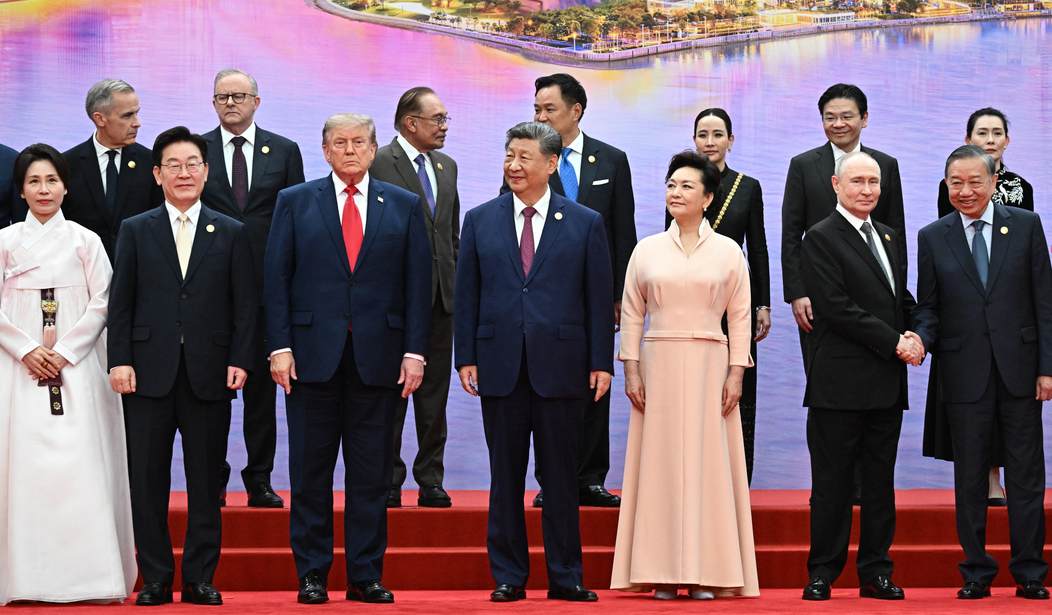
On Thursday, in Shenzhen, the leaders of the world's three greatest powers sat down at the same table for the first time. Now, yes, they have met in pairs many times before, and they have talked through intermediaries. This time, Donald Trump, Xi Jinping, and Vladimir Putin met together, on the sidelines of the Asia-Pacific Economic Cooperation summit. The meeting ran about ninety minutes and ended with a four-point joint declaration. There has never been a summit quite like it.
The comparison everyone reached for was Yalta. That's particularly true of Putin's Russia, as our Rick Moran correctly notes. In 1945, Roosevelt, Churchill, and Stalin met there and sketched out the postwar world. It's an imperfect comparison, and Chatham House was quick to say so. But look at the detail that makes it most imperfect. At Yalta, Europe had a seat at the table. In Shenzhen, it didn't. And therein lies the biggest clue to the impact of this meeting. As for Putin, his attempts at being equal with the U.S. and the PRC failed rather spectacularly, particularly as regards Putin's land grab in Ukraine
What leaped out at me was a shade different than most, I think. There's a school of thought that says this summit ends European domination of world events. I'd put it more precisely: Shenzhen didn't end that dominance; it recognized that the dominance has already ended, and that everyone except Brussels has noticed. I fully expect the tone from Brussels to be one of full-on panic for the foreseeable future.
Some of you will say I'm overplaying it, but that's not so. Consider how the European Union responded when the summit was announced. Its leaders met in Dublin and nominated a committee of national security advisers. They then decided to be represented by five countries plus EU officials, which is a lovely way of saying nobody invited them and they'd like to be noticed anyway. This is a bloc of more than 500 million people that, by its own boosters' math, still accounts for nearly a quarter of global GDP.
That's the paradox of the EU in one frame: enormous wealth, an enormous population, and almost no capacity to act. Even Europe's own think tanks have stopped pretending otherwise. In May, after Xi hosted Trump and Putin in back-to-back visits to Beijing, the European Policy Centre ran an analysis under the blunt headline "Europe is on its own." It conceded that neither Washington nor Beijing regards the EU as indispensable to managing world affairs. Shenzhen made that conclusion highly and conclusively visible. In turn, this is why the domestic press here in the States went so low-key with it.
Now, let’s set the commentary aside and look at the text. The three powers agreed on four points. Taken together, they read like a rejection of the worldview that built the EU.
1. Reforming the United Nations. All three countries are permanent members of the Security Council, and all three pledged to reform the UN so it can respond more effectively to global challenges. The details are thin. Still, when the three veto-holders who actually matter agree that the institution needs fixing, it carries more weight than another General Assembly resolution nobody reads or heeds.
2. Reducing nuclear risks. The leaders restated that "a nuclear war cannot be won and must never be fought," and they committed to talks on reducing nuclear risk and stopping proliferation. That matters more than it sounds. When New START expired in February, it left the United States and Russia without binding limits on their arsenals for the first time in decades. The U.S. and Russia each hold more than 5,000 warheads. China holds far fewer, but it is building fast, and it has long refused three-way talks on the grounds that its arsenal is smaller. Trump has pushed for exactly this format since his first term, so getting Beijing into the room at all is the story, the win for Trump that cannot be overstated. Even UN Secretary-General António Guterres offered to help with whatever comes out of it, for whatever that's worth.
3. Increasing fuel supplies. The three powers committed to increase production and supply of refined petroleum products and stressed the importance of stable energy flows. In other words, oil is back, and bigly, as the President would put it. Compare that with a decade of European climate policy built around making fuel scarcer and more expensive on purpose. The three nations that actually run the world just agreed that the world needs more energy, not less. Europe, which has been lagging on its own supply-chain independence, had no say in that, either.
4. Defending sovereignty against the tribunals. This is the point most of the coverage buried, and despite being the most important of the four. The leaders affirmed that state consent and the immunities of state officials are essential, and they declared that "the International Criminal Court and other similar bodies must not abuse their jurisdiction." CBC put that line in its headline, and it deserved the attention. Whatever you think of the three men who signed it, the world's three largest military powers have now told the transnational tribunal crowd, in writing, that sovereignty still means something.
The EU is the purest expression of a particular line of non-thinking. It holds that national sovereignty is an obstacle to be managed and, in fact, overcome, and that unelected bodies and international courts should sit above elected governments. It also assumes that if Brussels writes enough rules, power will politely follow them.
The real truth here is that it doesn't. Power follows the people who can produce energy, field militaries, and make decisions without first convening a committee to decide which committee decides. Put the third and fourth points side by side — more fuel and less deference to supranational courts — and you have the globalist project rejected point-for-point by the three nations with the most power to reject it.
That is what Shenzhen tells Europe. The rules-based order Europe built for itself was only ever as strong as other nations' willingness to go along with that invitation. Three of them just declined, the biggest and most powerful of them, together, at the same table.
Now admittedly, none of this means the three signed a peace treaty for the ages. The declaration set no targets or deadlines, and it said nothing about Ukraine and little about Iran, save for placing limits on any nation's nuclear ambitions. Critics warn that Putin got a status boost just by standing beside the other two. Those are fair points, and a summit is the beginning of a process, not the end of one.
But look at what even Moscow felt obliged to say going in. The Kremlin's spokesman insisted that Russia and China rule out any single power deciding the fate of other nations. Fine. Then the question is who does decide. More and more, the answer is the nations that show up with the power to act, not the ones that send a committee to stand outside the door.
For most of the last five centuries, the big questions of world order were settled in European capitals. For the last thirty years, Europe has tried to keep that role by putting regulation, treaties, and international courts in place of the hard power it stopped bothering to maintain. This goes directly to the point about maintaining the military that the president has been making for years now.
Shenzhen is the receipt. The three nations that matter met and agreed to reform the UN, reduce nuclear risk, and increase the energy supply. They also told the international tribunals to stay within their jurisdiction.
Now, look, I share to a large degree some of the angst that we're about to see vivid demonstrations of, regarding two of the superpowers being dictatorships. It's certainly a point that cannot be ignored. But even assuming this agreement carries real weight going forward, how much better or worse was our situation in the grip of the Marxist one-worlders in Brussels?
Rick Moran writes in his piece that:
…the takeaway is that Trump got high-profile stagecraft, direct face time with Xi and Putin, and rhetorical alignment on a few broad themes, while concrete policy outcomes were left for negotiators and future talks.
Chalk it up as a win for Xi and Trump and a humiliation for Putin.
Rick is correct, but I would add that the list of losers here includes the EU. There were no concrete points of agreement, merely general directions of thought. The consequential part is that the EU was basically out in the hallway, pacing back and forth, waiting for the outcome. That's probably more consequential than anything else to come from this summit. European dominance didn't end this week; it ended a while ago. This week, anyone with any say in the matter stopped pretending otherwise and acknowledged reality.
= = =
Thought of the Day: Influence is something a nation earns by being able to act. Once it stops acting, it keeps only the memory of having had it.
VIP members: What are your thoughts here?
Take care of yourselves, gang. You've got a weekend in front of you. I'll see you here tomorrow.
Editor's Note: Thanks to President Trump and War Secretary Pete Hegseth's leadership, the warrior ethos is coming back to America's military.
Help us continue to report on Trump and Hegseth's successes as they make our military great again. Join PJ Media VIP and use promo code FIGHT to receive 60% off your membership.


Join the Conversation
VIP members get the ability to comment on articles.