Note: Most Thursdays, I take readers on a deep dive into a topic I hope you'll find interesting, important, or at least amusing. These essays are made possible by — and are exclusive to — our VIP supporters. If you'd like to join us, take advantage of our 60% off promotion.
"Patriotism is when love of your own people comes first; nationalism, when hate for people other than your own comes first." —Charles de Gaulle
Like so many other bad ideas — state terror, postmodernism, the 1956 Renault Dauphine — modern nationalism was born in France. I chose nationalism for this week's essay in part because when patriotism fails, nationalism tends to rear its ugly head, but stick a pin in that thought while we take a quick look at how we got here.
Before inevitably descending into the Reign of Terror, the French Revolution transformed "the nation" from a vague or dynastic concept into something that embraced the people as a whole. Which sounds nice, until you realize how much forcible "square peg/round hole" action is required to make the people fit.
It's no coincidence that France was smack-dab in the middle of the Terror when Abbé (Abbot) Henri Grégoire — a devout Catholic priest and a revolutionary extremist, go figure — submitted a report to the National Assembly charmingly titled, "On the necessity and means of annihilating the patois and universalizing the use of the French language."
The patois were the regional variations of French, but Grégoire believed that to have a "Republic, one and indivisible," the language had to be one and indivisible, too. To Grégoire, patois was a security risk. If a citizen couldn't understand the laws of the Republic, they couldn't be a good citizen.
And Another Thing: It's a great irony that neither Grégoire nor Napoleon managed to eliminate the non-French languages spoken in France — including Breton, Basque, Catalan, German, and even Napoleon's native Corsu. Some historian whose name I've long since forgotten joked about Hitler that only an Austrian could take being German so seriously. And I guess it took a Corsican to get so bloodthirsty about making everything French.
Fair enough, I suppose — particularly since I'm a longtime advocate of making English the official language of this country. But this was Revolutionary France, where even the good ideas got taken to bad extremes. And so teaching standardized French turned into a "linguistic cleansing" campaign where local customs, local traditions, local ways of speaking all had to give way to the needs of the new, nationalistic state.
The kind of (mostly) harmless regional pride we enjoy in this country was squashed in France to turn the country into a single — manageable — unit.
It was Napoleon — also inevitably — who weaponized what Grégoire started.
The Revolution might have deposed the monarchy, but the revolutionaries still had the monarchy's debts to deal with. So they seized the lands of the Catholic Church and issued paper money called Assignats, that was in theory, at least, backed by the value of those lands.
You'll be shocked to learn what happened next: they printed way more Assignats than the land actually backed up. The predictable results included hyperinflation, the destruction of the merchant class, price controls, the country's best and brightest (largely from the surviving aristocracy and upper bourgeoisie) fleeing, starvation, and eventually, a terribly overwritten Charles Dickens novel.
By the time Napoleon seized power in 1799, the revolutionary state had already burned through its experiments — hyperinflation, terror, endless wars — but teetered on the edge of failure.
And Another Thing: Whatever else you might say about him, Grégoire was a true survivor. He pledged fealty to the Revolution, but refused to renounce his faith even during the murderously atheistic "Cult of Reason" phase. Then he joined the Anti-Bonapartist party while Napoleon ruled, and the Liberal Left after the Bourbon restoration. He died at age 81 in 1831 and in 1989, his ashes were transferred to the Panthéon, the resting place of French notables. Interesting cat.
Napoleon's solution was as simple as it was ancient: His armies would simply take what France required. Doing so required turning to mass conscription instead of the small, professional armies of old — and that required turning the patois-speaking peasants of France's distinct regions into Français enthousiastes.
If patriotism binds people to a country they share, nationalism insists on stultifying conformity — often expressed by wars of conquest.
And conquer, they did. Napoleon and his armies redrew the map of Europe like a spastic child with an Etch-a-Sketch. The First Consul crowned himself Emperor in 1804, and at its peak, his First French Empire directly incorporated the Low Countries, Germany west of the Rhine, the German North Sea coast, northwest and central Italy, Illyria in the Adriatic, and (formerly) Spanish Catalonia. French client states included the rest of Germany (barring Prussia) the rest of mainland Italy, and all of Spain.
While Napoleon's empire — like most nationalistic conquests — proved short-lived, the ripple effects of French nationalism would only grow throughout the Continent.
Austrian Emperor Francis I reigned during the tumultuous decades of the French Revolution and the nationalistic wars of conquest that followed under Napoleon. The times were particularly dangerous for Austria's Habsburg monarchy, and not just because they kept losing to Napoleon's armies. Francis ruled over a polyglot empire of German-speaking Austrians, Hungarians, Italians, Slovenians, Czechs, Slovaks, Poles, Ukrainians, Romanians... I could go on. As nationalistic aspirations rose — inspired for whatever reason by France's particularly bloody example — devotion to the monarchy was increasingly the only thing holding the Empire together.
The story goes one high-ranking official visiting Francis praised some non-German nobleman or leader, assuring the emperor that the man was "a great patriot."
Francis is supposed to have replied, "Yes, but is he a patriot for me?"
Over the next century, Austria would suffer a civil war to keep the Hungarians in, evolve into a Dual Monarchy respecting some Hungarian nationalist ambitions, and in its twilight years, entertain notions about a Triple Monarchy to keep the various Slavic people happy.
Nevertheless, at the end of the First World War, the Habsburg empire collapsed into a collection of squabbling nationalistic successor states. One of them — Yugoslavia, originally known as The Kingdom of Serbs, Croats, and Slovenes — violently disintegrated in similar nationalistic fashion following the end of the Cold War.
Before the war, a patriot might have looked at the Habsburg empire and decided his little country of Slovaks was better off inside it. A nationalist would demand independence no matter what, even if the new country — Czechoslovakia for one infamous example — proved too weak to fend off the nationalist predators next door.
I'm not saying people sharing the same language shouldn't create their own countries, if that's what they want. I am saying there's a difference between patriotism and nationalism — and it's a difference that Americans don't often appreciate. Thankfully, that's because we've never really had to.
And my complaints aside, France has survived (at least so far; let's see what the Muslims do) while the Habsburg empire did not.
The jury remains out on Russia, too. The Soviet "prison of nations" couldn't survive Communist mismanagement and oppression, built and expanded largely on the old Romanov model. Current Russian strongman Vladimir Putin called the disintegration of the U.S.S.R. "the greatest geopolitical catastrophe of the 20th century," but the Russian Federation is almost as much of an ethnic hodgepodge as the Soviet Union was. Whether the Federation can survive Putin's nationalistic endeavor in Ukraine — and associated economic problems — remains to be seen.
The betting line is that the Russian Federation survives, and even expands a bit in eastern and southern Ukraine, if not the whole country. But the longer the war drags on without victory, the weaker the betting line becomes.
But then there's Great Britain, unraveling before our eyes.
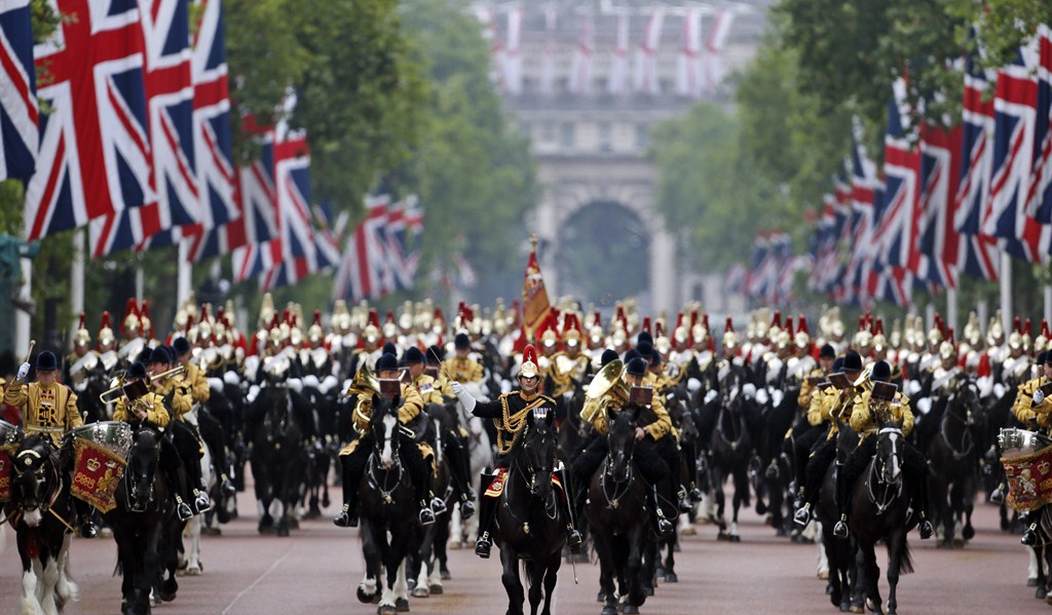
Britain was arguably the first European power where patriotism itself became passé. In an infamous moment of upper class cowardice, a 1933 Oxford Union Debate took up the topic: "That this House will in no circumstances fight for its King and Country." Oxford was and remains the training ground for Britain's very best, and the "King and Country" pledge was long the bedrock of British identity.
Yet the motion passed, 275 to 153.
The press went nuts, calling the students "sexual indeterminates" and "unpatriotic." Winston Churchill called the vote "abject, squalid, shameless" and accused Oxford students of being "soft, pink, and woolly."
Just a few years later — after France fell to a particularly virulent nationalist in Nazi Germany — Britain was lucky that the job of leading Britain to victory fell to Churchill and not the "men" of that 1933 Oxford Union Debate. If Britain's upper class had begun the long process of giving up on patriotism, the common British man and woman still believed in that quaint notion.
If the same Oxford vote were held today, I imagine it would be even more lopsided — and that the British press would hound the very few still clinging to king and country. Granted, not that there's much to be said in favor of Charles III, but that's largely beside the point.
Although it would probably help if Charles could at least give an Easter message without praising Islam.
I could run through the years-long litany of what Britons have had to endure these last 20 years, under both Tory and Labour governments that just don't give a damn about Britishness. The worse might be the Muslim grooming gangs and mass rapes endured by working-class British girls, left unpunished to assuage the guilty consciouses of the country's upper crust. Guilty of what? Being British, old chap.
But it's this week's news about banknotes, even more so than this current headline: "English, Scottish and Union flags on streets has been linked to 'tools of hate' in a leaked draft of the Government’s new social cohesion strategy."
Social cohesion? I do not think that phrase means what you think it means.
That UK Sun report also noted that the draft "also pledges action against 'divisive content' online, raising fears about risks to free speech," which would be scary if there was much online freedom of speech remaining in Britain.
But back to those banknotes, where Keir Starmer's Labour government pretty much just memory-holed British history.
"According to a stinging barb from U.S. President Donald Trump, Britons are being led by a prime minister who is no Winston Churchill," Bloomberg reported on Wednesday. "Soon they will have to cope without the popular wartime British leader on their banknotes too."
"The bank said it was looking for images that symbolized the U.K., resonated with the public and weren’t divisive," and settled on images of native wildlife.
Churchill, gone.
Jane Austen, gone.
Alan Turing, gone.
It's safe to assume that those vicious warmongers, Horatio Nelson and Arthur Wellesley, 1st Duke of Wellington, are never to return. Not unless something changes.
Ah, but won't the Englishman's, Welshman's, or Scot's heart swell with patriotic fervor at the sight of hedgehogs, badgers, and puffins on his bank notes?
Of course not. Which is the entire point.
That's where nationalism just might come in.
Basically abandoned by the ruling class, patriotism is now being driven underground by government writ. This is just the most recent in a string of British governments, I don't have to remind you, that tolerates almost any kind of public display from the country's growing — and increasingly assertive — Muslim population.
The good news, if you want to call it that, is that a 2025 poll showed that 16- and 17-year-old Britons are more proud to be British than their parents are — but only just. The poll found that 45 percent of the general population feel proud to be British, while 15 percent actually said they were ashamed. Among the younger set, those proud of their national identity rose all the way to a still-dismal 49%.
Perhaps not even a Churchill could rouse this population, I'm sad to say.
If the restive and assertive 6% or so of the United Kingdom that is Muslim can make Whitehall bend the knee, imagine the potential for a nationalistic backlash from similar numbers of traditionally ethnic and religious Britons.
Many years ago, an English acquaintance who came of age in the 1970s learned how to shoot (he came from money) because he assumed that the pre-Thatcher street battles between socialists and nihilist punks would only grow worse. Having done their best to drive patriotism out of existence, Britain's future street battles might be between Muslims and English nationalists.
We know which side the socialists would come down on but, thankfully, they're afraid of guns.
The point is that if push does come to shove in the U.K., we should wish the nationalists well. I'd go even further and suggest we airlift or sealift them as many AR-15s and as much ammo as they need.
But never forget that nationalism is an ugly force, and once unleashed, there's no telling where it might lead — or who it might consume.
Last Thursday: One Intel Coup After Another