







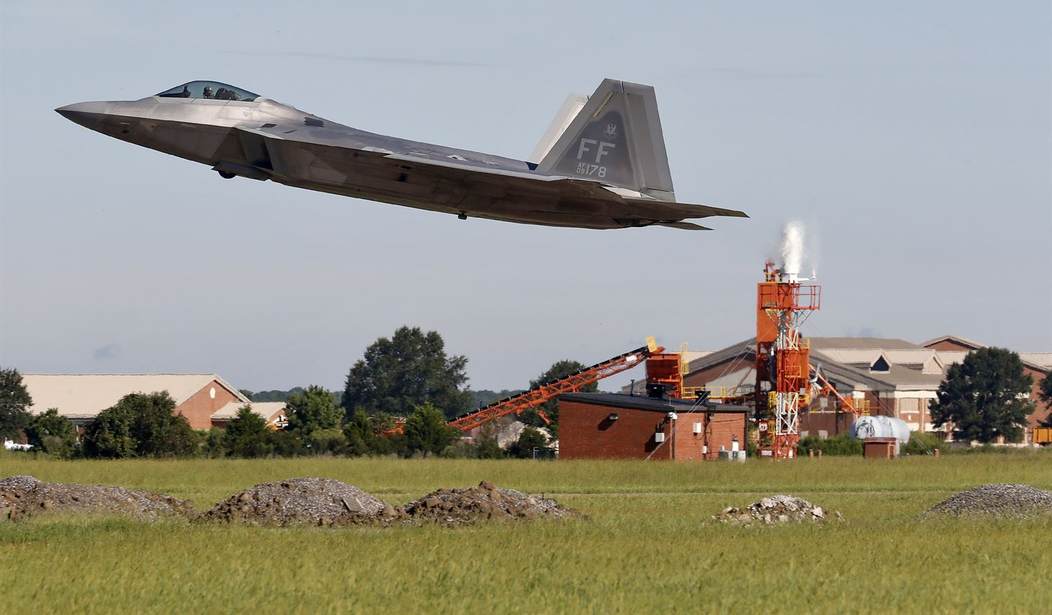
An Air Force F-22 Raptor pilot had an in-flight "talk" with his drone wingman during a just-revealed test mission at Edwards Air Force base, bringing us one step closer to our fighter pilots flying into action with a cohort of AI-powered jets.
In this case — and stick a pin in that thought because I'll circle back to it in just a moment — the drone was a General Atomics MQ-20 Avenger, formerly known as the Predator C. The pedigree of the stealthy drone actually goes back to 2009 and a since-cancelled Air Force program to replace the famous (or infamous, for those on the receiving end) MQ-9 Reaper.
Since then, the Avenger found new life as a testbed for new technologies, including serving as a semi-sorta-kinda smart "loyal wingman" for manned fighter jets — or collaborative combat aircraft (CCA) as the Air Force now insists we call them.
Bureaucrats take the romance out of everything.
Anyway, the unnamed Raptor pilot, according to a company statement, used the Autonodyne Bashi pilot-vehicle interface to send commands to his loyal wingman (take that, Air Force bureaucrats!) "directing the MQ-20 to execute tactical maneuvers and adjust waypoints, and perform Combat Air Patrol (CAP) and airborne threat engagement tasks."
The Avenger was then able to perform its various missions and commands autonomously. “This demo featured the integration of mission elements and the ability of autonomy to utilize onboard sensors to make independent decisions and execute commands from the F-22," General Atomics Aeronautical Systems President David R. Alexander.
But this might be the best part: GA is hardly the only company in the running to produce stealthy and lethal loyal wingmen.
CCAs, whatever.
DefenseOne's Thomas Novelly reported Monday that "General Atomics, Anduril, and Northrop Grumman are all in the running to build the Air Force’s first collaborative combat aircraft," and that a government-owned software platform is in use by all three companies to integrate their drones with manned aircraft.
Depending on the mission, loyal wingmen can be armed for air-to-air combat — presumably flying in front of the manned jet — or air-to-ground attack missions. A human pilot can even order his CCA to put itself in between his jet and an incoming enemy missile, should the need arise. I'd also add that CCAs aren't just stealthy, they're small. That means they could potentially be even more difficult to target than our best air superiority fighters, the F-22 and the upcoming F-47.
So, yeah, send one or two of them in first, using the manned jet's detection systems (radar, infrared, optical) to take out any bad guys first. You could even have loyal wingmen work with our bombers, giving them an air-to-air combat ability they currently lack.
The Air Force indicates it wants at least 185 F-47s — roughly a one-for-one replacement for our aging Raptors — and about 1,000 CCAs.
One for one seems a little low to me, given that pretty much everybody in the know agrees that we never built enough F-22s. But even if 185 is all the F-47s we can afford, I'd wager the Air Force will end up with far more than 1,000 CCAs, because they're just too useful and, should war come, expendable.
Let's just hope that as they get smarter, they still loyal.
I kid, I kid... I think.
Recommended: Newsom Tells Black Audience He's Just Like Them Because He Has a Mental Disorder
Enjoying PJ Media?
Get exclusive content and support independent journalism with 60% off a PJ Media VIP membership. Use promo code FIGHT and join today.



Join the Conversation
VIP members get the ability to comment on articles.