We live in dangerous times, no doubt, but some of us are old enough to remember the fears of the Cold War. I’ll never forget watching a news program in the early ‘80s that featured a dramatization of what would happen if the Russians dropped a nuclear weapon on an American metropolitan area. A friend of mine who went to a private school had atomic bomb drills at school (we didn’t do those in public school).
Sixty-eight years ago this week, those Cold War fears became all too real for a small town in South Carolina. On the afternoon of March 11, 1958, a B-47 took off from Hunter Air Force Base near Savannah, Ga., on a route that would take it to the UK and eventually to North Africa with a nuclear weapon aboard. The flight was part of Operation Snow Flurry.
Less than half an hour into the flight, Capt. Bruce Kulka and Capt. Earl Koehler responded to a fault light in the cockpit that indicated that the bomb’s harness locking pin wasn’t engaged. In his attempts to engage it, Kulka inadvertently unhooked the bomb. It hit the bomb bay doors, knocked them open, and fell from an altitude of 15,000 feet.
The bomb hit the ground in Mars Bluff, an unincorporated community near Florence, S.C. By the grace of God, the nuclear core of the bomb wasn’t engaged. Army Times reports:
The radioactive payload either wasn’t loaded in the warhead or didn’t detonate — the stories differ.
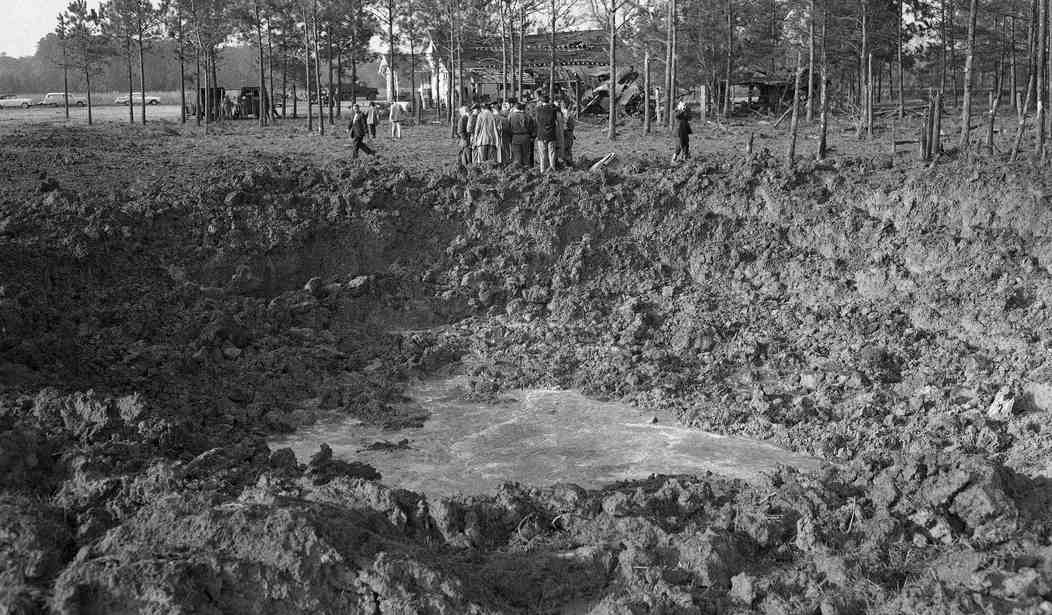
But the TNT trigger for the bomb blew a crater in Walter Gregg’s garden some 24 feet deep and 50 feet wide. The blast shredded his farm house about 100 yards away. Hudson, a cousin, had been playing with two of Gregg’s children in the backyard.
The atomic warhead would have been 30 kilotons — twice as powerful as the bomb that devastated Hiroshima in World War II. Florence, five miles away, would have been obliterated. Most of the rest of the 30,000 residents of Florence County would have been wiped out or sickened by radiation.
It’s frightening to think what could have happened to eastern South Carolina if the nuclear core of that bomb had detonated. The victims sued the USAF and received $54,000. That sounds like a pittance even for 1958, but that would be roughly $607,737.30 today. Interestingly enough, no one died, and injuries were mostly minor.
For Our VIPs: The Year We Learned Japanese by Satellite — and Didn’t Know We Were Pioneers
“The military moved in, cleaned up what they could, and locked the details away,” writes meteorologist Jamie Arnold on Facebook. “For years, the Mars Bluff bombing was mostly hidden in classified reports and quiet conversations—a strange, almost unbelievable footnote in Cold War history…right here in our back yard.”
There’s a small marker on the site of the explosion, which sits on private property. Tourists visit nonetheless, much to the bemusement of neighbors.
What’s crazy is that the Mars Bluff explosion wasn’t the only accidental bomb release in 1958. Just over a month before that, a collision dropped a Mark IV “Fat Man” bomb into the water just off the coast of Tybee Island, Ga.
Roger Pinckney wrote in Garden & Gun in 2018:
Air Force records indicate the Mark 15 bomb bore serial number 47782. It contained four hundred pounds of high explosives and an undisclosed amount of enriched uranium and other nuclear material. When armed with its nuclear capsule—a device containing plutonium, which triggers the nuclear explosion—the bomb was capable of producing a fireball with a radius of 1.2 miles and causing severe structural damage and third-degree burns for ten times that distance.
A recovery effort began on February 6, 1958, for what became known as the Tybee bomb. On April 16, 1958, the military announced that the search efforts had proved unsuccessful, although the team had discovered several Civil War cannonballs, still full of explosives.
Broken Arrow: military jargon for a lost nuke.
Several weeks later, the Savannah Coast Guard allegedly received reports of a Soviet submarine just off the coast. The Soviets had already successfully tested their own hydrogen bomb in 1953, but an intact American weapon would have constituted an intelligence coup. Presumably, the Russians did not find the bomb either. Or if they did, they kept mum.
It’s unsettling to think that two nuclear weapons were accidentally lost in the Southeast within five weeks of each other in 1958. Those incidents are reminders that the Cold War wasn’t just a distant geopolitical chess match played in Washington and Moscow. Sometimes the danger literally fell out of the sky, landing in a South Carolina garden or disappearing into the waters off the Georgia coast. By the grace of God and a measure of sheer luck, both incidents ended as historical footnotes instead of tragedies that would have reshaped the region forever.