
It’s weird what can trigger certain memories. Yesterday, seeing a social media post about the 18th anniversary of the passing of blues guitarist and singer Jeff Healey reminded me of one of my favorite memories from high school.
Near the end of my sophomore year, my high school agreed to be a part of a pilot program that taught foreign languages by satellite. The next school year, the program would offer Japanese and Russian classes at the school.
I was finishing up two years of Latin at that point, which felt like a duty. Teachers told me that the serious college-bound students took Latin, so I dutifully took two years of it. But Japanese? That sounded like fun, so I wanted in.
I’ve actually had a lifelong fascination with Japanese culture, and I still want to learn Japanese. I’ve tried several different programs, including Duolingo, which led me to discover its wokeness.
Flashback: You Thought You Were Learning a New Language, but There's a Different Agenda Afoot
With a little help from Grok, I tracked down the information about the program. It came from a group called the Satellite Educational Resources Consortium (SERC — pronounced like “Circe”).
From Grok:
It was produced jointly by Nebraska Educational Television (Nebraska ETV Network in Lincoln) and the Nebraska Department of Education—the only foreign-language course among SERC’s initial offerings. SERC itself was a national partnership of state education departments and public broadcasters, funded in part by the federal Star Schools program, aimed at delivering advanced or specialized courses (especially to small/rural high schools that couldn’t offer them locally).
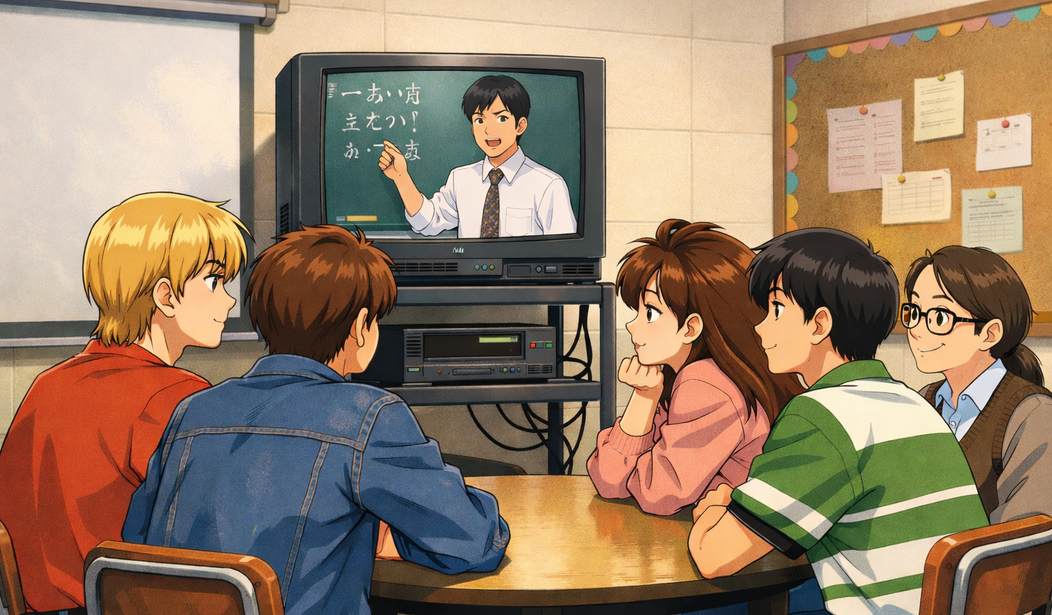
The instructor’s name was Tim Cook — no relation to the Apple CEO. We watched him teach live via satellite two days a week, and we had two days where we could call in for specialized pronunciation work and additional learning on a conference call.
Side note: The facilitator for the Russian class was the teacher who taught the 9th-grade economics and federal government classes to gifted students. She taught economics with such an anti-capitalist (and anti-Ronald Reagan) bias that our entire class refused to take her federal government class. We called her a Communist (to her face), so it was on-brand for her to facilitate the Russian class.
Our class was made up of four students and a teacher/facilitator who learned alongside us. We were a tight-knit group who had a blast learning and hanging out together (because we had free time on Fridays and extra time at the end of class after the lessons were over). My friend Billy was in the class with me, which gave us plenty of opportunities to laugh and share music (hence the Jeff Healey connection).
Each of the schools involved in the SERC program had to call into the broadcast on a rotation for Sensei Tim to call on students. One high school in Miami was notorious for not taking the program seriously. So one day, when we figured out that the Miami students hadn’t called in on their assigned day, we called in and pretended to be the class from that school. Any time Dr. Cook would call on someone from the school, we would answer the questions stupidly on purpose. We laughed so hard that day.
One of the highlights of the year was an after-school field trip we took. We didn’t have any Japanese steakhouses or hibachi restaurants nearby in 1989-1990 like we do now (plenty of options within a short drive that range from decent to excellent), so the five of us drove all the way to Atlanta for a fun dinner at Kobe Steak. I can take good Japanese food somewhat for granted now, but for a 17-year-old with fewer dining options at his fingertips, that was an absolute treat.
I still remember a few words and phrases in Japanese from that class, and as I said earlier, it has continued to spur my desire to learn the language. I even reconnected with Dr. Cook several years later and had a nice email exchange. He even sent me a Japanese-English parallel New Testament. I also found the videos for the program Cook developed with Georgia Public Broadcasting, and I think I’m going to explore those soon.
My junior year of high school was pivotal. I had some adversity — family struggles and church hurt — that grew me in the long run, but the good far outweighed the bad. The Japanese class, our concert choir’s Carnegie Hall trip, and founding the church that I call home now were big events that shaped me that year.
Bonus Flashback: How Do You Get to Carnegie Hall? Practice, Practice, Practice — and a Brave High School Choir Director
Looking back, we knew that this satellite program was innovative at the time, but I can’t imagine that we would’ve ever considered that it would lead to apps, YouTube videos, and other methods that allow people to learn languages in ways that would’ve been unimaginable decades ago. We were pioneers in retrospect, but in our eyes at the time, we were just a bunch of teens having fun.