
Note: Most Thursdays, I take readers on a deep dive into a topic I hope you'll find interesting, important, or at least amusing. These essays are made possible by — and are exclusive to — our VIP supporters. If you'd like to join us, take advantage of our 60% off promotion.
"We defeated the enemy, but the Motherland bled white. Victory came at a cost no one should ever forget." —Marshal of the Soviet Union Georgy Zhukov
One thousand, four hundred, and eighteen days.
It's one of those "grim milestones" the press like to drone on about when there's a war going on the Left doesn't approve of, but seems to have gone largely unnoticed outside of social media: On Sunday, the duration of Vladimir Putin's Special Military Operation against Ukraine exactly matched the Soviet Union's Great Patriotic War of national survival against Nazi Germany.
The war that began on June 22, 1941, when Hitler's Wehrmacht blitzed into the Soviet Union — they were Nazi-Soviet Pact buddies just the day before — and formally ended on May 8, 1945, with Hitler dead in his bunker for over a week already and Soviet troops occupying the rubble of his once-great capital city.
Maybe more instructive is the time and distance covered by Soviet forces from the peak of Nazi conquest to Germany's final defeat.
The Battle of Stalingrad began on July 17, 1942, and raged for six-and-a-half months of some of the most brutal combat ever endured. It ended on Feb. 2, 1943, with the surrender of Friedrich Paulus's German Sixth Army and with it, the end of German expansion.
Stalin's Red Army required 820 days from the end of the Battle of Stalingrad to capture Berlin — a distance of roughly 1,380 miles, fighting the entire way. There was a bit of a dustup around Kursk in the summer of '43 to keep things interesting.
1,418 days of war — twice in the last 80 years or so.
Yet Vladimir Putin's Russian Army is far luckier than Stalin's. They weren't forced to retreat for 18 humiliating months, and their cities and people were never captured by high-tech barbarians on a mission of extermination. Putin's front lines were never sliced open by seasoned Panzer troops, and his soldiers were never cut off and surrounded by the hundreds of thousands. They were never forced to surrender and sent to camps where three million of them were starved, frozen, or worked to death by their Nazi captors.
Putin's troops went on the offensive from the start — Feb. 24, 2022 — and as of Sunday, after 1,418 days of heavy fighting, forever on the attack, they've advanced and held...
...well, not much.
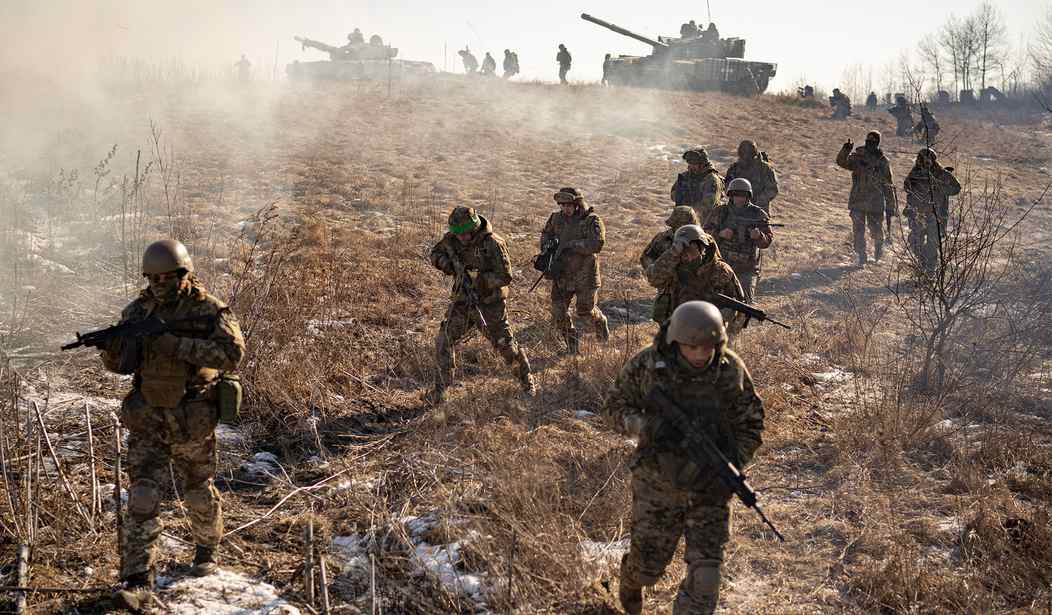
After being forced to abandon advances on Kyiv and Kharkiv, and pushed back behind the left bank of the Dnipro River in the south, Russia's furthest advance from the 2014-2022 Line of Contact is just 155 miles at the unimportant Kinburn Spit near Mykolaiv. In the Donbas — the subject of Putin's desires and the scene of the hardest fighting perhaps anywhere in the world since WWII — the furthest Russian advance is just 43 miles in the Pokrovsk Sector. The Battle of Pokrovsk has gone on twice as long as the Battle of Stalingrad.
But after Pokrovsk falls, it's only another 320 miles or so across Ukraine to link up with Russian separatist forces in the east of Moldova.
Is Russia winning? Losing? I don't know. But I'm damn sure that 1,418 days of this is a pointless, stupid waste.
World War II, now that was a worthwhile fight.
Hitler didn't launch Operation Barbarossa for kicks and giggles. He spelled out his desire for German lebensraum (living space) in the East in Mein Kampf long before the war. That desire was made explicit in Generalplan Ost (General Plan for the East), drawn up before the war.
Hitler's mad plan called for the virtual elimination of the Poles, Ukrainians, Belarusians, Baltic peoples, and Russians west of the Ural mountains. Some would find their fates in the crematoriums, others would be starved to death, some would be made slaves (and likely neutered), and the rest would be driven further east into Siberia.
Over the next 25-30 years, formerly Slavic lands were to be resettled by German soldier-farmers. Something of an agrarian romantic — albeit a twisted one — Hitler saw Germany's future in the rich soils of European Russia, not in the steel mills of the Rhine.
Slavic women "lucky" enough to pass for Aryan — even Himmler knew there weren't enough Germans to make Hitler's resettlement plans real — would become breeding mares, sex slaves for the Greater German Reich.
Those driven into Siberia east of the Ural Mountains would likely have starved or frozen to death. There was simply no infrastructure to support so many more millions of people.
The Holocaust against six million Jews (and another six million so-called Untermenschen like gays, the handicapped, Romani, etc.) was merely the warm-up act for Generalplan Ost.
Perhaps no one figure in the Soviet military was more responsible for vanquishing the Nazis than Marshal Georgy Zhukov, who organized the defense of Leningrad — the Nazis' first quagmire — then Moscow, and then Stalingrad. In the dark days of the summer of '41, Zhukov commanded the Red Army's first victory over the Germans during the Yelnya offensive. Along with Marshal Aleksandr Vasilevsky, Zhukov oversaw the brilliant Soviet defense and counteroffensive at Kursk in 1943 that cut the offensive heart out of the Wehrmacht.
But at such a cost. All of it.
Zhukov was famous — infamous? — for his gruff public demeanor. In his memoir, Crusade in Europe, Gen. Dwight Eisenhower recalled a wartime conversation with Zhukov:
Highly illuminating to me was [Zhukov's] description of the Russian method of attacking through mine fields. The German minefields, covered by defensive fire, were tactical obstacles that caused [the Western allies] many casualties and delays. It was our laborious business to break through them, even though our technicians invented every conceivable kind of mechanical appliance to destroy mines safely. Marshal Zhukov gave me a matter-of-fact statement of his practice, which was roughly "There are two kinds of mines; one is the personnel mine and the other is the vehicular mine. When we come to a minefield our infantry attacks exactly as if it were not there."
Emphasis added but perhaps unneeded. Zhukov's words speak for themselves.
After the war, however, Zhukov could be less blunt and more understanding. "We won the war, but at what price? The Soviet people paid dearly for victory. Millions of lives were lost, and the country was left in ruins," he later reflected.
But it was a price that had to be paid because if the Soviet Union's wartime losses were nearly unbearable, the alternative was unthinkable — except by madmen like Adolf Hitler and his Nazi inner circle.
After 1,418 days of fighting, Putin's ever-changing set of generals has conquered an area a little smaller than South Carolina. Zhukov might have accomplished that on a Tuesday.
And Another Thing: Memories are long (and more than a little resentful) about the "Unequal Treaties" imposed on China by Imperial Russia in the 19th Century. Russia might have prised various Chinese territories away from Beijing, including the now-prized port at Vladivostok. Those same territories are growing more economically (and perhaps even demographically) tied to Beijing than to Moscow.
"The Russians, at the moment, are losing massive amounts of their soldiers thanks to the Ukrainian defense," NATO Secretary Gen. Mark Rutte told European lawmakers in Brussels this week. Best estimate is that Russia now loses 20,000-25,000 men each month. "I'm not talking seriously wounded," Rutte added. "Killed."
Rutte called the losses "unsustainable," but I'm less certain.
We'll never know the real numbers because the Great Patriotic War was so devastating, but the Soviets lost around 8.7-11.4 million soldiers, and an estimated 15 to 18 million civilians to the Nazis and the resulting privations. A nation that lost something like 26 million people can perhaps sustain most anything.
Or maybe times have changed — I don't know.
But those World War II losses, staggering though they were, were not for naught. In addition to doing most of the bloodletting of the Nazi war machine, the Soviet Union emerged in the end as one of the world's only two superpowers. They'd hold that position for another 45 years, including tremendous scientific achievements like putting Sputnik into orbit in 1957, and cosmonaut Yuri Gagarin into space just four years later.
What's the loss then of 26 million people when the alternative was the extermination of 150 million — and the prize is superpower status? Likewise, what's the loss of 20,000 men each month when the alternative is [checks notes] peace and reintegration into the global economy and a halt to growing vassal-like dependence on China — and the prize is millions of unwilling Ukrainians requiring Stalin-era levels of repression?
Russia's losses in Ukraine hardly compare to those lamented by Zhukov, but they must be counted.
The Russo-Ukraine War is not by any definition a war of national survival for Russia. It's an offensive war of choice — the choice having been made by exactly one man. Yet after 1,418 days of combat, Western intelligence estimates Russian combat deaths at 240,000-260,000, another million men wounded too badly for further service, and 80,000 or so missing.
By comparison, the U.S. military suffered 58,220 in-theater deaths in Vietnam, including those who died of their wounds after the war, MIAs later declared dead, men who died in North Vietnamese captivity, and 10,786 "non-hostile" deaths from accidents, illness, and the like. Another 153,303 of our men were wounded, for a heartbreaking total of 211,523 casualties during our decade of fighting there.
Russia, with 60 million fewer citizens today than the U.S. had during the Vietnam era, suffered nearly twice our 211,523 losses — in just the last 12 months.
If you add up every U.S. service member killed in Korea, Vietnam, the Gulf War, Iraq, and Afghanistan, the total is roughly 102,000 deaths. Russia has lost over double that amount in Ukraine in just four years.
The numbers are sobering, and you know how much I hate that word.
So as I close this essay, Putin's weeklong Special Military Operation has gone on for a little more than 1,418 days — and appears no closer to a successful conclusion than it was on Day 1,018. Or Day 518. Or Day 18.
Kyiv remains defiantly Slava Ukraini. Volodymyr Zelensky is not dead in a bunker. The Ukrainian Army — which I must add is certainly no Wehrmacht — remains in the field, killing an estimated 20,000-25,000 Russians a month.
When Hitler's successor, Karl Dönitz, submitted his country's unconditional surrender to the Western Allies and the Soviet Union, Stalin strode like a behemoth across Europe and even the world. All that spilled blood bought Russia the kind of status and respect it had long dreamed of but never quite achieved.
Should Ukraine fall tomorrow — a complete and unconditional surrender from the Carpathian Mountains in the West to the Donbas in the east — what will all that spilled blood buy for Vladimir Putin?
Anything? Anything at all?
Last Thursday: Re-Ranking China After 'Absolute Resolve' (and Russia, Too)