
Note: Most Thursdays, I take readers on a deep dive into a topic I hope you'll find interesting, important, or at least amusing. These essays are made possible by — and are exclusive to — our VIP supporters. If you'd like to join us, take advantage of our 60% off promotion.
If global power rankings came out every Monday morning like they do for the NFL, this season's strongest playoff contender just got knocked down a notch or two after a stunning shutout this weekend to the seasoned vets of Operation Absolute Resolve.
In less time than it takes to watch the first half of a regular-season game, 150 American warplanes and cyber assets opened up Venezuela's Chinese-made defenses like the L.A. Rams' Matthew Stafford and Puka Nacua taking their passing game up against your local high school team.
Some in Beijing might comfort themselves with the fact that Venezuela was played in our stadium, and that they'd perform better on their home turf. And yet, much closer to home, both China and Russia were powerless against a brief — but stunningly effective — 12-day Israeli air offensive last summer against Iran, their Middle East partner in the Axis of Resistance.
Venezuela's air defenses crumpled, too — and it isn't like China hasn't been preparing for something like this for a very long time.
What you're about to read might seem like a major digression, but I promise this all comes together.
Way back in 1999, NATO's Operation Allied Force air campaign against Serbia caught Beijing's eye in a big way. Technically still the Federal Republic of Yugoslavia (FRY), NATO sought to put an end to President Slobodan Milošević's repression and ethnic cleansing campaign against the majority Albanians of the country's Kosovo province.
The campaign lasted 78 days and involved something like 38,000 sorties against Serbian forces, and widespread (at least compared to the 1991 Gulf War) use of smart munitions and stealth jets — including the by-then venerable F-117 Nighthawk, and the first combat use of the B-2 Spirit stealth heavy bomber.
The efficacy of the air campaign remains in dispute to this day, but there's no disputing two things. First, NATO enforced its will on Serbia entirely through airpower. Second, NATO (American, really) electronic warfare (EW, and stick a pin in that acronym) almost immediately reduced the Serbian army from an effective fighting force to various small armed mobs without larger unit cohesion.
Imagine trying to win a football game when none of your players can see or talk to one another. That's what our EW did to Serbian forces. So while it's still subject to debate just how many enemy troops NATO killed or how many tanks NATO blew up, the debate hardly matters because our EW turned an army into a collection of roving armed gangs.
Stealth doesn't operate in a vacuum. "Low observability" is a more accurate way to describe the combination of odd shapes and radar-absorbing materials that make it much more difficult to detect, track, and target-lock on jets like the F-22 Raptor and F-35 Lightning II. Another crucial element is Suppression of Enemy Air Defenses (SEAD, and stick a pin in that acronym, too) — a collection of dark arts invented (and seemingly perfected) by the United States.
You've probably heard of Wild Weasels, the Air Force pilots and Navy aviators (originally in much older jets during Vietnam) whose specialty is attacking enemy anti-air guns and missile sites, whose specialty is trying to shoot down Air Force and Navy jets. That's SEAD, and like James Bond, nobody does it better.
Serbia actually managed to shoot down a Nighthawk, but not because of some high-tech trickery. In fact, the Serbs used nothing better than an old Soviet-era S-125 Neva/Pechora surface-to-air missile system (NATO designation SA-3 Goa).
And Another Thing: We also accidentally bombed the Chinese embassy, and I'm just certain enough we didn't mean to that I didn't put "accidentally" in scare quotes. Opinions differ. But accident or not, that bombing also deeply affected Chinese thinking about the U.S. CCP strongman Xi Jinping even made a point to visit Belgrade in 2024 on the 25th anniversary of the bombing, where he promised to "build a community of destiny with China, fully reflecting the strategic, special and high level of China-Serbia relations."
Stealth doesn't mean invisible. It just means (much) more difficult to detect. Without proper operational doctrine and EW/SEAD support, stealth really means "very expensive airplane that can still get shot down."
In Serbia, we grew overconfident, even complacent, and became predictable. Our pilots used and reused the same flight paths, and Serbia used old-fashioned spycraft to catch an F-117 taking off on a sortie. From there, a Serbian SAM unit was able to keep its radar switched off (and thus undetected by us) until the perfect moment — when the Nighthawk's bomb bay doors were open, and its stealth properties were compromised by the big open doors and a big metal bomb, both much more reflective to radar.
It was a one-time ambush, made possible by American hubris. And I do mean "one-time." Despite being at war for almost all of the intervening 27 years, that one F-117 Nighthawk remains the only American stealth aircraft lost to enemy fire.
Not for lack of trying, believe me — just as recently as last Friday night/Saturday morning.
If China... excuse me, if Venezuela... had managed to shoot down just one American stealth jet, can you imagine the propaganda coup?
Anyway, the point of recounting Operation Allied Force was its second-order effects in Beijing and Moscow, and how two potential rivals — despite all those '90s-era good feelz — launched long-term plans to counter U.S. airpower. And how they would use what they learned to protect their socialist ally, Venezuela, right here in our hemisphere.
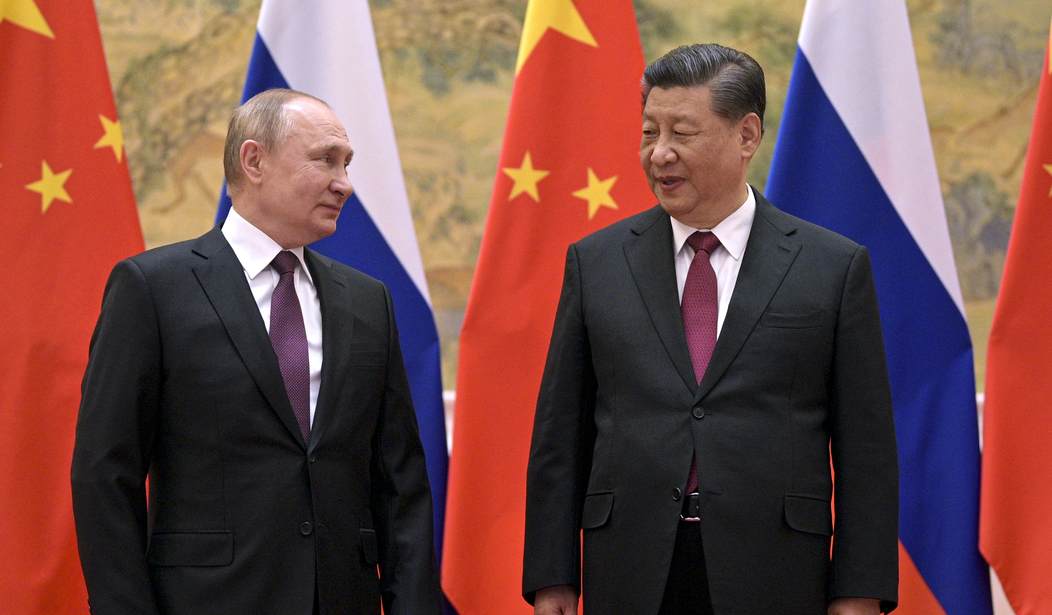
How's that hopey-shooty thing workin' out for ya, Comrade Xi?
You remember Operation Absolute Resolve, don't you, Comrade? Just last weekend, kind of a big deal? When American airpower totally shut down a multilayered Sino-Russian air defense system in a matter of minutes, like it had never even been there?
It was all over the news, Xi.
Don Surber beat me to the good stuff Thursday morning with a piece headlined, "Temu Radar failed Venezuela." Surber wrote:
The EurAsia Times, an Indian publication that is no friend of Trump, reported, “Boasting one of the strongest militaries in Latin America, Venezuela possessed a variety of advanced radars, including the JY-27, whose capabilities have now been called into question by observers.
“These radars were integrated into Venezuela’s air defense network alongside Russian systems like the S-300VM surface-to-air missiles, forming a layered defense around key sites, including Caracas.”
America stuffed both systems.
The publication said, “Designed to detect low-observable aircraft like the US F-22 and F-35 by operating at meter-wave frequencies that, in theory, exploit resonance effects on stealth designs, the JY-27 has been marketed by Beijing as an anti-stealth or stealth hunter radar.”
Surber landed the knockout blow with this line: "The only person in their showroom now is Wile E. Coyote."
Damn, I wish I'd written that.
But the important thing is that a combination of stealth, EW, SEAD, intra-service ("joint") operations, operational flexibility, and what the U.S. Navy calls "instilled aggression" undid everything that Chinese and Russian gear was supposed to protect Nicolas Maduro and his now-defunct regime.
I'd also add that when a smaller ally buys Great Power gear, it usually comes with "technicians" and "advisors" to help operate it. In other words, well-trained military officers who do most of the actual work — and report back to Beijing/Moscow/Washington how their gear worked in practice.
You'd hate to be the Chinese officer writing back to HQ last Monday morning.
And Another Thing: If somebody has to steal your snark-thunder, let it be Don Surber. There's a guy I don't mind losing to. Just not too often.
Snark aside, I'm the first to admit that Chinese military engineering proved less fearsome in practice than on parade — and what that might say about China's growing navy that I spend so much time fretting about.
Much of my concern about China's engineering prowess was based on David P. Goldman's (aka Spengler) estimations. He's written about just that here at PJ Media and for Asia Times, but perhaps most forcefully in a 2019 interview with Urs Gehriger headlined "You can never be China’s friend."
Spengler warned:
The Chinese empire is doing better than us because it’s absorbed the talent of a very large number of others. Fifty percent of their engineers are foreign. They bankrupted their competition and hired their talent. They have 50,000 foreign employees, and a very disproportionate amount of their research and development (R&D) is conducted by foreign employees.
In a PJ Media column that I was unable to locate before publication time, Spengler noted that not only does China graduate more engineers than the rest of the world combined, but the professors at their engineering schools were trained by the best of the best at American universities like Stanford and MIT. The implication was that you still think of China as producing nothing but cheap Temu knockoffs at your own risk.
Indeed, Chinese guided missile destroyers, stealth jets like the J-20 Mighty Dragon, and stealth-defeating anti-air systems all look awfully good. On paper, anyway, and before recent events in Venezuela.
But he also told Gehriger, "The People’s Liberation Army (PLA) infantry is one of the most poorly-equipped and badly trained in the world. On the other hand, their missile forces, their satellite forces, their submarines, and so forth, are extremely good."
I'd say that Absolute Resolve ought to call into question Spengler's absolute certainty.
But let's not spend all our time picking on China.
Russian gear was also put to the test in Venezuela, and to almost nobody's shock, it was found wanting. There's little point in examining Russia's latest failure in depth, but a few items are worth mentioning.
Russian equipment (antitank missiles in particular), training, and doctrine proved shockingly effective — at least during the early stages — in Arab hands against Israel in 1973. The Yom Kippur War opened with a well-planned Egyptian-Syrian surprise attack, and Soviet-made missiles thwarted Israeli armor and airpower early on.
The IDF managed to absorb the opening blows, and then, through improvisation and ruthless exploitation of Arab command failures, turned early Arab advantages into a decisive military reversal. Still, IDF casualties were so high that Jerusalem waited until after the war was over to announce the number of dead, wounded, and missing. The Yom Kippur War was a frighteningly near-run thing, all thanks to the Russians.
Since then, Russian air defenses have been put to the test multiple times in the Middle East, last week in Venezuela, and even within the borders of the Russian Federation during the 2022-20?? Ukraine War, and have underperformed every time.
To give just one more example, our F-15 Eagle was developed to counter the Soviet MiG-25. But as it turned out, the MiG-25 was a flop — relatively few were built by Soviet standards, and also quickly retired (also by Soviet standards). Meanwhile, F-15 pilots from multiple Western nations went on to shoot down 104 Russian-designed jets in air-to-air combat (plus a satellite!) for zero losses.
That's right, the Eagle is 104-0.
But let me finish by reminding you that in the end, doctrine and training matter more than the equipment does, no matter how technologically advanced.
Israeli forces suffered terrible losses in 1973's surprise attack, with the Arab armies using weapons of shocking effectiveness that IDF tank crews and fighter pilots weren't prepared to deal with. But the IDF absorbed those initial losses, and over the next three weeks, it overcame. They did so because the IDF is built on the Western model, where tactical flexibility and quick decision-making are baked into the entire force, right down to the individual soldier.
When the unexpected happens to an army private trained on the Communist model still followed by Russia and China, the private asks his sergeant what to do, the sergeant asks the captain what to do, the captain sends the request up to his colonel, who then has to consult a general, who may or may not be able to issue an order without asking permission from a politician, or at least from his accompanying zampolit (political officer).
I exaggerate, but probably not by much. In terms of his authority to exercise initiative, judgment, and battlefield authority, a low-ranking Western NCO is probably functionally equivalent to a Chinese or Russian colonel. Our junior officers and NCOs are expected — required — to act without waiting for permission.
And Another Thing: I skipped the sergeant's lieutenant because, to the best of my knowledge, nobody ever asks a lieutenant anything, except perhaps, "AYFKM?" I kid, I kid. But not really.
In recent years, the Chinese People's Liberation Army has been quite public with its reform efforts to abandon strict Communist command-and-control. But whatever reforms are in place have yet to be tested, and Comrade Xi's obsession with one-man rule... well, that's the rub. One-man rule and operational flexibility go together like chocolate pudding and pickled herring. That's why I suspect that the PLA's reforms are mostly cosmetic.
Whatever disparaging things Spengler said about the U.S. and the West during that 2019 interview, he also noted that "The Chinese system is very bad at identifying those eccentrics, like an Einstein, who make fundamental contributions. We are much better at that." He added, "The Western idea of the divine spark in the individual simply doesn’t exist in China. So, I think we do have a chance against the Chinese."
Me, too.
And much more than I did just six days ago.
Also for Our VIPs: A Very VodkaPundit Look Back at 2025