
Note: Most Thursdays, I take readers on a deep dive into a topic I hope you'll find interesting, important, or at least amusing. These essays are made possible by — and are exclusive to — our VIP supporters. If you'd like to join us, take advantage of our 60% off promotion.
"Chronic wrongdoing, or an impotence which results in a general loosening of the ties of civilized society, may in America, as elsewhere, ultimately require intervention by some civilized nation, and in the Western Hemisphere the adherence of the United States to the Monroe Doctrine may force the United States, however reluctantly, in flagrant cases of such wrongdoing or impotence, to the exercise of an international police power." —Theodore Roosevelt.
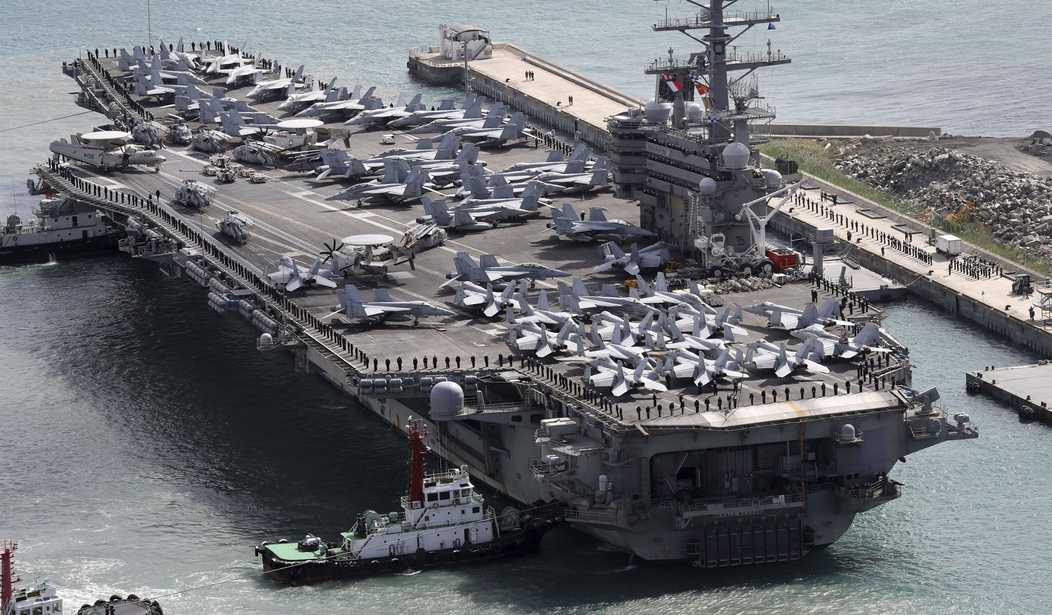
While the USS Gerald R. Ford — the Navy's newest, first in its class, and (hopefully) deadliest nuclear-powered aircraft carrier — makes good speed toward the Middle East in case nuclear talks with Iran fail, the Telegraph's Memphis Barker warns, "The message to the Islamic Republic is unmistakable: submit to US demands or face the wrath of the world’s most powerful navy."
Or as the British paper's front page headline put it, "How Trump revived gunboat diplomacy."
This being a postmodern British paper, even if it is semi-somewhat conservative (at least graded on their curve), I assume Barker means that as a bad thing. But the headline I'd have written is "Trump Makes Gunboat Diplomacy Great Again."
Oh, wait. I did write that headline. Just not for the Telegraph. They should call me.
Anyway, it's been just over two centuries since President James Monroe warned the European powers away from further meddling in our hemisphere. And it's been more than a century — thank God and the United States Navy — since we had to lean on the Royal Navy to actually enforce it. Fortunately, Britain also had an interest against those nasty Continental powers increasing their footprints in our hemisphere.
There's more to acting as a Great Power, of course.
Teddy Roosevelt warned more than a century ago bad actors sometimes require "intervention by some civilized nation," endorsing "however reluctantly" to "the exercise of an international police power" in pursuit of our interests. And, if I may be unfashionably patriarchal for a moment, in the best interests of the governments with our gunboats aimed at them.
And Another Thing: I know it's passé at best, borderline racist at worst, but I maintain a soft spot for old-school English bias against Continental nations. "Wogs" was their catch-all derogatory term for the people of sub-Saharan Africa and the Raj, and while that's a word I'd never use in its original meaning, I can't help but smile every time I remember the English expression, "Wogs begin at Calais."
America's interests are global now, far less parochial than they were at the time of the Monroe Doctrine, or even in Roosevelt's time.
I've written distressingly often over the last — decade? longer? — about all the things the US Navy gets wrong. So today, let's look at what the Navy still gets right.
There's no greater representation of our seriousness than the 11 Carrier Strike Groups (CSG) that protect our global trade, our freedom of the seas, and our ability to exercise our international police power as the need reluctantly arises.
You might have read that the aircraft carrier is obsolete.
Jerry Hendrix, former Director of the Defense Strategies and Assessments Program at CNAS wasn't even half-right when he asked in 2016, "If these carriers can’t do that first day lethal strike mission inside an A2/AD [anti-access/area denial missiles] bubble, why are we paying $13 billion dollars for them?"
That's a bit like asking why we don't just order infantry to storm a fortress without first softening it up with artillery and missiles. That isn't the infantryman's job — except maybe in the most dire situation — and presidents don't order carriers into missile nests until those missile nests have been pummeled by other, longer-range means.
Barack Obama's uniformed pet, Army Gen. Mark Milley, even said that a carrier is just a "big piece of steel that – sorry – saw its best day at Midway." Try telling that to the Imperial Japanese carriers that fought at Midway, assuming you can hold your breath long enough, and dive deep enough, to find them.
And Another Thing: Milley makes me want to type out all the bad words that Management insists are verboten.
Not that carriers don't have weaknesses, because they certainly do.
Historian Mark R. Peattie in his book Sunburst: The Rise of Japanese Naval Air Power, and echoed in later works, described the Japanese carrier fleet as having a "glass jaw: it could throw a punch but couldn't take one." That was — is — true of every carrier ever built. It's the nature of the beast.
We already talked about A2/AD defenses, the kind China hopes will keep our carriers at bay long enough to complete their conquest of Taiwan, should Beijing's need reluctantly arise. But that, Jerry Hendrix aside, is where our submarine force comes in. There's something to be said about our four Ohio-class guided missile subs (as opposed to the other 12 that carry nuclear missiles), or the upcoming Block V Virginia-class attack subs, any one of which can unleash enough Tomahawk missiles to undo an A2/AD network.
Only then do the carriers go in, far more formidable — and much better protected — than they were at the Battle of Midway.
Suck it, Milley.
[MANAGING EDITOR CHRIS QUEEN OR WHOEVER EDITS THIS PIECE, PLEASE REMOVE THE PREVIOUS LINE. I JUST HAD TO VENT.]
[Editor's note: The line stays because it reflects the views of pretty much everybody.]
The CSG itself is a work of deadly, well-guarded art.
First, of course, is the carrier's air wing, particularly the fighters. There are the well-known F/A-18 Super Hornet (a jet whose deadliness and beauty too often go underappreciated), and the stealthy F-35C. But a vital ingredient in the mix is the EA-18G Growler, probably the most effective electronic warfare jet in the world. The Growlers go up, blind enemy radars, jam their comms into gibberish, and then politely escort the strike package — those Hornets and Lightnings — through the door they just kicked open.
There's also what you can't see. Each CSG is accompanied by at least one nuclear-powered attack sub. An SSN is an all-around performer, with a complement of anti-sub, anti-surface ship, and land-attack weapons. Its sonar can detect threats from miles away.
The CSG's complement of guided-missile destroyers (DDG) and, while we still have a few left, guided-missile cruisers (CG) provide radars with better eyesight than God's, and antiair missiles capable of knocking down everything from subsonic cruise missiles and fighter aircraft to supersonic anti-ship missiles, ballistic missile warheads in the terminal phase (including nuclear, oh yes!), and — in some configurations — even hypersonic threats.
At least until the anti-air missiles run out. We need both to up our missile production and perfect at-sea replenishment of those CG and DDG missile tubes.
So it isn't that carriers are obsolete. It's that their defenses must, have, and will continue to evolve in tempo with the threats against them.
And Another Thing: No, nuclear-powered subs are not a substitute for a CSG. They have vital roles to play, but unlike carriers, they must return to port to re-arm, and more importantly, they lack the deterrent value of presence. A carrier announces our seriousness, and bad actors often wisely choose to back down. Lacking presence, by the time an SSN or SSGN unleashes its missiles, deterrence has failed. Personally, I prefer deterrence to a shooting war — something I learned from Reagan.
Tehran has warned repeatedly that it'll do whatever it can to sink or at least score a big hit on an American aircraft carrier. Beijing would love to see that, too, and I suspect China provides the Mullahs with all the location data they can gather. The Islamic Republic seems to believe that with a little luck, swarm tactics — numerous small surface boats, maybe a baby sub or two, and as many drones as they can get in the air — might overcome a CSG's layered defenses, and knock a carrier out of action.
They'd have to get very lucky, indeed — and maybe someday they will. But of all the things the USN has screwed up in the last 20 or so years, they're still tops at carrier operations.
To give you an idea of just how difficult it all is — carrier design, air wing design, escort submarine and surface combatants, and particularly the training and doctrine that makes them all work together as a strike group — let's take a brief look at our growing adversary in the Far East, China's People's Liberation Army Navy (PLAN).
Yes, they really call it that.
China's first carrier, the Liaoning, was originally ordered for the Soviet Navy as Varyag in the 1980s, and after the Cold War, its unfinished hull ended up making its way to China by hook and crook. She's designed and built to, well, Soviet carrier spec. Which is to say she isn't much of a carrier by USN standards. Varyag uses an old-school "ski jump" launch system, meaning fighters can't carry full loads of weapons or fuel. Liaoning is more or less a PLAN training vessel.
Shandong is China's first truly operational carrier, but the inherent limits on how much airpower she can launch — there's that ski jump again — make her more like the USN's Wasp- or America-class amphibious assault ships with their complement of helicopters and vertical takeoff F-35B stealth fighters. For Shandong, China took the Varyag design and made it more efficient. But she was fully built in China, giving PLAN the kind of shipbuilding experience that, unlike Varyag, you can't tow thousands of miles from the Black Sea.
Beijing's first completely indigenous carrier was commissioned last November and represents a big advance over her predecessors — but still with serious limitations. Fujian features a state-of-the-art Electromagnetic Aircraft Launch System (EMALS), which reduces wear and tear on aircraft and (in theory) allows for a faster launch cadence than the old-school steam-catapult system found on our Nimitz-class carriers.
The Soviet ski jump is gone, replaced with a proper, flat flight deck allowing for fully armed and fueled jets. At first glance, Fujian and her complement of guided-missile destroyers look as though they might be able to tangle with an American CSG. Assuming, that is, that China's nuclear attack subs don't suck, which they do. They'll get better, but if PLAN has a weak link in its non-carrier forces, it's their noisy submarines.
But Fujian's poorly angled flight deck prevents aircraft from launching and landing at the same time as they do on USN carriers. And there's a "missing" deck elevator that complicates and slows down deck operations. Why PLAN chose to angle the deck the way they did, or go with three elevators instead of four, remains a mystery. But they have a fourth carrier, believed to be nuclear-powered, under construction, and presumably they'll learn from the mistakes baked into Fujian.
And Another Thing: Ford and her follow-on ships, including the John F. Kennedy scheduled for delivery to the Navy in 2027, use EMALS and four high-speed elevators to generate sortie rates up to 25% higher than our Nimitz-class carriers can. The ability to launch, recover, refuel, re-arm, and re-launch aircraft faster than the other guy is a big advantage. Fujian isn't even up to Nimitz standards.
It's telling that despite all the handwringing over the aircraft carrier's obsolescence, China spends so much money, talent, material, and focus on building a fleet of its own.
Back to the topic at hand: When a Great Power rouses to the reluctant necessity of policing some ill-behaved banana (bamboo?) republic, Fujian is probably good enough.
Not, however, nearly good enough should Chinese Communist Party boss Xi Jinping do what he'd probably love to do, and order PLAN to protect his Axis of Resistance allies in Tehran. For now, all Xi can do is sit and watch as events unfold beyond his control.
I bet he hates that. Cool.
When it comes to Iran, Trump earned my trust in part because of the restraint he showed in January during Operation Absolute Resolve to bring Venezuelan President Nicolás Maduro to justice. Trump could have ordered a regime-ending series of strikes, triggering Colin Powell’s “You broke it, you bought it” doctrine.
Instead, Trump’s combination of, well, absolute resolve and wise restraint put the Fear of God (or at least of Trump) into Maduro’s successor, former Vice President Delcy Rodríguez. After Maduro's swift capture, Rodríguez stepped in as acting president — and, crucially, chose cooperation with Washington over continued confrontation.
She and her regime now behave tolerably enough that Venezuela is safely on the back burner. Which, by the way, freed up the Ford and her CSG — they took part in Absolute Resolve — for action in the Middle East.
Iran is a different story. If Tehran won't let go of its nuclear ambitions, then the regime simply must be ended. The Islamic Republic was born in an act of war against the United States, and has waged war against us, our interests, and our allies by means direct and indirect for nearly 50 years. If it's casus belli you're looking for, we have plenty already.
“Jaw, jaw is better than war, war,” and we should all hope and pray that SecState Marco Rubio and his team can somehow talk the Mad Mullahs out of their nuclear and missile programs. But with Ford on the way to join Lincoln, the current talks feel more like that other definition of diplomacy: “The art of saying ‘nice doggie’ until you can pick up a rock.”
We’ll see.
Either way, I'm certain the men and women of the Lincoln and Ford Strike Groups will perform admirably.
Last Thursday: What in the Actual Hell Is Going on in Russia?