







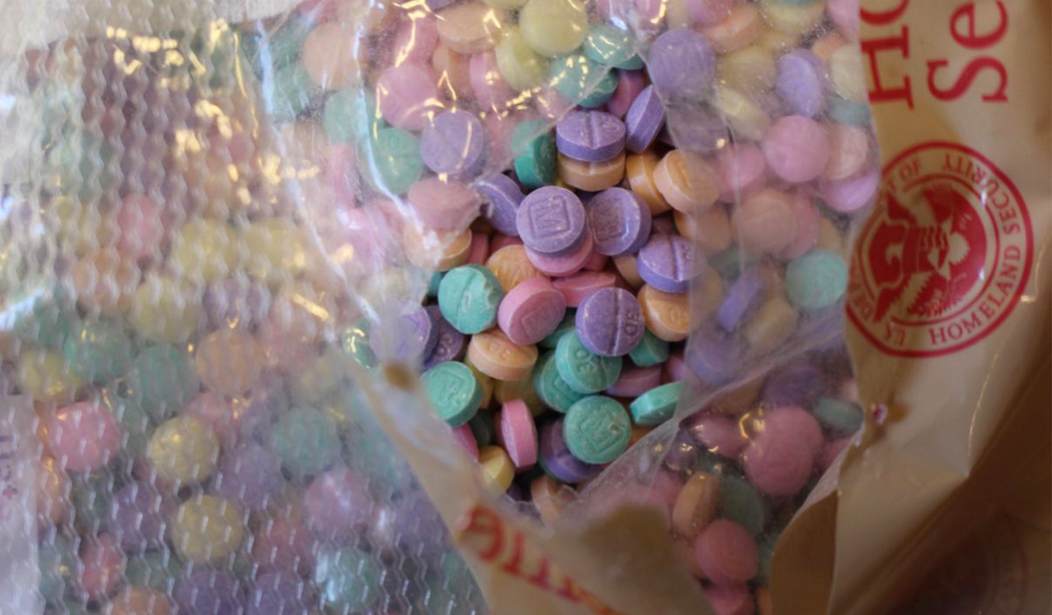
"An insanely powerful and addictive opioid responsible for the deaths of half a million Americans" and "good news" hardly go hand in hand. And yet some good news about fentanyl is exactly what I have for you today.
No, I'm not here to tell you that prices are down and availability is up — not even my sense of humor runs quite that grim. Besides, I wouldn't know. Fentanyl pricing and availability aren't exactly the kind of neighborhood news I look for on Nextdoor, and my only "dealer" is the clerk behind the cash register at my corner liquor store.
But how about this: Fentanyl deaths are plummeting in the U.S.
Good news, right?
Don't get me wrong — we're hardly out of the woods on this one. As recently as 2013, the Centers for Disease Control and Prevention reported around 3,105 synthetic opioid-involved overdose deaths. Each needless death like that remains, well, needless, but then fentanyl hit the scene — cheap to manufacture, easy to cut into "safer" drugs for increased illicit profits — and the numbers went through the stratosphere.
By 2019, synthetic-opioid deaths skyrocketed to just over 36,000. If I've done my math correctly (OK, if Grok did my math correctly), that's an increase of more than 1,000%. Then in 2020, America suffered a years-long COVID-19 lockdown mental health/mental wellness crisis, and synthetic opioid deaths (mostly but not exclusively fentanyl) doubled yet again to 73,838 in 2022, according to the CDC.
Deaths declined in 2023, if barely, to 72,776.
Since 2024, however, the downward trend has accelerated. CDC reported around 54,000 fentanyl deaths in 2024, and early estimates indicate the number could be as low as 45,000-50,000 for 2025. Those numbers are still much too high, but they still represent an encouraging trendline.
Various reports credit a couple of different causes for the big declines, but there's another element that hasn't been discussed — one I'll come back to momentarily.
Much as I hate to credit the Biden administration for anything other than multitrillion-dollar theft, a humiliating foreign policy, and a crippling economic policy, Psypost reported last week on a Science study claiming that "regulatory actions taken by the Chinese government, following high-level diplomatic engagement with the Biden administration, may be the primary driver behind."
Yes, Communist China produces the chemical precursors to fentanyl that then somehow mysteriously find their way to Latin American cartels (typically in Mexico) for final assembly and smuggling into the U.S. President Donald Trump doubled down on that policy late last year:
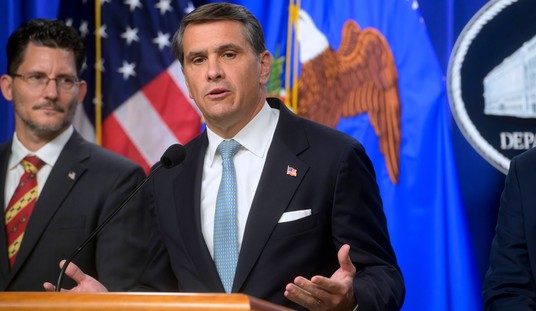
President Donald Trump has banned chemicals used as precursors to manufacture fentanyl, and China has agreed to control seven subsidiaries used to produce the lethal drug, FBI Director Kash Patel said Wednesday.
Opening the White House press briefing, Patel called the agreement between the U.S. and China a "historic, first-of-its-kind achievement" that effectively "shut off the pipeline that creates fentanyl."
Patel credited "Trump's direct engagement with Chinese President Xi Jinping and a months-long, whole-of-government push led by Attorney General Pam Bondi, Secretary of State Marco Rubio, and U.S. Ambassador David Perdue."
That Marco Rubio sure is busy, isn't he?
Marco Rubio, first of his name, Secretary of State, National Security Advisor, Chief Archivist, Viceroy of Venezuela, Governor-General of Cuba, Storhertug of Greenland, Shah-in-Waiting, Martian Lord High Admiral of the Outer Worlds, and Webelo. pic.twitter.com/LX3qACPSrF
— Stephen Green (@VodkaPundit) January 13, 2026
But I digress.
Forbes reported last weekend that the result of China's Biden & Trump-inspired crackdown is illicit drug suppliers resorting to "shrinkflation."
When access to fentanyl became constrained, the shrinkage appeared in reduced purity. In fact, the average purity of seized fentanyl powder fell sharply from a peak of roughly 25% in mid-2023 to about 11% by the end of 2024. Fentanyl pills showed a similar, slightly delayed decline in potency.
Lower potency = fewer deaths.
“From about 1980 to 2022, the number of fatal overdoses from all drugs went up about 20-fold,” said Peter Reuter, a University of Maryland drug policy researcher who co-authored that Science report linked above. “And then in June, July of 2023, suddenly the curve turns down. There was clearly some systematic event that drove it down over the next two years by at least one-third.”
Two more possible causes for the decline in fentanyl deaths you might not see in any study.
One got stuck in my mind three decades ago as the "not like my big brother effect." Crack cocaine hooked — and killed — and an awful lot of people in the '80s and early '90s, before a similar rapid decline kicked in:
Ethnographic research confirmed the sharp curtailment of cocaine use. Richard Curtis spent 10 years, from 1987 to 1997, conducting fieldwork in several Hispanic neighborhoods in Brooklyn.
He noted firsthand the devastation wrought by drugs, followed in the mid-1990s by what he called “an improbable transformation” motivated by fear of drugs and their consequences.
Some of the credit goes to increased enforcement and sentencing, but Curtis found that most of it went to younger kids seeing the crack pipe and the damage done, and deciding to just say no.
Finally, there's this brutal truth: After killing off more than half a million Americans in the last dozen years, the ranks of fentanyl's at-risk users are likely wearing thin.
Still, I'll take the good news where I can find it.
Recommended: Will There Still Be an Iran the Day After Tomorrow?
Welcome to the New Year — and it's already a great one for America.
Keep up-to-the-minute on just how great, courtesy of the exclusive analysis, podcasts, and video live chats that are all a part of a PJ Media VIP membership. There's rarely a better time to show your support than during our 60% off FIGHT promotion.

Join the Conversation
VIP members get the ability to comment on articles.