


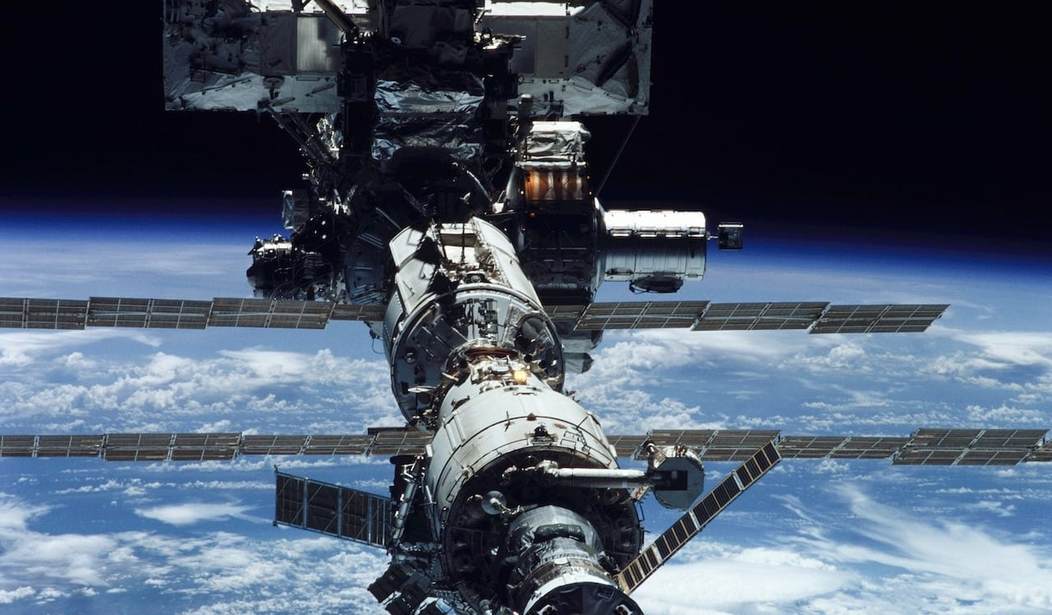
With the International Space Station (ISS) due for deorbiting in 2030 — and the growing schism between the West and Russia over the invasion of Ukraine — Moscow had grand plans for a new Russian Orbital Station (ROS) of its own.
Yeah, about that.
As originally conceived, ROS would consist of seven all-new modules, with launches beginning in 2027, human habitation in 2028, and full construction complete in the mid-2030s. Just as importantly, ROS would fly at a higher inclination, allowing Moscow to conduct all launches from Russian territory.
But now ROS will fly the same orbit as ISS, and will still rely on launches from Kazakhstan — and that's the least of Moscow's problems with it.
This is partly due to Russia no longer having enough funds to fully develop the Vostochny Cosmodrome, which recently had its power turned off for failure to pay its bills. But it's also because instead of all-new space station modules, ROS's core will be the existing Russian ISS segment.
Some of those modules have been up there and exposed to radiation for almost 30 years.
"The Scientific and Technical Council of Roscosmos supported this proposal and approved the deployment of a Russian orbital station as part of the Russian segment of the ISS as the main possible scenario," Oleg Orlov, Director of the Institute of Biomedical Problems of the Russian Academy of Sciences (RAS), said on Wednesday.
This is a bit like planning to buy a new car, but then looking at the expense and saying you'll buy most of a new car. Instead, you'll pull the engine out of your 1998 Accord — the engine that needs a full rebuild — and drop it under the hood of your "new" car.
Oh, and that old engine also needs major fumigation:
In a scathing article on the decision, the Russian newspaper New Izvestia explored its consequences. The article, translated for Ars by Rob Mitchell, recalled comments from Orlov in 2022 about the dangerous bacteria and fungi that have accumulated on the International Space Station over its extended lifetime. Because of these microorganisms from hundreds of visiting astronauts, he said, there is danger to both humans and degraded electrical components. At the time, Orlov was seeking to justify funding for a new station. “Have bacteria and fungi suddenly become less dangerous over the past three years?” the Russian article asks.
Space is hard. The ISS is old. Despite the value of all that mass already being in orbit, the West chose deorbiting over recycling because there's just so little sense in even attempting it.
So I look at the revised ROS and wonder, "How do you say 'vaporware' in Russian?"
And Another Thing: These are the days of miracle and wonder, so I asked Grok for the Russian word for vaporware. I double-checked to make sure Grok wasn't hallucinating, and can report with some confidence that the Russian word is вейпорве́р. Which, according to Google Translate, is pronounced veyporvér. In other words, the Russian word for vaporware is pretty much still vaporware. Пожалуйста, товарищи.
NASA has yet to settle on firm plans for the West's next space station — by design. The agency's Commercial LEO Destinations (CLD) plan sets various requirements like safety, life support, docking, research capability, but otherwise sets the country's vigorous space private sector loose on the problem.
Given that a single SpaceX Starship has more livable volume than the entire ISS does — and will be built in the thousands — the mind reels at the possibilities for CLD from just one American company.
There is one bright spot on Russia's space program, even if you do have to squint a bit to see it. Authorities said last week that Site 31/6 at the Baikonur Cosmodrome — the country's only pad rated for manned launches — should be back in business by the end of February.
If you'll recall, a mysterious Soyuz launch incident blew pad's 144-ton maintenance cabin right through the flame trench, requiring either major repairs or a full replacement. Roscosmos deputy director Dmitry Baranov said that "Work on restoring the service cabin and launch pad is being carried out at full speed," and that "it will be ready to handle the first launch by the end of winter 2026."
Good for Roscosmos, and good for the ISS crews that rely on those Soyuz launches.
But if you asked me to lay down $100 on when this new vision for a Russian space station will open for business, I'd say "Never."
Since at least 1957, Russia's space program has been a huge source of national pride, and for good reason. But Moscow can't afford a real space program any longer because Vladimir Putin would rather conquer a ruined slice of Ukraine, instead.
What a sad comedown.
Recommended: Everything Is Going to Hell — Cheer Up!
Help us keep telling uncomfortable truths with your VIP membership. And get exclusive columns, podcasts, and video live chats — now 74% off during our Christmas promotion.






Join the conversation as a VIP Member